
Bolingbrook Epoxy Flooring has coated industrial and warehouse floors for 20+ years in Bolingbrook, IL, and our warehouse floor coating work serves surrounding cities including Lemont, Warrenville, Burr Ridge, Hinsdale and Shorewood. A warehouse floor is a working surface under forklifts, pallet jacks and dragged loads, and the coating has to be planned around the racking, the joints and the dock schedule rather than dropped onto an empty slab.
We start with a walk of the building with the facility manager, marking which aisles, staging areas and dock lanes can close and when. The proposal then lays out the system, the phases and the return-to-service time for each section, priced per square foot.
That planning is what keeps a building shipping during the work. A coating that forces a full shutdown is rarely the right answer for a distribution floor.
Distribution Floors Along I-55 and Weber Road
Large Floors, Phased Work
The distribution buildings along I-55 and Weber Road run very large slabs. One of them, 1601 Remington Boulevard, is listed at 591,748 square feet with 59 exterior docks. Floors on that scale are never coated at once; they are divided into phases that follow the building’s flow.
We typically start with areas that can close most easily, such as an empty bay or a reserve storage zone, then move through aisles and dock lanes in planned sections. Each phase is closed off, prepared, coated and returned before the next one opens.
Dock Lanes and Staging Areas
Dock lanes take the heaviest wear in most buildings: every pallet crosses them, and winter brings in water, salt and grit from trailers. We often give these areas a thicker build and a harder topcoat than the storage aisles, and schedule them for weekends when the doors are quiet.
Overnight and Weekend Schedules
Grinding and coating can be scheduled for second and third shifts or across a weekend shutdown. Fast-curing polyaspartic and polyurea topcoats shorten the time a section stays closed, which often decides whether a phase fits inside one weekend.
Joints, Racking and the Slab Itself
Control Joint Repair and Filling
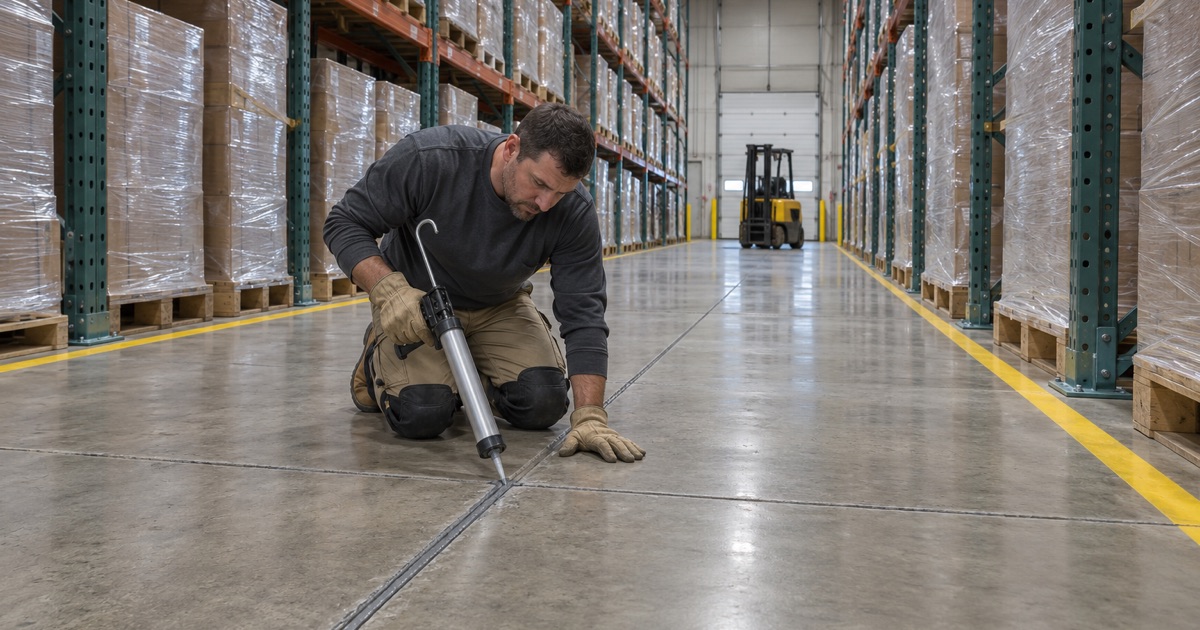
Warehouse slabs are cut with control joints, and their edges break down where forklift wheels cross them. We clean out failed filler, rebuild broken edges with an epoxy mortar and fill the joints with a semi-rigid polyurea joint filler that supports the edges under wheel loads.
Coating straight over an open joint is a common shortcut, and it fails along the joint line within months. Repairing and filling the joints first is what lets a warehouse coating last.
Rack Anchors and Baseplates
Racking is anchored into the slab, and the concrete around anchors can crack or spall under impacts. When racking is moved or reset, we fill old anchor holes and repair damaged areas so the slab is continuous before coating, and we leave clean, uncoated areas where new baseplates will land.
Moisture Testing Large Slabs
Many warehouse slabs were poured directly on grade, and moisture can vary across the building. We test in several locations with ASTM F1869 calcium chloride kits or ASTM F2170 relative humidity probes, so a damp section is found before it is coated rather than after it blisters.
Coating Systems for Warehouse Floors
Epoxy and Polyaspartic Systems
A thick 100% solids epoxy base with a polyaspartic or polyurethane topcoat is the standard warehouse system. It resists abrasion from forklift tires, wipes clean of spills and brightens the floor, which improves light levels in aisles.
Densifying and Polishing
For dry storage floors, a lithium silicate densifier and a polish can be the better choice. It hardens the surface against dusting and wear with no coating to maintain, and we will say so where it fits.
Chemical Zones and Charging Areas
Battery charging stations, maintenance bays and chemical storage areas need coatings rated for what they will see. We specify those zones separately and mark them with color so they stand out.
Striping, Safety and Compliance
Aisle Striping and Floor Marking
Aisle lines, pedestrian walkways, forklift lanes and staging boxes are laid out from your plan and built into the coating so they wear with it. Federal workplace rules require aisles to be marked but do not set a stripe width or color, so the layout follows your operation.
Dust Control
Warehouse grinding and shot blasting produce a lot of dust. We collect it at the machine with industrial vacuums and keep it out of floor drains and storm inlets, so inventory and neighboring sections stay clean.
VOC Rules and Village Requirements
Coatings are chosen within the Illinois VOC limits for industrial maintenance and floor coatings, which bind the installer as well as the maker. We confirm the village’s contractor registration, bond and insurance requirements before scheduling, since Illinois issues no state license for this work.
Cold Docks, Food Storage and Winter Work
Cold Storage and Freezer Floors
Cold storage rooms and freezer docks put coatings through temperature swings that ordinary systems do not handle well. Where a floor runs cold year-round, we use systems rated for low-temperature service and plan the installation around how long the room can be brought up to a workable temperature.
Food Distribution Floors
Warehouses that store or handle food often need cleanable, seamless floors in certain zones, and some fall under health department review. We identify those areas during the walk-through and specify a system that can be washed down without breaking down.
Winter Installs in Unheated Areas
Dock areas and unheated storage zones can be too cold for most coatings in midwinter. We measure the slab temperature and the dew point spread at the surface before each coat, and where a zone cannot be heated to a workable range, we schedule it for spring and coat the heated interior first.
Planning a Multi-Year Program
Some facilities prefer to coat in stages over several budget years. We can map the building into zones, coat the highest-wear areas first and document the system used so later phases match.
- 20+ Years Coating Concrete
- Moisture Testing in Every Scope
- Free Written Estimates