Bolingbrook Epoxy Flooring has worked on epoxy flooring in Summit and the surrounding suburbs for more than 20 years, and the question we ask first is how cold the slab runs. A garage floor, a loading dock and a freezer room can share one concrete pour and still need three different systems. The temperature of the concrete on install day, and every day after it, decides which one will hold.
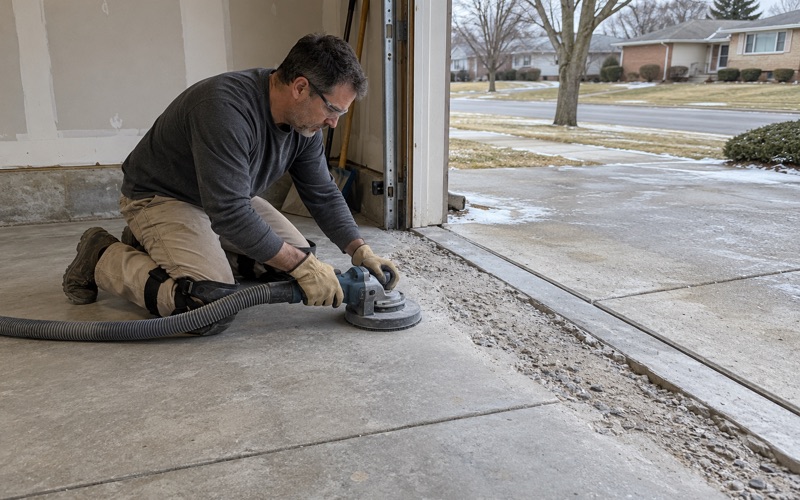
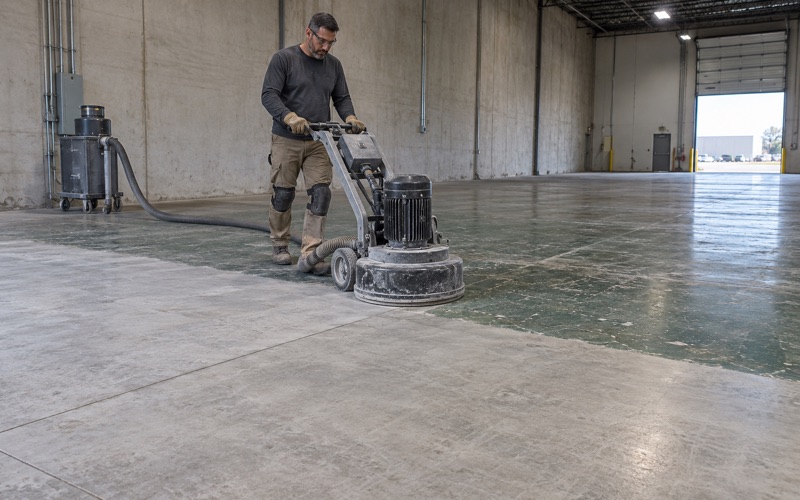
Before any resin is mixed, we grind or shot blast the slab open and skip acid etching entirely. Moisture testing appears as a priced line in our scope, because a slab that has been sweating or sitting in damp air carries water a coating will find later. When the joints, cracks or an old failed coating say the concrete needs repair or replacement first, we tell you that before we tell you a price.
Our proposals name the product, the system build and the finished thickness, priced per square foot for that system. That gives a facility manager or a homeowner something to hold the crew to. We also read out the warranty exclusions before anything is signed, and moisture is the first one on the list.
A Freezer Warehouse Off I-55 and First Avenue

Summit is home to a public cold-storage operation that shapes how we think about floors here. Summit Cold Storage sits at 5450 S. Center Avenue, off Interstate 55 and First Avenue, and was established in 1999. The address geocodes inside the village, in Lyons Township, Cook County, so it falls under the Village of Summit rather than a neighboring town.
Minus 10 to 45 degrees under one roof
The company describes a 175,000-square-foot multi-temperature freezer and cooler that holds product anywhere from minus 10 degrees to 45 degrees Fahrenheit. It runs racked storage, blast freezing with over 120 pallet positions, and more than 50 refrigerated cross-dock doors. That is a building where one slab spans several climates, and a coating that works in one room may be the wrong choice ten feet away.
We have not seen that floor, and we read no specification or condition for it. We point to it because it shows plainly what a cold-storage floor in this area is up against. Any freezer or cooler owner weighing a coating faces the same physics, whether the building is 175,000 square feet or a single walk-in box behind a shop.
Racking, joints and a building that keeps shipping
Cold rooms rarely get a quiet week. We plan around rack anchors, control joints and the dock schedule, breaking the floor into phased or weekend sections so product keeps moving. Joints get a semi-rigid polyurea filler that can flex as the slab moves, rather than a rigid fill that cracks loose at the first temperature swing.
Grinding dust in a food building is its own concern. We collect it at the grinder with vacuum extraction and never wash it toward a floor drain. In a room where product is stored, a clean tie-in between old and new sections matters as much as the coating itself.
Closed cold rooms also exchange little air, which makes product choice a practical matter as well as a legal one. Every coating we specify falls within the Illinois VOC content limits in 35 Ill. Adm. Code Part 223, a rule that binds the installer as well as the manufacturer. In a building sealed to hold temperature, a low-odor, compliant system is simply easier on the people working beside it.
Looking for epoxy-flooring closer to Chicago Ridge? See Chicago Ridge Epoxy-Flooring.
Why a Freezer Floor Cannot Simply Be Warmed Up
An ordinary epoxy is mixed, spread and cured on a slab at room temperature. A working freezer is not going to be brought up to room temperature for a weekend, because the stock inside it has nowhere else to go and the refrigeration exists to keep that room cold. Warming a frozen slab also changes how moisture moves through the concrete, which is the last thing a fresh coating needs.
What we test before choosing a system
A chilled slab with humid air moving over it makes the moisture readings matter more, not less. We use ASTM F2170 in-situ relative humidity probes where the slab allows them and compare the results against the manufacturer’s limits and the ASTM F710 thresholds. Where the numbers run high, a moisture-mitigation primer goes into the system build before the body coat, and it is named on the proposal.
Cold-cure systems or a scheduled shutdown
A room that must stay cold has two honest routes. One is a system made to cure in the cold, chosen for the actual temperature of that room and installed to the manufacturer’s written limits. The other is to schedule the room out of service, empty it and bring it to a temperature a standard system can cure at, which is a planning decision the operator has to make well ahead of time.
We do not quote a cure temperature from memory, and we will not promise a figure the product data sheet does not support. We measure slab temperature, air temperature and the dew point spread at the surface, and we schedule the cure against those readings. If the numbers are not there, the work waits.
Cooler, freezer and blast-freeze rooms are different jobs
A cooler near the top of that range sees wet product and frequent forklift traffic, and the slab hovers in a zone where condensation forms easily. A freezer holds steadier but colder, so the coating has to stay tough without turning brittle. A blast-freeze room drops product temperature fast, so its floor sees the sharpest swings.
Each room gets its own system build on the proposal. Urethane cement is often where we start in cold, wet or thermally punished rooms, because it tolerates temperature change and moisture better than most standard epoxies. A 100% solids epoxy or a polyaspartic topcoat can still be right in a dry cooler or an office corridor at the same building.
Fifty Dock Doors: Where Warm Air Meets a Frozen Slab
The refrigerated dock doors are where a cold-storage floor is tested hardest. Every time a door opens, warm and often humid outside air rolls over a slab that has been chilled from below. When the concrete surface sits below the dew point of that air, water condenses on it, and a coating applied or curing in that film can fail to bond or develop amine blush.
Condensation at the threshold
A building with more than 50 cross-dock doors, like the one on Center Avenue, has dozens of these thresholds working all day. We treat the dock line as its own zone on any cold-storage job, with its own moisture readings and its own timing. Work there is scheduled for the hours when doors stay closed and the surface reads dry above the dew point.
Thermal cycling and the edge of the slab
The dock line also cycles between the cold of the room and the warmth of the apron and the trailer. Concrete expands and contracts with those swings, and a hard, thin coating can shear off along the boundary where the temperatures meet. That is usually where we expect a cold-storage coating to fail first.
We answer that with a system that flexes with the slab, a profile ground to the right ICRI surface profile for the build, and joints detailed so movement lands in the filler rather than in the coating. Where a broadcast is wanted for footing at a wet threshold, we use quartz aggregate sized to the traffic. A finish that looks sharp in the middle of the room means little if the dock edge peels within a season.
Reading an existing dock floor
On a dock that already carries a coating, we walk the threshold before quoting. Lifting edges, hairline cracks running parallel to the door, and white efflorescence along a joint all tell us how the slab has been moving and where water has been coming through. Those signs decide whether we patch, strip back to sound concrete or recommend repairing the slab before anything new goes down.
The Same Cold Edge at a Home Garage Door
The physics at a freezer dock shows up on a much smaller scale in a Summit garage. A garage that is heated in winter goes cold every time the overhead door opens, and the slab near the door cycles more than the slab at the back wall. Tires carry in calcium chloride brine and rock salt, which sit on the floor and work at any weak spot in the finish.
Building a garage floor for the door line
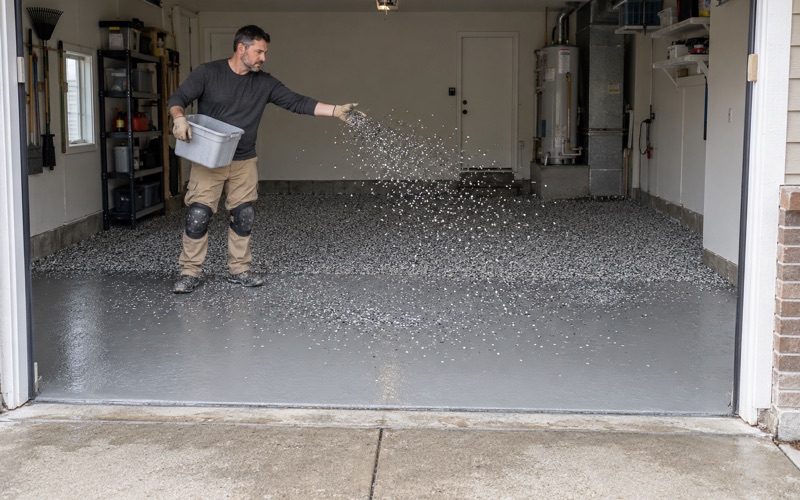
We grind the garage slab open, repair cracks with materials that can move, and build a system rated for the salt and hot tire pickup a winter of driving brings. A vinyl flake broadcast under a polyaspartic topcoat is a common choice. Moisture testing comes first, using an ASTM F2170 in-situ relative humidity probe or ASTM F1869 calcium chloride testing depending on the slab.
Most of Summit’s housing went up before the 1980s, so the garage floors we see here are existing slabs rather than fresh pours. Older concrete may have patches, old paint or sealer, and no record of what sits underneath. We read all of that before we quote.
Timing a garage install
Curing follows slab temperature and dew point, not the date on the calendar. An unheated garage in the coldest months may simply have to wait until spring, and we say so rather than pushing resin onto cold, damp concrete. A heated garage can be scheduled sooner, with the door kept shut while the coating cures.
Renters occupy 39.1 percent of Summit’s occupied homes, so a garage floor here can just as easily be booked around a lease turnover as around a free weekend. That gap between tenants can be a good window, as long as the slab tests dry and the temperatures cooperate. We give the owner a realistic cure and return-to-service time so the next move-in date is not a guess.
Illinois issues no state license for floor coating work, so we confirm the Village of Summit’s own contractor registration, bond and insurance rules before booking a job. Every home project gets a written contract and the state’s consumer-rights pamphlet before work starts, as the Illinois Home Repair and Remodeling Act requires.
- 20+ Years Coating Concrete
- Moisture Testing in Every Scope
- Free Written Estimates