Bolingbrook Epoxy Flooring has spent more than 20 years putting down epoxy flooring in Shorewood and across Will County, and the floors we think hardest about are the ones that get wet on purpose every day. A room that is mopped, hosed or rinsed on a schedule asks a different question of a coating than a showroom does. The question is not how the floor looks on the first day but what has soaked into it by the three hundredth.
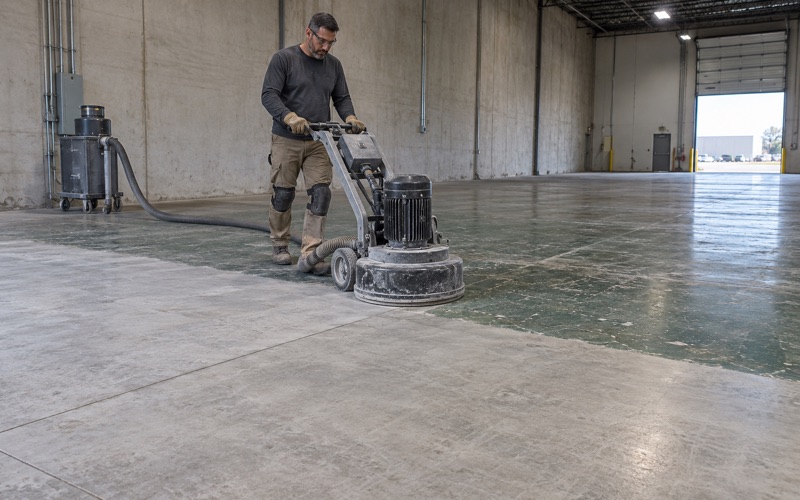
Before anything goes down, the slab is opened with a diamond grinder or a shot blaster to a measured ICRI CSP profile, and we do not acid etch. Moisture testing sits on the proposal as its own line item, and the proposal names the product, the system build and the finished thickness so the floor that goes down can be checked against the one that was quoted. Those three habits matter most on a floor that will see standing liquid.
This page is about one kind of floor in particular: the one under animals. Boarding rooms, daycare play areas and the pet corner of a house share a problem that plain concrete handles badly, and the fix is a specific build rather than a thicker coat of sealer.
A New Boarding and Daycare Building on US 52
What opened at Wynstone Drive
The Village of Shorewood’s Community Development major-projects list carries Rusty Ridge Animal Center, at West Jefferson and Wynstone, as now open and describes it as a veterinary and luxury pet lodging project. Patch reported that it opened December 15, 2025, at 1850 W. Jefferson St., the stretch of US 52 that runs through the village. The center’s own site lists Luxury Lodging, Doggy Daycare and Grooming alongside its veterinary care.
That combination puts overnight boarding, daytime play groups and an animal hospital under one roof. We have not seen which floors that building has, and we make no claim to have worked there. What it gives Shorewood is a clear local example of a floor type with a well-understood failure, one that also shows up at smaller scale in kennels, rescue rooms and home pet spaces.
Why urine wins against bare concrete
Concrete looks solid, but it is porous, with a network of capillaries running through the cement paste. Urine is mostly water carrying dissolved salts and organic compounds, and on a bare or merely sealed slab it wicks down into those pores instead of sitting on top to be washed away. When the water evaporates, the salts stay behind inside the slab.
That is why the odor comes back. A floor can be scrubbed until the surface is clean while the source sits a fraction of an inch down, and every wet cleaning rehydrates what is already there. Penetrating sealers and a lithium silicate densifier tighten the surface without closing it, and a thin film rolled over a contaminated slab has little sound concrete to bond to.
The working answer is to stop liquid at the surface in the first place. On an older floor that has absorbed years of use, we grind until we reach clean, sound concrete, and we say plainly when contamination or cracking means the slab needs repair or replacement before a coating is worth the money.
Looking for epoxy-flooring closer to Western Springs? See Western Springs Epoxy-Flooring.
One Seamless Surface, Coved Up the Wall
Non-porous from wall to wall
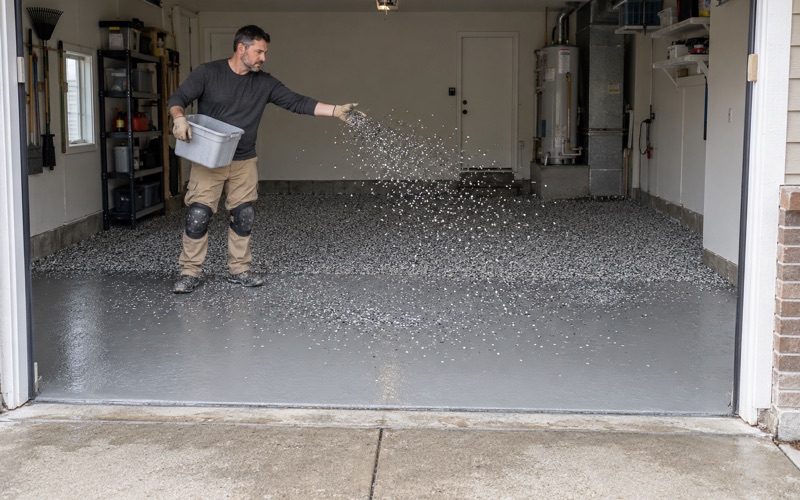
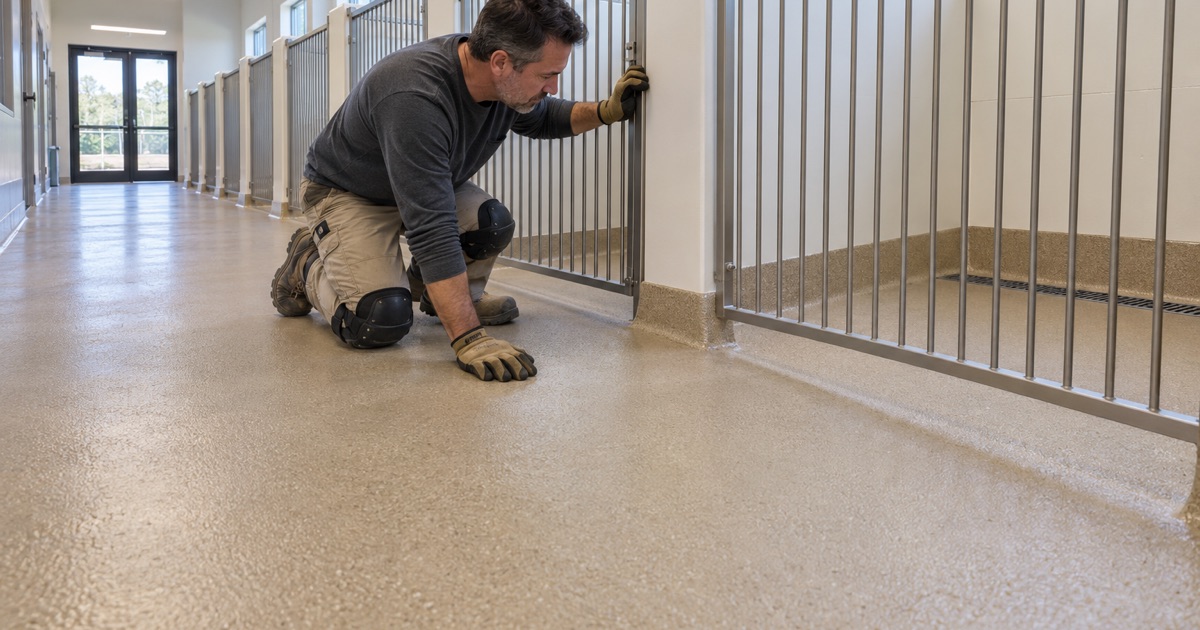
The specification boarding floors follow is a single continuous, non-porous surface with no seams for liquid to find. In practice that usually means a 100% solids epoxy system or urethane cement, built in layers with a quartz aggregate broadcast for texture and finished with a sealing topcoat. A vinyl flake broadcast can be part of the build, but the seal coat over it has to be complete, because a missed patch is exactly where a floor starts absorbing again.
Urethane cement earns its place where hot water and frequent wet cleaning are routine, since it tolerates temperature swings better than many standard epoxies. A polyaspartic or polyurea topcoat is another option when a room has to return to service quickly. Either way, the proposal states which system we recommend, why, and at what finished thickness, so the choice is visible rather than hidden behind a brand name.
The integral cove at kennel and run walls
The weakest point in most animal rooms is not the middle of the floor but the edge, where the floor meets a wall or a kennel partition. An integral cove carries the same resin system up the wall several inches in one continuous radius, so there is no square corner for urine and wash water to collect in and no seam hiding behind a baseboard.
The cove is troweled in place from the same material as the floor, which makes it part of the system rather than a trim piece glued on afterward. Around run partitions, anchored gates and posts, every penetration is sealed into the coating so the surface stays unbroken where animals spend the most time.
The wall needs the same preparation the floor gets. Where the cove climbs onto block or concrete, that face is ground and cleaned so the resin bonds to it, and the transition at the top of the cove is finished to a clean, sealed edge. A cove that lifts at the top simply moves the hidden seam up a few inches.
Joints and cracks come first
Control joints and cracks are the other path down into the slab. We read them before quoting, fill moving joints with a semi-rigid polyurea joint filler, and repair cracks so the coating spans sound concrete instead of bridging a gap that will open again.
Daily Washdown and What Illinois Asks of Surfaces
Hosed and disinfected every day
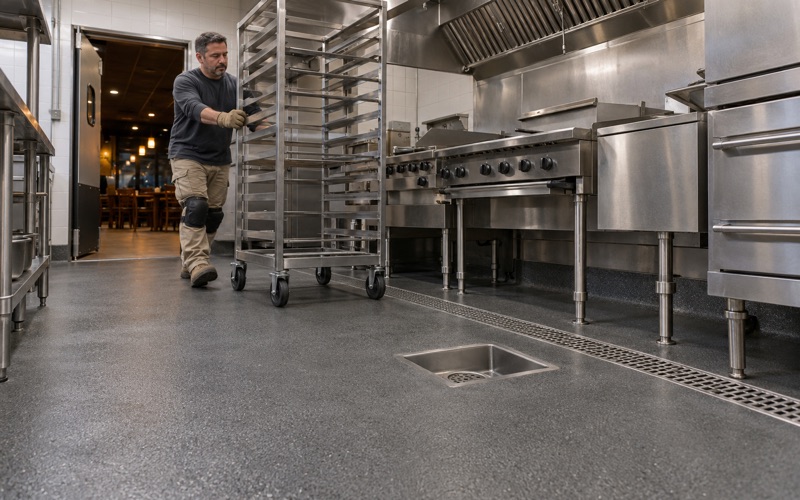
Lodging and daycare floors are cleaned the way the work demands: pick up, hose down, apply a disinfectant, rinse and squeegee, often more than once a day. That routine is hard on a floor in two ways. It keeps the surface wet for long stretches, and it puts cleaning chemistry in contact with the coating day after day.
A sealed, non-porous floor is what lets the routine work as intended, because the disinfectant reaches what is on the surface instead of chasing what has soaked below it. No coating resists every cleaning product on the market, and we will not tell you otherwise. What we do is ask which cleaners the staff actually use, at what dilution, and match the topcoat to that list against the manufacturer’s published chemical resistance data before the job is quoted.
Footing is the other half of a wet floor. Dogs and staff both move quickly across it, so the broadcast is chosen to give grip when wet while staying easy to clean, rather than left smooth and glossy.
A boarding floor also cannot simply close for a week. We schedule the work in sections around the hours the building has to keep running, including overnight and weekend windows, so animals can be moved to a finished room while the next one is ground and coated. Curing is timed against slab temperature and dew point rather than the calendar, because a resin that cures cold or damp can develop amine blush and lose adhesion between coats.
What Illinois kennel rules ask of surfaces
Illinois regulates kennel and boarding operations under the Illinois Animal Welfare Act, and its rules at 8 Ill. Adm. Code Part 25 say cages shall be constructed of a material that is impervious to urine and water and able to withstand damage from gnawing. That phrase is the standard in plain words: impervious to urine and water.
We read that rule as a statement of the requirement, not as a floor-coating specification, and we do not suggest it calls for epoxy or that any installer holds a license for kennel work. Illinois issues no state license for flooring or coatings work at all. What the rule does is name the property every surface in an animal room should have, and a seamless coved floor is one established way to get it underfoot.
The American Animal Hospital Association’s design guide makes a related point: floors and drains have to work together to handle water, animal eliminations and cleaning solutions. The drain layout belongs to the building’s designer. Our part is a surface that sheds liquid instead of absorbing it.
Pet Rooms and Mudrooms in Shorewood Homes
The same problem at house scale
Most of the floors we are asked about in Shorewood are residential, and with 6,632 of the village’s 6,852 occupied homes owner-occupied, the decision usually rests with the person who lives there. A crate in the basement, a puppy in the laundry room or an older dog with accidents brings the same urine-and-concrete problem onto a smaller floor. Garage slabs that have become the dog’s room are common, too.
The answer scales down cleanly: grind to open the slab, test it, then build a seamless non-porous system with a short cove where the floor meets the wall. In a basement we check moisture first, because a slab pushing vapor up from below will lift a coating from underneath however well the top is sealed. That is also why moisture is the first exclusion we read out before any warranty is signed.
A mudroom or garage that doubles as the dog’s entrance takes more than accidents. Wet paws, wash water from a bath at the utility sink and the calcium chloride brine and rock salt a Will County winter tracks in all land on the same few square feet. We build those floors for that whole load, with a texture that still gives a dog footing when the surface is wet.
Working in the village
Shorewood is a village in Troy Township, Will County, and its Building Department at One Towne Center Blvd. registers every contractor working there for $120 a year, with a $10,000 bond for a general contractor and $500,000 in general liability coverage. We confirm that registration is current before a job is scheduled. Whether an interior floor coating needs a village permit is a question we put to the Building Department at (815) 553-2310 rather than guess at.
Every home job gets a written contract and the Home Repair: Know Your Consumer Rights pamphlet before work starts, as the Illinois Home Repair and Remodeling Act requires. Prices are quoted per square foot for the system we actually propose, whether that is a single pet room or a full lodging floor. Grinding dust is collected at the grinder and never washed toward a floor drain.
- 20+ Years Coating Concrete
- Moisture Testing in Every Scope
- Free Written Estimates