
Bolingbrook Epoxy Flooring has spent 20+ years grinding and finishing concrete in Bolingbrook, IL, and our polished concrete floors serve surrounding cities including Lemont, Warrenville, Burr Ridge, Hinsdale and Shorewood. Polishing turns the slab itself into the finished floor: no resin layer, no peel line, just concrete ground through progressive diamond grits, densified and brought up to the sheen you choose.
Because nothing covers the surface, the slab you have is the floor you get. We read cracks, patches, joints and old adhesive before quoting, grind a sample area so you can see the actual aggregate and color, and say plainly when a slab would serve better under a coating.
Every proposal names the grit sequence, the densifier, the guard and the target sheen, priced per square foot. That gives you a specification you can hold the finished floor against, rather than a promise of a shiny floor.
Commercial and Residential Polished Concrete
Retail and Showroom Floors
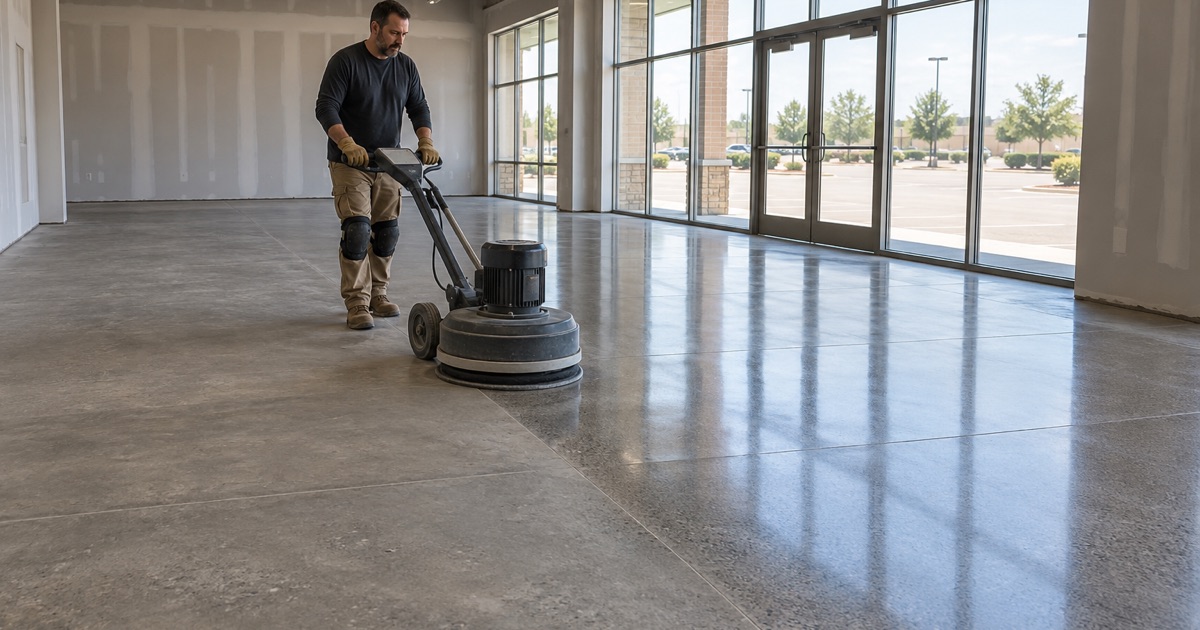
Polished concrete suits retail floors that take steady foot traffic, carts and display fixtures moved between seasons. With no coating to scratch through or peel at the edges, wear shows as a gradual loss of sheen that a burnish restores, rather than a worn patch that needs recoating.
Tenant spaces turned over between leases are a common job. We grind out old carpet glue or tile mastic, repair the slab, and polish inside the vacancy window, so the floor is finished before the next tenant’s fixtures arrive.
Warehouse and Distribution Floors
Distribution buildings along I-55 and Weber Road run large, open slabs where polishing and densifying make sense: a lithium silicate densifier hardens the surface against forklift wear and dusting, and the higher reflectivity brightens aisles. Control joints are filled with a semi-rigid polyurea joint filler so wheel loads do not chip the edges.
Work is phased around the racking and the dock schedule, with sections ground overnight or on weekends. Because there is no resin to cure, a finished section can usually take traffic soon after the final pass.
Offices, Clinics and Public Spaces
Lobbies, corridors, fitness rooms and clinics use polished concrete for a clean look that holds up to cleaning machines. We set the sheen for the space, keeping entries and areas near water at a lower gloss for traction.
Occupied buildings set the schedule. Grinding is loud, so clinic and office floors are usually done after hours or over a weekend, with the work area closed off and the dust pulled into a vacuum at the grinder rather than left to drift down a corridor.
Basements and Homes
In a house, polished concrete works in basements, mudrooms and open living areas on a slab. It has no coating to blister if vapor moves through it, which is an advantage on a basement floor, though we still test moisture so you know what the slab is doing before rugs and furniture go down.
Residential slabs are often less forgiving than commercial ones. Basement floors may carry patches, old adhesive lines and tool marks from the original finisher, all of which show through a polish, so we grind a sample in a corner first and you decide whether you like what your own concrete looks like.
Choosing the Look of a Polished Floor
Cream, Salt-and-Pepper or Full Aggregate
How deep we grind decides what you see. A cream polish stays in the top paste with little or no stone showing; a salt-and-pepper finish exposes fine sand; a full aggregate finish grinds down to the larger stone for a terrazzo-like look.
Each slab mixes differently, so the same grind gives different results on two floors. That is why a sample area on your concrete comes before the quote is final.
Sheen Levels
Polished concrete is graded by how fine the last grit is and how reflective the surface becomes, from a flat honed finish to a high gloss. Higher sheen shows reflection and highlights cracks and patches more, while a satin finish hides them and needs less upkeep to look consistent.
The right sheen depends on the room. A showroom under bright lights can carry a high gloss, while a warehouse aisle or a busy entry usually looks better for longer at a satin level, where tire marks and scuffs blend in between cleanings.
Dyes, Saw Cuts and Borders
Penetrating dyes add color without a coating, and saw-cut lines, borders and patterns can be laid out before the final passes. We plan any pattern around the existing control joints so they become part of the design rather than fighting it.
How a Polished Concrete Floor Is Built
Assessment and Sample Grind
We check the slab for hardness, cracks, joints, patches and contamination, and grind a test area through the first few grits. That sample settles the aggregate exposure and shows any surprises before the full floor is opened.
Grinding and Repair
Metal-bond diamonds remove coatings, adhesives and surface paste and flatten the floor, while dust is collected at the grinder by a vacuum system rather than washed toward floor drains. Cracks and spalls are filled with a color-matched filler so repairs blend rather than stand out.
Densifying
After the early grits, a lithium silicate densifier is applied. It reacts with the free lime in the concrete to harden the surface, which lets the later grits refine it to a higher, more durable polish and reduces dusting on warehouse and shop floors.
Polishing and Guard
Resin-bond diamonds take the floor through progressively finer grits to the target sheen. A penetrating stain guard is applied last to help resist oil and spills, and you receive cleaning instructions matched to the finish.
Pricing and Upkeep
What Moves the Price per Square Foot
Polished concrete is priced per square foot, and the biggest variables are what has to come off the slab first and how deep the finish goes. Removing carpet glue, tile mastic or an old coating adds passes with aggressive tooling, and a full aggregate finish takes more grinding than a cream polish.
Repairs, joint filling, dyes and the target sheen all add to the number as well. We list each one separately in the proposal, so you can see what a lower sheen or a cream finish would save before you choose.
Keeping the Shine Through a Salt Winter
Sand and road salt tracked through a door are what wear a polished floor fastest, scratching the surface and leaving a white film as the brine dries. Walk-off mats at every entrance, daily dust mopping and a neutral cleaner keep most of it off the finish.
On busy commercial floors, a periodic burnish with a high-speed pad restores the gloss in high-traffic lanes. Because the shine is in the concrete rather than in a coating, the floor can be refreshed this way for years without stripping or recoating.
When Polished Concrete Is Not the Answer
Floors That Need a Coating Instead
Polished concrete is still porous compared with a resin system. Commercial kitchens with hot washdown, food plants, auto repair bays with constant oil and chemicals, and hangars with fuel on the floor usually need a sealed coating such as epoxy or urethane cement, and we recommend one rather than polishing a floor that will stain.
Slabs Too Damaged to Polish
A slab with widespread scaling, heavy patching or uneven sections will show every flaw once polished. Where a slab needs significant repair, a coating that covers the repair is often the better result, and we tell you which way your floor leans before you pay for either.
- 20+ Years Coating Concrete
- Moisture Testing in Every Scope
- Free Written Estimates