Bolingbrook Epoxy Flooring brings more than 20 years of epoxy flooring in Palos Hills and the surrounding southwest suburbs to the kind of floor most coating brochures skip: the working shop floor. A garage that holds two cars and a stored mower is one job. A bay where someone welds, grinds, drains oil and drops a wrench several times a shift is a different one, and it deserves a different conversation before anyone talks about color.
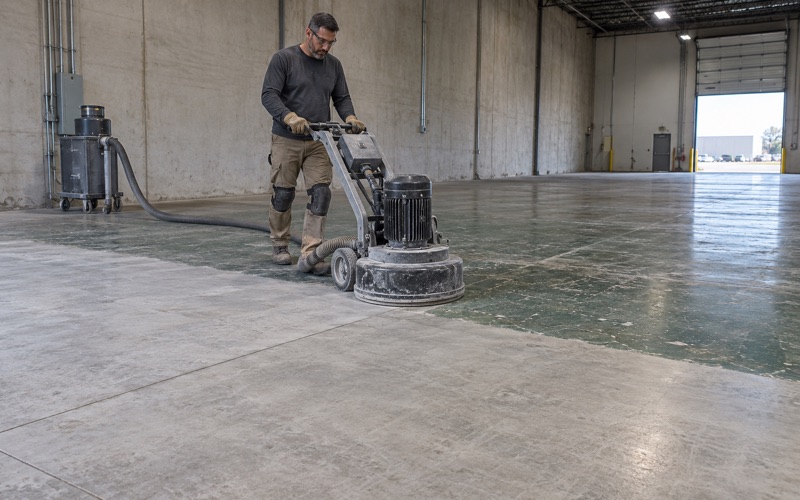
That conversation starts with the slab. Every floor we coat is opened mechanically with a diamond grinder or shot blaster, never acid etched, and moisture is tested as its own line on the proposal rather than discovered after a coating lifts. We also read the cracks, joints and any old coating first, and we say so plainly when the concrete needs repair before a resin can go on it.
The written proposal names the product, the system build and the finished thickness, priced per square foot for that system. On a shop floor that matters more than anywhere, because the gap between a thin roll-coat and a troweled or broadcast build is the gap between a floor that lasts and one that peels under the first jack stand.
A Palos Hills College Asks for a Trades Building
Palos Hills is home to Moraine Valley Community College, founded in 1967, whose main campus on College Parkway sits beside the Palos Forest Preserves. The college’s published coordinates place the campus inside the city limits, in Palos Township, Cook County. It counted 10,578 students in spring 2022.
What goes to voters on November 3, 2026
On May 21, 2026, the Moraine Valley Board of Trustees voted to place a $115 million bond referendum on the November 3, 2026 ballot. The plan calls for a new building on the east side of campus with large learning spaces for the Automotive Technology, HVAC/Refrigeration and Welding programs, along with more room for Automation and Engineering Technology and for Fire Science/EMS where those programs already sit. As of early October 2026 the referendum had not been held, so the building remains a proposal.
Why a training shop is a floor problem
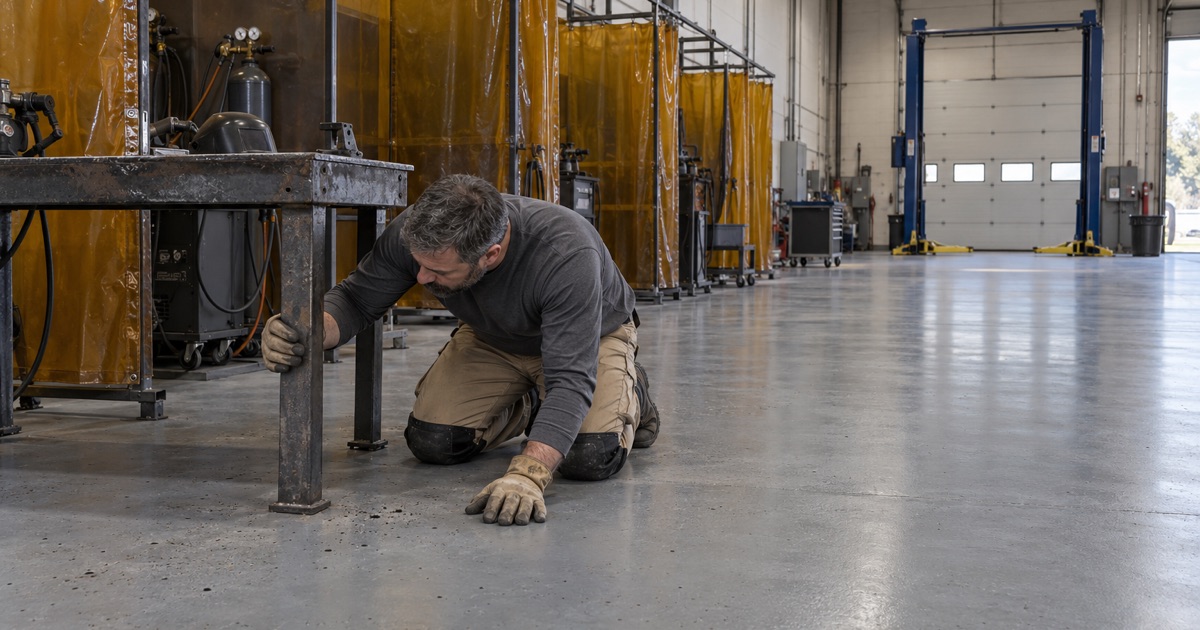
The college has not published any floor specification, and we make no claim about what it would choose. What we can say is what the programs named on that ballot do to concrete. Welding, automotive and refrigeration instruction all happen at floor level, with hot metal, heavy steel and slick fluids landing on the same surface every day, and students are still learning where things fall.
That makes a training shop a useful way to think about the working shop floors in Palos Hills. A teaching bay and a working repair or fabrication shop often put the same conditions on the slab, so the same floor decisions apply to both. The sections below walk through each kind.
Looking for epoxy-flooring closer to Hickory Hills? See Epoxy-Flooring in Hickory Hills.
Welding Floors: Spatter, Slag and Grinding Sparks
Welding puts heat onto a floor in small, sharp doses. Spatter lands as tiny beads of molten metal, slag chips off a finished bead and drops while still hot, and an angle grinder throws a steady stream of sparks across the room. None of it is dramatic on its own, but over thousands of hours it marks almost any surface.
What hot metal does to a resin floor
No floor coating is immune to weld spatter, and we will not tell a shop owner otherwise. A hot bead can scorch, pit or embed itself in an epoxy surface, and a dropped piece of fresh slag can leave a burn mark. The practical goal is a floor that shrugs off most of it, shows less of what it does not, and can be repaired in sections rather than stripped and redone.
Building a floor for a welding area
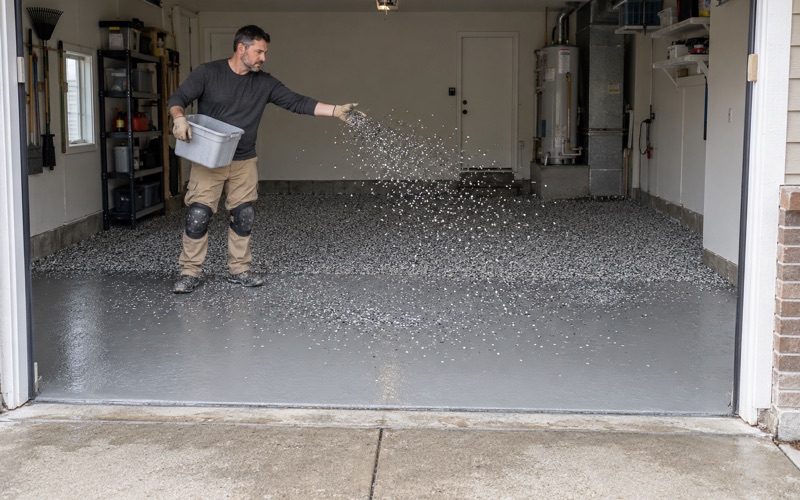
For the welding stalls themselves, many shops keep the cell as densified bare concrete, treated with a lithium silicate densifier, and coat the aisles and work zones around it. Where the whole room is coated, a thicker build helps: a 100% solids epoxy with a quartz aggregate broadcast, or a urethane cement system, carries more mass and texture than a thin film and hides small burns in the grain. Welding blankets and steel plates at the bench still belong in the plan.
Repairability is part of the design, not an afterthought. A broadcast floor can be ground out locally around a burn, reprimed and rebroadcast without the patch standing out, while a high-gloss solid coat tends to show every repair. We talk through that tradeoff before the system is chosen, because a welding area will need touch-ups, and the question is only how visible they will be.
Grinding dust and sparks at the surface
Grinding sparks rarely damage a well-built floor the way slag does, but the metal dust they leave behind is abrasive and stains light colors. Darker, broadcast finishes hold up visually far better than a glossy solid color in a fabrication room. Sweeping metal fines up daily, rather than letting carts grind them in, adds years to any topcoat. When we prepare the slab ourselves, our own grinding dust is collected at the grinder and never washed toward a floor drain or storm inlet.
Lift Bays, Fluids and Refrigeration Labs
An automotive bay asks for something different from a welding cell. The heat is mostly gone, replaced by weight, fluids and impact, all concentrated around the lift posts and the drain line.
Lift posts and dropped steel
A two-post lift transmits the whole weight of a vehicle into a few anchor points, and the slab under those posts has to be sound before any coating matters. We check the concrete thickness and condition at the lift locations, and we read the control joints and cracks across the bay before quoting. Dropped tools, transmission jacks and rolling creepers then work the surface every day, which is why we lean toward a thick, aggregate-filled system over a thin decorative coat in a working bay.
Control joints deserve their own attention in a lift bay. A rigid coating bridged straight across a joint will crack along it as the slab moves, and steel creeper wheels then chip the edges open. We fill working joints with a semi-rigid polyurea joint filler that supports a wheel load yet still tolerates the movement, and we note on the proposal which joints are being filled and which are being honored.
Motor oil, coolant and hot tires
Motor oil and coolant sit on the surface of a sealed floor and wipe up, but they soak deep into raw or poorly prepared concrete and keep wicking back out. A properly profiled slab, a 100% solids epoxy base and a chemical-resistant topcoat such as polyaspartic or polyurea keep those fluids on top where a squeegee can reach them. The same system resists hot tire pickup when cars roll in warm from a test drive.
HVAC and refrigeration labs
Refrigeration work brings its own fluids. Refrigerant oils leave a thin, slippery film, and a smooth gloss floor under that film becomes a slip hazard quickly, so we build texture into the topcoat with a fine aggregate broadcast. Recovery cylinders, compressors and condensing units also get rolled, set down hard and occasionally dropped, which calls for the same impact-tolerant build as a lift bay rather than a showroom finish.
Cleanup habits matter in these rooms too. Refrigerant oils and degreasers are best taken up with an absorbent and a mild cleaner rather than solvent washes, which can dull some topcoats over time. We leave every shop with written care instructions matched to the system we installed, so the people mopping the floor know what it was built to handle.
Moisture under a busy shop
A shop floor is often an older slab, and older slabs sometimes carry more moisture than anyone expects. We test with ASTM F1869 calcium chloride kits or ASTM F2170 in-situ relative humidity probes before we commit to a system, and if the readings call for a moisture-mitigation primer, it goes on the proposal. Warranty exclusions are read out before the job is sold, and moisture is the first one we name.
The Same Floors in the Shops Graduates Work In
Students who finish programs like these go on to work in repair, fabrication and mechanical shops, and Palos Hills has shops of that kind within its own limits. Small commercial buildings along Roberts Road and Southwest Highway can hold the same kind of bays a training shop imitates.
A Roberts Road example
One building at 10058 S Roberts Road shows the pattern. It is a 4,480-square-foot, two-tenant mixed-use building on 0.54 acres, recently listed for sale, and one of its tenants is an auto repair business on a three-year lease. A floor in a building like that has to serve a working shop now and stay sound through a change of ownership later.
That is where a written system build earns its keep. When the proposal names the product, the build and the finished thickness, the next owner or tenant can see what is under their feet instead of guessing. It also gives both sides a fair way to judge the floor years later, since what was quoted can be checked against what actually went down.
Working around the hours a shop keeps
A repair shop that closes for a week loses a week of revenue, so we schedule shop floors around the hours the business has to keep running. That can mean overnight work, weekend sections, or coating half the bays while the other half stays open. Curing is planned around slab temperature and dew point, not a calendar date, and we tell an owner plainly when the conditions will not support a cure.
Commercial work in Palos Hills: a registered contractor
The City of Palos Hills requires registered contractors on commercial property, and its Building Department handles that registration at 708-598-3400. A general contractor registers for $50, good for two years, with a $25,000 surety bond and a certificate of liability insurance. Illinois issues no state license for flooring or coatings work, so the city registration is the binding requirement, and we confirm it before a commercial job is scheduled.
On a home garage or basement, the paperwork changes but does not disappear. Every residential job gets a written contract and the state’s Home Repair: Know Your Consumer Rights pamphlet before work begins, as the Illinois Home Repair and Remodeling Act requires. Whether the floor is a two-car garage or a four-bay shop, the coatings we choose fall within the Illinois limits on VOC content.
- 20+ Years Coating Concrete
- Moisture Testing in Every Scope
- Free Written Estimates