Bolingbrook Epoxy Flooring has spent more than 20 years on epoxy flooring in Northlake and across the western suburbs, and the work here rarely begins on bare concrete. A basement or garage slab in this city has often been coated, covered or patched before, sometimes more than once, and each of those layers decides what a new floor can stand on. So we start by finding out what is already there.
That makes the first visit an inspection rather than a sales call. We look at the slab, scrape and test what sits on it, check for moisture, and read the cracks and joints before writing a number down. If something underneath has to come off, or the concrete itself needs repair first, the proposal says so in plain terms.
What you get in writing is specific: the product, the system build and the finished thickness, priced per square foot for the floor we are actually proposing. A home job also comes with a written contract and the Home Repair: Know Your Consumer Rights pamphlet before any work starts, as the Illinois Home Repair and Remodeling Act requires.
A City of Houses Their Owners Finished
Northlake took shape in the late 1930s, when the Midland Development Company bought a tract at the southwest corner of North Avenue and Wolf Road that a bankrupt developer had already subdivided. Early sales went well enough that Midland bought more land, and Northlake incorporated as a city in 1949. Many of the first residents worked at the defense plant that had come to nearby Melrose Park.
Shell homes and weekend carpentry
The Cook County hazard-mitigation annex for Northlake records that Midland’s houses were advertised as “semi-finished,” and that the plant employees who bought them were required to finish the interiors. A published history of the city describes those first residents living in “shell homes” that needed weekend work to complete, with the owners doing their own carpentry, plumbing and wiring. Not all of the city’s houses started that way, but Midland’s early homes did.
Seventy years of owners
A house finished by its first owner tends to keep being finished by the owners who follow. The 1950s alone account for 1,799 of the city’s 4,526 housing units, which means a large share of the homes here have had decades of owners. Each of them had a weekend, a budget and an idea about what to do with the basement or garage floor.
Why that history matters on a slab
None of this shows up in a photo of the garage. It shows up when a grinder reaches a layer nobody mentioned, or when a new coating lifts because it was bonded to an old one rather than to the concrete. We would rather find that out with a scraper and a test than with a callback.
Looking for epoxy-flooring closer to Minooka? See Epoxy-Flooring in Minooka.
What Is Already on the Floor
No survey records what covers Northlake’s basement and garage floors today, so we assume nothing. Each floor is its own record of the people who lived in the house, and we read it one layer at a time.
Floor paint and hardware-store epoxy kits
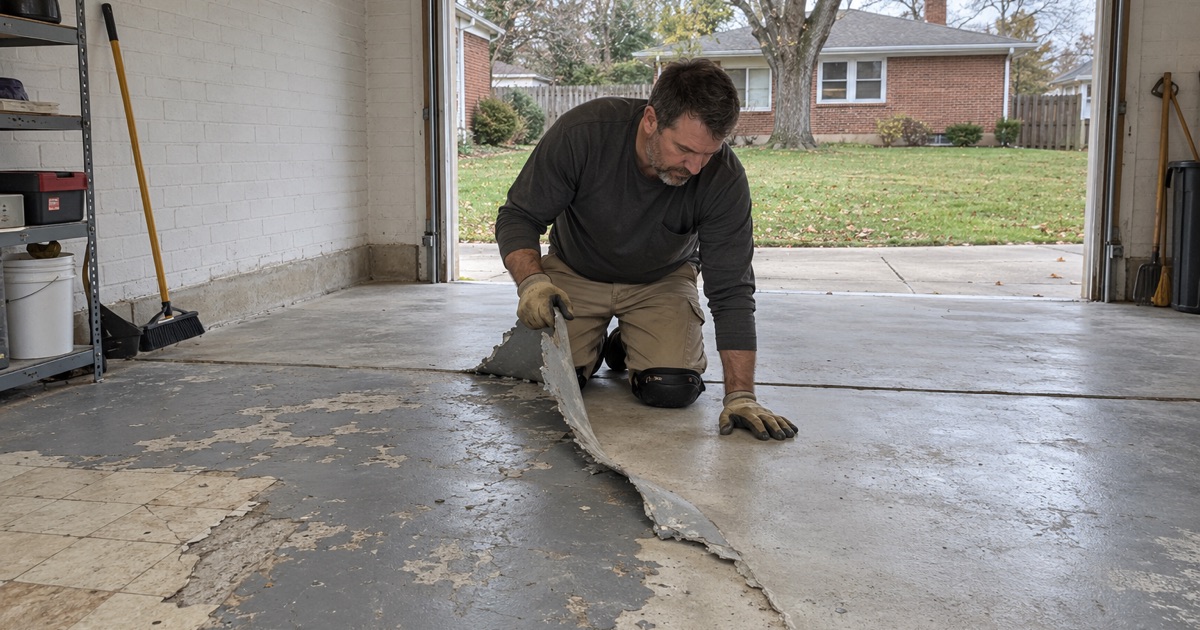
Porch-and-floor paint and water-based or one-part epoxy kits are the usual owner-applied finishes on garage and basement slabs. They go down thin, often over an acid-etched or barely cleaned surface, and they tend to fail in the tire tracks first, where hot tire pickup pulls the film off the concrete. A kit that still looks intact in the middle of the floor can be loose at the edges, and a new system bonded to it inherits that weak bond.
Paint and kits also stack. A newer color is often rolled straight over an older one that was already peeling, so the top layer holds only to the flakes beneath it. Counting the layers at a chipped edge tells us how many owners had a go at the floor.
Glued tile and its adhesive
Basements finished by hand were often tiled, and tile leaves adhesive behind even after the squares come up. We do not assume what an old tile or its mastic is made of. If either could contain asbestos, it is sampled and sent to a lab before anyone grinds it, because grinding is the one step that turns a stable layer into dust.
Once the tile question is settled, the adhesive is usually the harder part to remove. Mastic gums up a grinder and can bleed through a thin coating if any is left behind, so it comes off completely before primer goes down.
Patches, leveler and filled cracks
Owner-finished floors also carry their repairs: a trench patched after a drain line was run, a skim of leveling compound, a crack filled with whatever was on the shelf. Some patching products crumble under a diamond head, and some are harder than the slab around them. We map each one, because a coating reads every change in what is underneath it.
Sealers you cannot see
Clear sealers and old curing compounds are invisible until water beads on them. A few drops on the slab show whether the concrete absorbs, and that tells us whether something is sitting on top that a coating would not grip.
Test the Layers, Then Decide: Strip or Bond Over
The order on a Northlake job is identify, test, then grind. Running a grinder first and asking questions afterward is how an unknown layer ends up as dust spread through a basement.
What the tests look like
We scrape and cross-hatch the existing coating to see whether it is holding to the concrete or only to itself, checking the edges and traffic lanes where failure starts. Moisture testing is a line item on every scope: an ASTM D4263 plastic sheet test as a first read, then ASTM F1869 calcium chloride tests or ASTM F2170 in-situ relative humidity probes on prepared concrete where the numbers matter. A basement slab that pushes water vapor through it will shed any coating, old or new.
Moisture readings taken through an old coating are not reliable, because the coating itself slows the vapor the test is trying to measure. That is why we open small test areas down to bare concrete before placing a calcium chloride dome or setting a relative humidity probe. The results go into the proposal, next to the system they point to.
When the old layer comes off
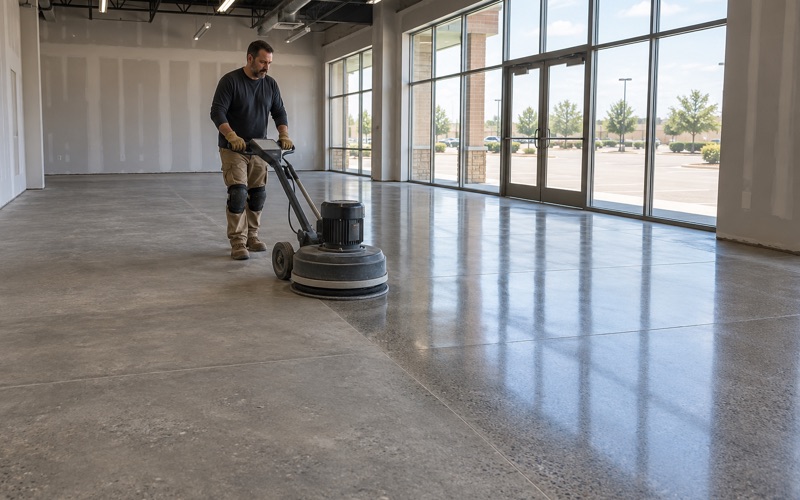
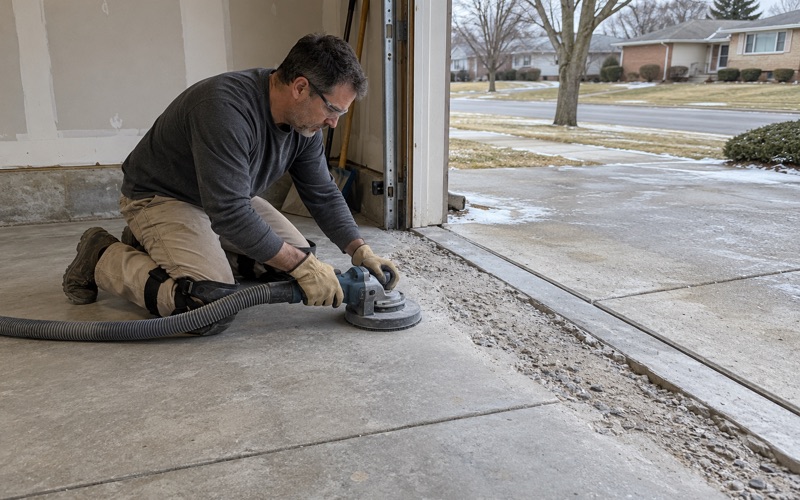
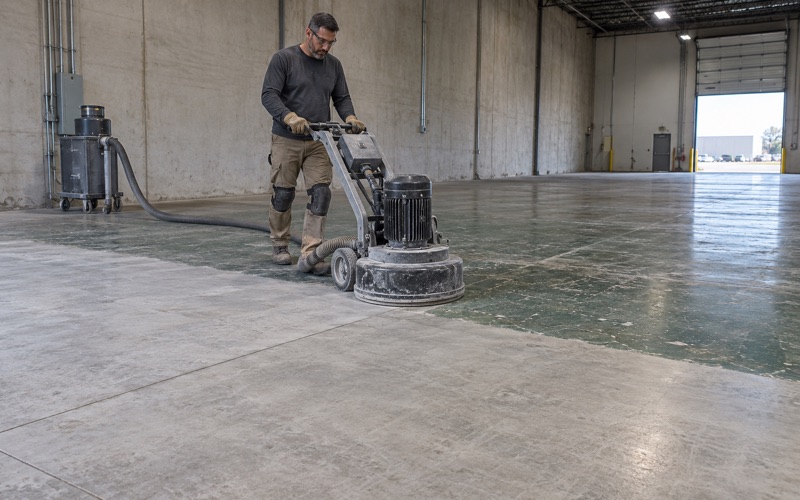
Most owner-applied paint and kit epoxy comes off. It is thin, it was rarely put down over a properly profiled surface, and a 100% solids epoxy built over it is only as strong as that original bond. We remove it by diamond grinding or shot blasting down to sound concrete at the ICRI surface profile the new system calls for, and we never acid etch. Dust is collected at the grinder rather than washed toward a floor drain.
Removal is priced as its own step, so you can see what the old finish is costing you. Taking off one coat of thin floor paint is a different job from cutting through a thick leveling patch or a kit layered over two older paints, and the quote reflects which one your floor turned out to be.
When bonding over is reasonable
Now and then an earlier coating turns out to be a well-bonded industrial system that passes adhesion testing across the whole floor. In that case a sanded, primed recoat can be a sound choice, and the proposal will say exactly why we made it. That is the exception, and the test decides it, not the price.
When the slab itself needs work
Sometimes taking the layers off reveals the real problem: a heaved section, a crack that is still moving, or concrete too weak to hold a coating. We say so plainly and price the repair or replacement on its own line, rather than sealing a problem under a new color.
A Floor That Is Finished Once, Properly
Every owner who coated a Northlake floor before you was trying to finish the house. The point of a professional system is to end that cycle with one floor, built to a written specification, that the next owner does not have to scrape.
Building the system
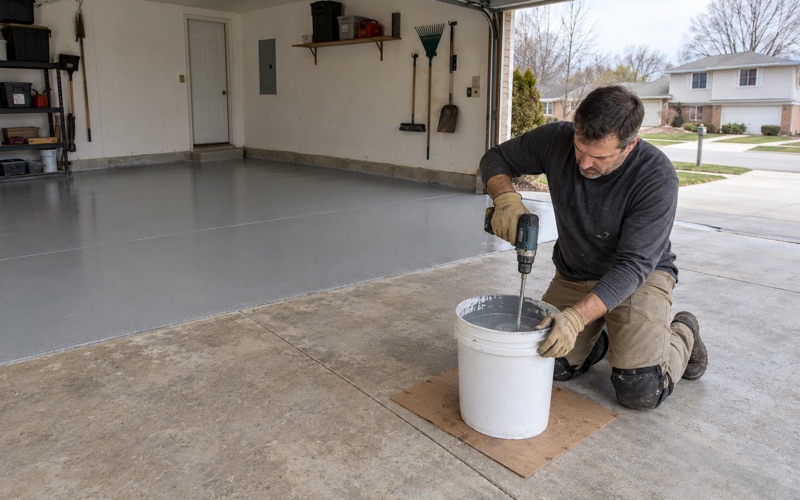
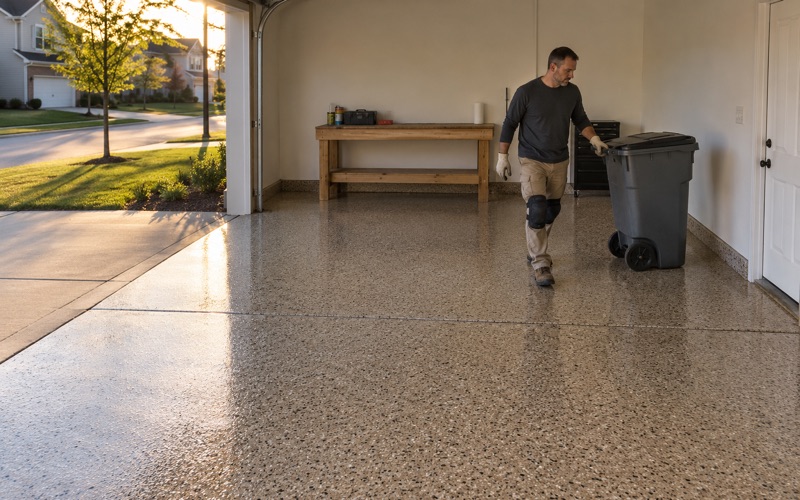
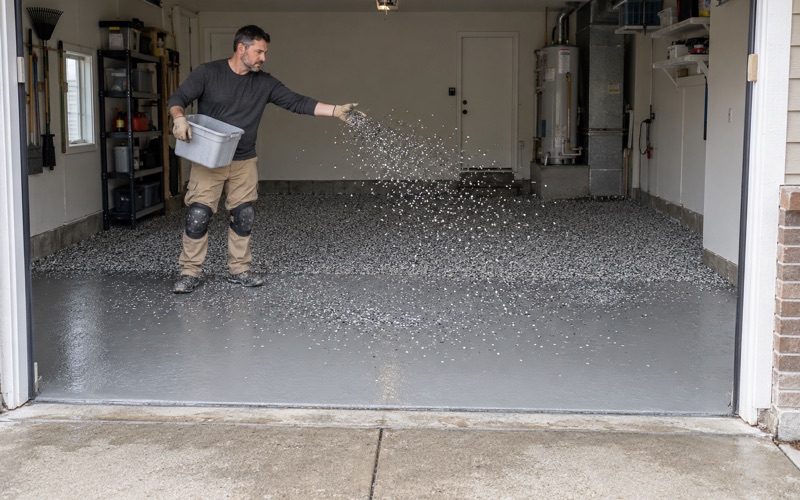
On a basement, that usually means a moisture-mitigation primer where testing calls for it, a 100% solids epoxy body coat, and a vinyl flake or quartz aggregate broadcast for texture. In a garage, we finish with a polyaspartic or polyurea topcoat that stands up to the calcium chloride brine and rock salt that ride in on tires all winter. Control joints and active cracks are filled with semi-rigid polyurea joint filler rather than buried under the coating.
The finished thickness of each coat is written into the proposal, so you can check what was quoted against what went down. On a floor that has already been coated by hand two or three times, being able to measure the new one is part of what makes it the last.
Curing on the slab’s terms
Cure is scheduled against slab temperature and the dew point spread at the surface, not against a date on the calendar. An unheated garage in January may have to wait for spring, and we will tell you that up front rather than coat a cold slab and hope. Every coating we use is chosen within the Illinois VOC limits for architectural coatings, which bind the installer as well as the manufacturer.
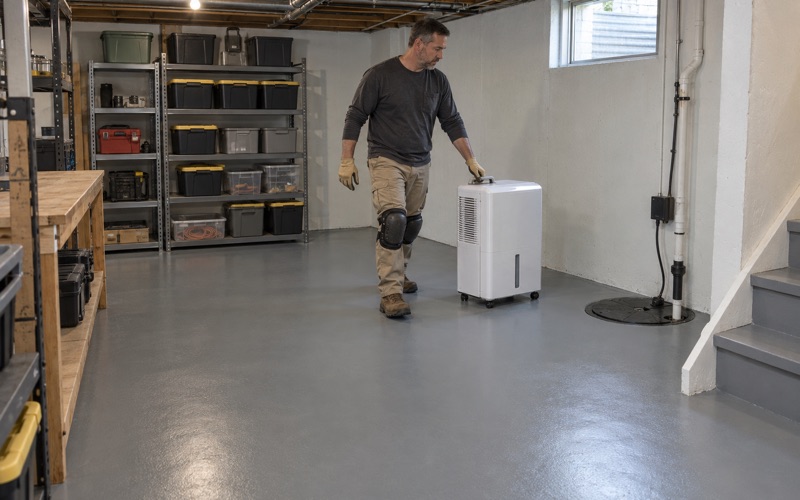
Basements are a different case. They hold temperature better than a garage, but they are where vapor and hydrostatic pressure under a basement slab show up first, so a basement schedule leans on the moisture results more than on the thermometer.
Warranty, paperwork and the city
Before the job is sold, we read the warranty exclusions aloud, moisture first, because it is the one most likely to matter on an older basement slab. Illinois issues no state license for coatings work, so we confirm the City of Northlake’s own contractor registration, bond and insurance requirements with its Building Department before a crew is scheduled. The aim is a floor whose history starts with a written record.
Paperwork is not the interesting part of a floor, but it is what lets you hold a contractor to the job. Keep the contract, the pamphlet and the proposal with the rest of the house records, so the next owner knows exactly what is on the slab.
- 20+ Years Coating Concrete
- Moisture Testing in Every Scope
- Free Written Estimates