Bolingbrook Epoxy Flooring has spent more than 20 years on epoxy-flooring in Midlothian and the rest of the southwest suburbs, and the question we hear most from basement owners here this year is not about color or flake size. It is about timing. A coating is the last thing that should happen to a floor, and right now something else may need to happen first.
That something is a lead service line replacement. When the pipe that feeds a house is being swapped out, the place it comes through the foundation is a work zone, and a finished floor laid down before that work is done is a floor waiting to be patched. We would rather schedule the coating once, after the plumbing is settled, than sell it twice.
So this page is less about systems and more about order of operations: what the village program covers, where its work stops inside your house, what it leaves for you, and how we plan a basement or utility-room floor around it.
Midlothian’s lead line program and where the new pipe ends
The Village of Midlothian is replacing the oldest water pipes in town, the lines that run from the water main in the street to the building plumbing, one property at a time. According to the village’s Summer 2025 newsletter, the program received a $3,735,329 award from the Illinois EPA for Year 1, roughly $1.6 million had been spent by July 9, 2025, and another $3,027,000 is lined up for a Year 2 project. The mayor has said the lines are replaced at no cost to the homeowner.
We are a flooring company, not a plumber, and we have no role in the program. We do not know which blocks fall in which year, and we will not guess. What we can do is explain how the program touches the inside of a house, because that is where our work begins.
Who does the work
The Year 1 contractor is Calumet City Plumbing. The village describes the sequence this way: the homeowner signs a property access agreement, and the contractor then reaches out to set up an initial house survey. Signing that agreement does not commit you to a replacement. The contractor also needs access to the building for a preconstruction inspection with photographs, and may excavate near the property line.
The first valve inside the house
The detail that matters most for a floor is the endpoint. The village program page says the new copper pipe will run from the water main in the street to the first valve inside the house, or at least 18 inches inside the building envelope, whichever is shorter. In plain terms, the work does not stop at your foundation wall. It comes through it.
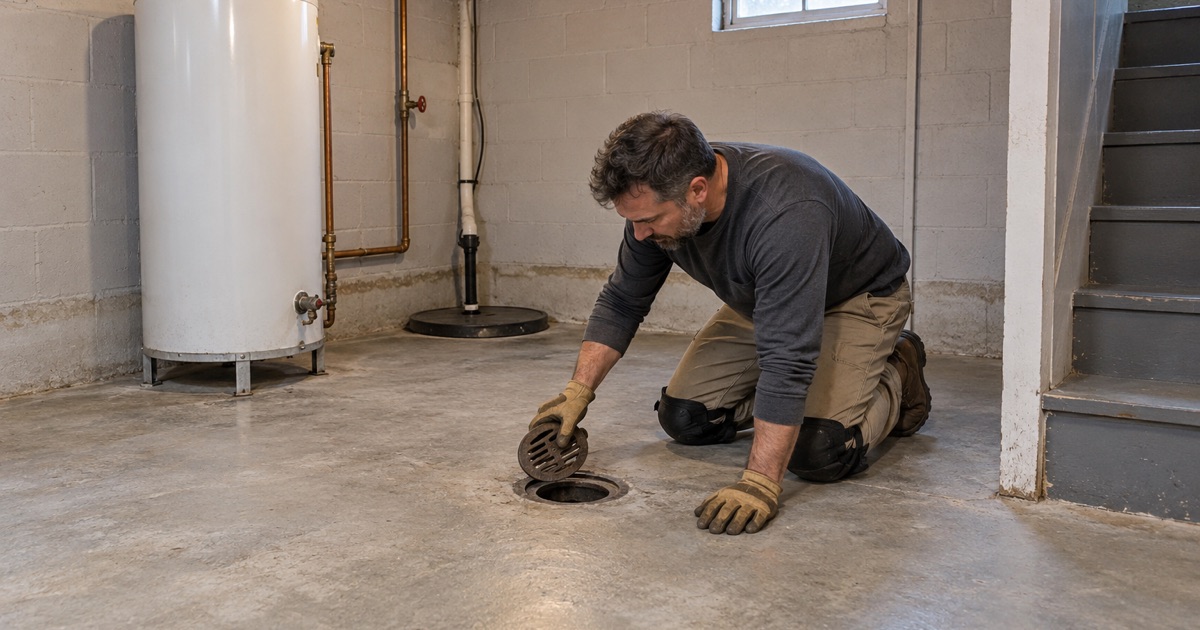
Where the service enters a basement, that means a crew working in the same corner where the meter and the shutoff sit. The program pages do not describe cutting a basement wall or floor, and plenty of homes will see very little change indoors. But until you know how your own replacement went, treat the area around the service entry as unfinished.
Looking for epoxy-flooring closer to Wood Dale? See Epoxy-Flooring Services in Wood Dale.
The village restores the yard, not the basement
Here is the part owners tend to miss. The program page promises that, once the new connection is made, the village will restore the customer’s outdoor property as nearly as practicable to its former condition. Repairs to the yard and sidewalk are covered too, along with a 12-month warranty on material and workmanship.
Indoors, the language is different. The contractor will minimize indoor disturbance. That is a reasonable promise, and it is also a smaller one. Nothing on the program page commits anyone to putting an interior floor coating, paint or finish back the way it was.
What that leaves on your side of the wall
If a crew has to set a new valve, anchor a pipe, or seal the point where the copper passes through the foundation, any of that can disturb a coated floor near the wall. Patched concrete, a drip from a new fitting or a fresh sealant bead at the entry are normal results of plumbing work. None of them is the program’s job to blend into an epoxy finish afterward.
That is not a criticism of the program. It simply means the coating in that corner is your responsibility, so it makes sense to put it down once, after the corner is final.
Why we ask before we quote
When a Midlothian owner calls about a basement or utility-room floor, one of our first questions is whether the house has had its lead line replaced, has a survey scheduled, or has not heard anything yet. The answer changes the plan. A house that is done can be scoped normally. A house that is waiting may be better served by a walkthrough and moisture readings now, with a start date set after the plumbing crew leaves.
Use the preconstruction photos
The contractor’s preconstruction inspection includes photographs, and those are worth keeping in mind. If your basement floor already carries a coating, take your own dated pictures of the service entry corner before the survey as well. A clear record of what the floor looked like beforehand makes any later conversation simpler, whether it is with the plumbing contractor or with us when we price the repair.
Replace first, coat second
The sequence we recommend is short: let the replacement happen, and let the new line, the first valve and any wall or floor penetration at the service entry be finished. Then let the plumbing sit long enough that a slow drip would have shown itself. After that, we grind and coat.
Keeping the meter and valve area clear
Even after the work is done, the meter and shutoff are places someone will need to reach again. We plan the coating so nothing a future crew needs is buried. That means no built-up cove or curb tight against the valve, no heavy broadcast that bridges over a pipe sleeve, and a clean termination line a short distance off the wall where a repair could be cut and patched without lifting the rest of the floor.
If an owner wants the whole room covered edge to edge, we can do that too, but we will point out that the corner by the meter is the one most likely to be opened again. A small, well-defined area there is easier to repair than a seamless field that has to be feathered back together.
What our scope includes either way
Every slab we coat is opened mechanically with a diamond grinder or a shot blaster to a measured ICRI CSP profile. We do not acid etch. Moisture testing is written into the proposal as its own line, typically ASTM F2170 in-situ relative humidity probes or ASTM F1869 calcium chloride tests, so a damp slab is found before a coating goes down rather than after it lifts.
The proposal names the product, the system build and the finished thickness, so you can hold the finished floor up against what was quoted. And moisture is the first exclusion we read aloud on the warranty, before anyone signs.
Paperwork for the job
Illinois issues no state license for flooring or coating work, so the rules that apply are the village’s. Midlothian requires an annual contractor license, a $10,000 bond and a $1 million liability certificate naming the village, with every license expiring December 31. We confirm that registration before a Midlothian job goes on the calendar. Every home job also gets a written contract and the state’s Home Repair: Know Your Consumer Rights pamphlet before work starts.
Basement floors in an older village
Midlothian’s housing is mostly from the middle of the last century. The Census Bureau’s five-year estimates put 81.3 percent of units in buildings from before 1980, with the largest groups from the 1950s, 1960s and 1970s, and none counted from 2010 on. For a coating contractor, that means nearly every basement or garage floor we see here is a retrofit over an older slab.
What an older slab brings with it
A slab from that era may or may not have a vapor retarder under it, and many have been painted, sealed or patched more than once. Old coatings have to come off completely before a new system can bond, which is one more reason we grind rather than etch. Cracks, joints and spalls get read before we quote, and if a slab needs repair or replacement before it can carry a coating, we say so in writing.
Basement slabs also sit against soil on every side. Where readings show elevated moisture, we specify a moisture-mitigation primer or steer the owner toward a system that tolerates vapor, such as a moisture-tolerant urethane cement. Hydrostatic pressure under a basement slab is a water problem, and no surface coating fixes it, so we will not sell one as if it does.
Systems that suit a utility room
For a basement or utility room near the service entry, we tend to favor a 100% solids epoxy base with a polyaspartic topcoat, or a vinyl flake broadcast that hides minor wear and gives some grip underfoot. Floors that see standing water from a water heater or laundry drain may get a quartz aggregate broadcast for slip resistance. Control joints are honored and filled with a semi-rigid polyurea joint filler rather than coated over.
Timing the cure
Curing is scheduled against slab temperature and dew point, not a date on the calendar. A basement often holds a steadier temperature than a detached garage, which helps, but a humid week can still narrow the spread between the slab surface and the dew point. That is when amine blush and poor adhesion show up, so when the readings say wait, we wait.
Pricing follows the same logic. We quote per square foot for the system we actually propose for your room, after the moisture numbers and the slab condition are known, rather than from a national per-basement figure.
If your house is still on the list for a lead line replacement, the simplest plan is to talk with us now, schedule the floor for after the plumbing crew has finished, and let the coating be the last trade in the room. That way the floor you pay for is the floor you keep.
- 20+ Years Coating Concrete
- Moisture Testing in Every Scope
- Free Written Estimates