Bolingbrook Epoxy Flooring has spent more than 20 years on epoxy flooring in Manhattan and the rest of Will County, and the question we ask first on a job here is not about color. It is about the water: what comes out of the hose bib, where the water softener sits, and how the floor will be rinsed once it is coated. Those three answers shape the system we propose more than most homeowners expect.
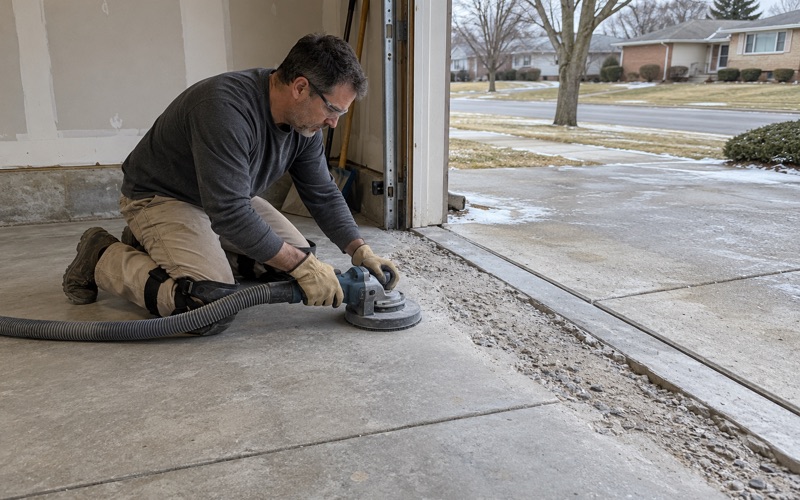
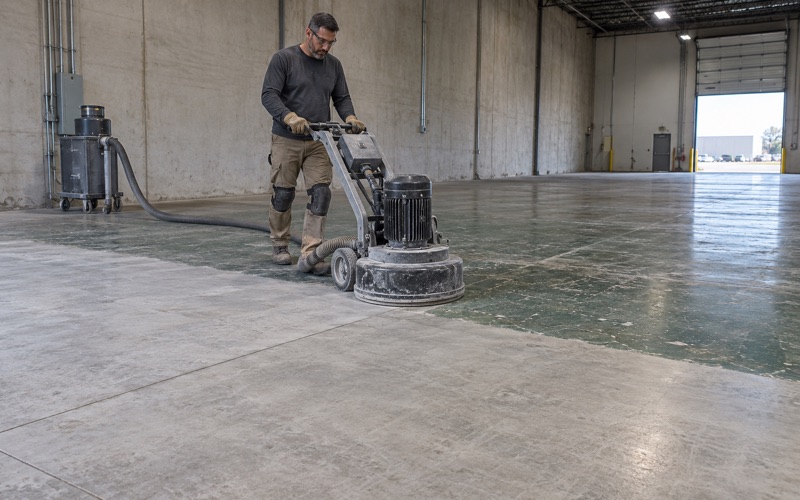
Every floor we coat starts the same way. The slab is opened with a diamond grinder or a shot blaster, never acid etched, and moisture is tested as a priced line item before any primer goes down. The written proposal then names the product, the system build and the finished thickness, so you can hold what we quoted against what we installed.
What changes in this village is the finish decision. Hard water and a softener corner on the floor are ordinary parts of daily life in a lot of homes, and a coating chosen without them in mind can look tired long before it has actually worn.
Manhattan’s Water Comes From 1,700-Foot Village Wells
The village draws its drinking water from groundwater, not from a lake or river. The Village of Manhattan’s 2025 water report lists two active wells, Well 6 on West North Street and Well 8 on West Smith Road, where the treatment facility sits. The system diagram labels a 1,700-foot deep well, and the report says the wells were constructed in a confined aquifer.
What 20-22 grains means in practice
The same report carries a short note for residents: if you are installing a water softener, you need to know that hardness is 20-22 grains and pH is 7.4. The village’s water quality page lists hardness as 21 grains. By standard conversion, that range works out to roughly 340 to 380 milligrams per liter as calcium carbonate, which is very hard water by any common scale.
For a floor, the number matters because of what happens when that water dries. Calcium and magnesium stay behind after the water evaporates. On bare concrete the residue disappears into the gray. On a sealed, smooth coating it sits on top, where you can see it.
Mineral film is a cleaning issue, not coating damage
We want to be precise about this, because it is often oversold. Hard water does not attack a properly cured epoxy, polyaspartic or polyurea floor. What it leaves is a white mineral film, a haze of spots and drip lines where water dried in place, and that film can be cleaned off.
The practical problem is that it comes back every time the floor is rinsed with unsoftened water and left to air dry. A homeowner who hoses out a garage every Saturday will see it every Saturday. So rather than promising a floor that never spots, we plan the finish and the rinse routine so the spotting is either hard to see or easy to remove.
Where the water touches the floor
In many homes here, coated floors meet village water in a few places. Garage floors get hosed down and see wet cars dripping on the slab. Basement floors take washer overflow, softener discharge and the occasional mop bucket. Each of those is a point where hard water dries on the surface, and each one is worth naming before a finish is picked.
Looking for epoxy-flooring closer to Channahon? See Channahon Epoxy-Flooring.
The Softener Corner: Brine, Salt Bags and the Discharge Line
The village does not track how many homes run a softener or where they put it, and we would not guess at a number. As general practice, though, a softener and its brine tank usually go wherever the water line enters the house, and in this area that is often a basement or the garage. That corner of the floor needs its own plan.
Brine and spilled salt
A brine tank sweats, drips and occasionally overflows. Salt bags get dragged across the slab, split and spill. Spilled pellets and brine can sit wet against the coating for days in a corner nobody looks at, and when the water evaporates they leave a crust that is harder to lift than ordinary hard-water film.
Our approach is to coat under and around the softener rather than around its footprint. If the unit has to move, we ask you to plan for a plumber to disconnect it so the full slab can be ground and coated, not just the open floor. A floor with a raw rectangle of bare concrete under the brine tank is the first place a coating edge lifts and the first place salt works in.
Regeneration discharge and the drain
When a softener regenerates, it flushes salty water out through a discharge line. If that line runs to a floor drain or a laundry tub, we look at the route before we quote. A loose hose that splashes on the floor during every cycle will mark any finish, so the fix is usually a fixed air gap at the drain, which a plumber sets, before the coating goes down.
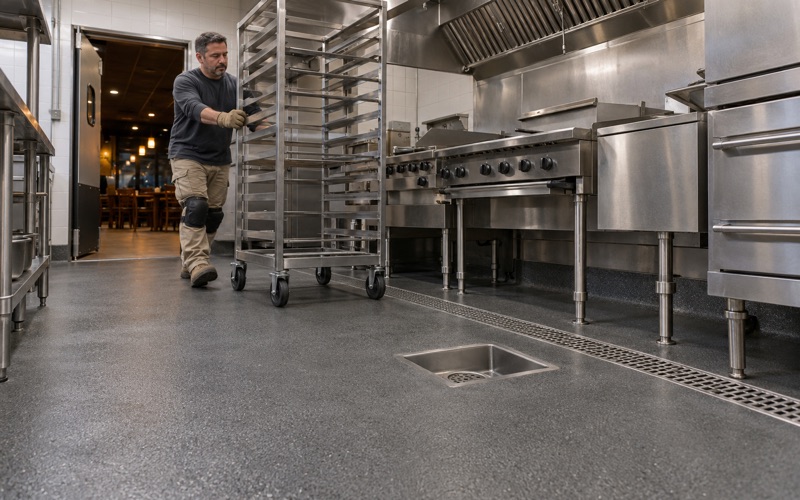
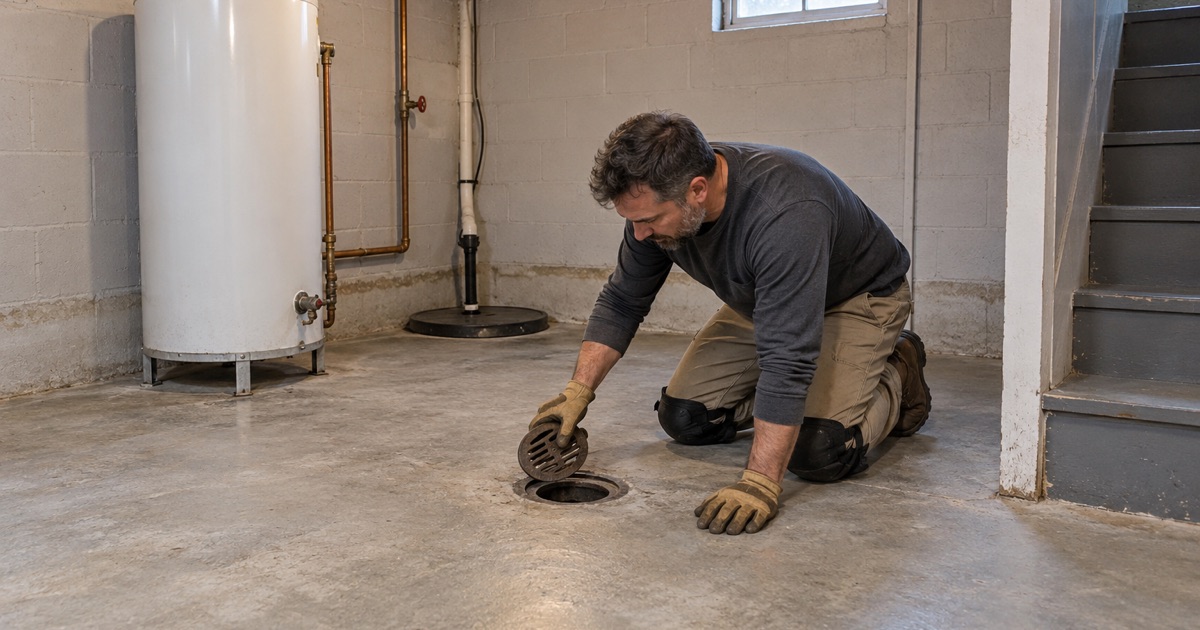
We also check the floor drain itself. The coating has to tie into the drain body cleanly, with the slope intact, so brine and rinse water run off instead of pooling in a low spot around the grate.
Testing the slab before the corner is coated
A basement corner that has been wet for years can hold more moisture than the rest of the slab. We test it, along with the open floor, using an ASTM F2170 in-situ relative humidity probe or an ASTM F1869 calcium chloride test as the slab calls for. If the readings are high, a moisture-mitigation primer goes down first, and we say so in the scope rather than after a blister appears. Moisture is also the first exclusion we read out of the warranty before the job is sold.
Choosing Color, Flake and Topcoat for Hard-Water Rinsing
Once we know where the water lands, the finish decision gets simpler. The goal is a floor that hides a dry rinse spot, cleans up with a wipe, and keeps its texture where people walk with wet shoes.
Color: mid-tones over black and deep solids
Solid dark colors and high-gloss blacks are the hardest finishes to keep looking clean on very hard water. A white film shows against them from across the garage. Mid-gray, tan and other medium tones hide light mineral spotting far better, and they still look sharp under garage lighting.
If you want a dark floor, we will build one. We will just tell you plainly that it will show every place water dried, and that it rewards squeegeeing or towel-drying rather than air drying.
Flake density and texture
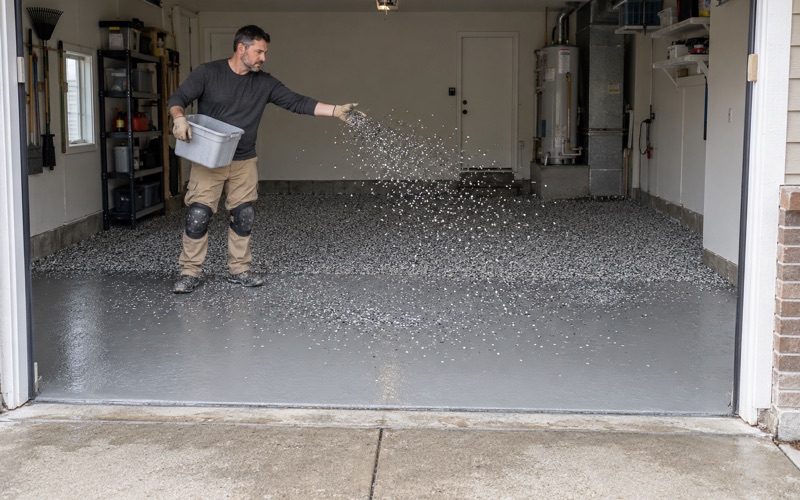
A full vinyl flake broadcast in a blended color is the most forgiving finish we install for a hard-water garage or basement. The multicolored chips break up the surface visually, so a faint ring where a puddle dried reads as part of the pattern. A quartz aggregate broadcast is another option for a basement utility area that sees regular wet traffic and needs more grip.
Texture matters near the softener and the drain too. A finish that is too slick will be slippery when brine is on it, so we adjust the broadcast and the topcoat in that corner to keep some tooth on the surface.
Topcoat and finish level
For the topcoat, we typically propose a polyaspartic or polyurea clear over a 100% solids epoxy base. These topcoats resist hot tire pickup, hold up to salt and household chemicals, and clean easily, which is exactly what a hard-water floor needs. Choosing a satin finish rather than a full gloss also helps, because a lower sheen scatters light and hides mineral spotting.
We pair the finish with simple care advice: rinse with softened water where you have it, squeegee the floor dry after a wash, and clean any film with a mild cleaner made for coated floors. Every coating we propose is also chosen within the Illinois limit on VOC content, which applies to us as the installer as well as to the manufacturer.
Garage Slabs and Older Basements Across the Village
Manhattan grew quickly. The Census count was 3,330 people in 2000 and 9,385 in 2020, and about two-thirds of the housing, 66.3 percent, was built in 2000 or later. Most of the floors we are asked to coat are garage slabs in the 2000s and 2010s subdivisions, with a smaller set of older basements and commercial spaces in the original town.
Newer garages in single-family and attached homes
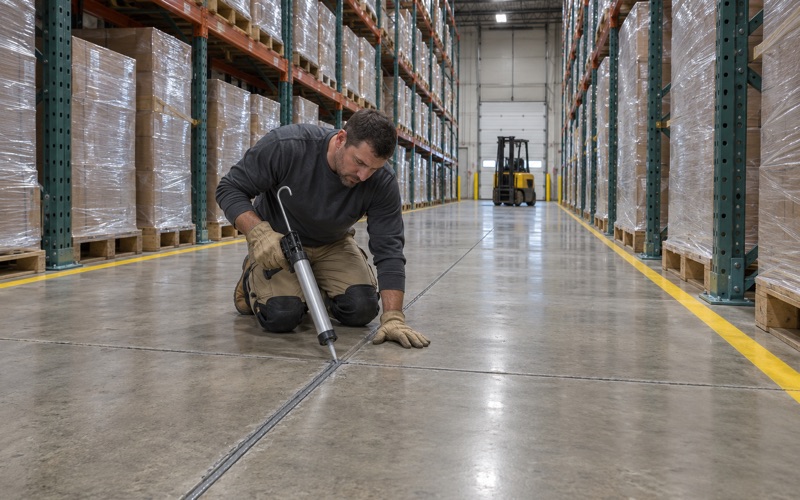
The village has a large share of single-family attached homes, 946 by the Census count, alongside its detached houses. In a townhome garage the floor is often shared space for the car, the bins and the softener, so the corner plan above applies to a lot of them. Before quoting, we read the cracks, control joints and any old sealer, and we fill moving joints with a semi-rigid polyurea joint filler rather than burying them.
Garage slabs from this era are usually sound but often carry a factory-applied sealer or curing compound. Grinding removes it and opens the surface to the right profile, which is why we do not skip that step on a newer slab. Curing is then scheduled against slab temperature and the dew point rather than the calendar, and we will tell you plainly when an unheated garage has to wait for spring.
Pre-1940 basements and downtown commercial floors
The village was founded in 1880 as a Wabash Railroad stop and incorporated in 1886, and 267 homes still date from 1939 or earlier. Basements of that age can be uneven, patched in several eras, and damp in ways a newer slab is not. We tell you plainly if a section needs repair, or if a floor is not a good candidate for a coating at all.
Downtown, the village approved its Downtown Design Guidelines by Village Board resolution in November 2025. For a storefront, office or restaurant floor in that area, we schedule around the hours the building has to stay open, including overnight and weekend windows, and we keep grinding dust collected at the machine rather than washed toward a drain.
Village registration before work starts
Illinois issues no state license for flooring or coatings work, so local rules govern. The Village of Manhattan requires all general contractors and subcontractors working within the corporate limits to register, with a certificate of insurance naming the village, and it no longer requires a permit bond. The village’s permit page does not name floor coating either way, so we ask Building & Zoning at 815-418-2042 before scheduling. Every home job also gets a written contract and the state’s consumer-rights pamphlet, as the Illinois Home Repair and Remodeling Act requires.
- 20+ Years Coating Concrete
- Moisture Testing in Every Scope
- Free Written Estimates