Bolingbrook Epoxy Flooring has spent more than 20 years on epoxy-flooring in Lyons and the rest of our service area, and a good share of the calls we take from this village arrive with a date attached. Someone is listing a house, or someone has just bought one, and the garage or basement floor has landed on a to-do list that also runs through village hall. That changes how we scope the job, and it should change how you plan it.
Our part is the floor itself: a mechanically ground slab, a moisture reading taken before anything is sold, and a written proposal that names the product, the system and the finished thickness. What we are not is a shortcut through a property transfer. A coating is a finish on concrete, and the paperwork that lets a house change hands is a separate process with its own rules and its own deadlines.
So this page is mostly about sequence. It covers what the village requires before a sale, where a floor project can sit inside that schedule without getting in the way, and why we will never put a coat of resin over a problem that somebody else still needs to see.
No Certificate, No Sale
Lyons puts a step in front of every closing that buyers and sellers coming from other towns may not have met before. The village’s own Property Inspection Application states that it is unlawful to transfer ownership of real property in the Village of Lyons without a certificate of compliance from the village. A deed does not simply move from one name to another here.
How the certificate is issued
The certificate comes after an inspection by the Building & Code Department, the office at 4200 Lawndale Avenue that handles building permits and property maintenance enforcement. Once the inspection is done, one of two things has to happen. Either every violation on the report is corrected, or the purchaser signs a completed Transfer of Compliance Responsibility form before closing and takes the corrections on.
The application is blunt about timing. Violations must be corrected before the compliance due date or the closing, whichever comes first. Even the water account will not change hands until a final water bill is settled and the certificate, or the transfer form, is on file.
The fee schedule
For a single-family house the sale inspection is $250. Two-flats and small apartment buildings pay $250 for the first unit plus $100 for each additional one, a vacant property inspection is $750, and commercial and industrial buildings are charged by the unit or by the square foot. Those numbers are the village’s, and we quote them only so a seller can see the whole cost of getting to closing.
What a sale inspection is, and is not
It is a code inspection. The application names certain electrical panels, among them Zinsco, Federal Pacific and Stab-Lok, as not allowed, and it says plainly that the village does not warrant the condition of the property. We have not seen a published checklist beyond that, so we do not tell anyone what the inspector will or will not look at on a given day.
What we can say is that a floor coating is not a requirement of that inspection and does not help a property pass it. A new epoxy floor in the garage may make a listing photograph better. It does nothing for a certificate of compliance, and any contractor who suggests otherwise is selling the wrong thing.
Looking for epoxy-flooring closer to Bellwood? See Epoxy-Flooring Services in Bellwood.
Seller’s Side: Fix First, Coat Second
When a seller calls us a few weeks before listing, the first question we ask is whether the sale inspection has been scheduled yet. If it has and there is a report, we want to read the part that touches the garage or basement before we price a floor. If it has not, we usually suggest the floor wait until it has.
Why the order matters
A coating locks in whatever sits under it. If the inspection turns up something that has to be opened, patched or replaced in a room we just coated, the finish gets cut, the repair gets made, and the patch never quite matches. Doing the corrective work first and the coating second is cheaper and looks better.
That order also protects the seller. The corrections run on a deadline the village set, and a floor that is still curing is not a room a contractor can work in. We would rather start the day after the repairs are signed off than ask a plumber or electrician to walk across a fresh topcoat.
Reading the slab before the price
Lyons is a village of old concrete. More than a quarter of its 4,390 housing units were built in 1939 or earlier, and almost nothing has gone up since 2010, so many of the slabs we see here carry decades of patching, paint and sealer on them. Before quoting, we read the cracks, the joints and any coating already down, and we say so when a slab needs repair before it can take a new system.
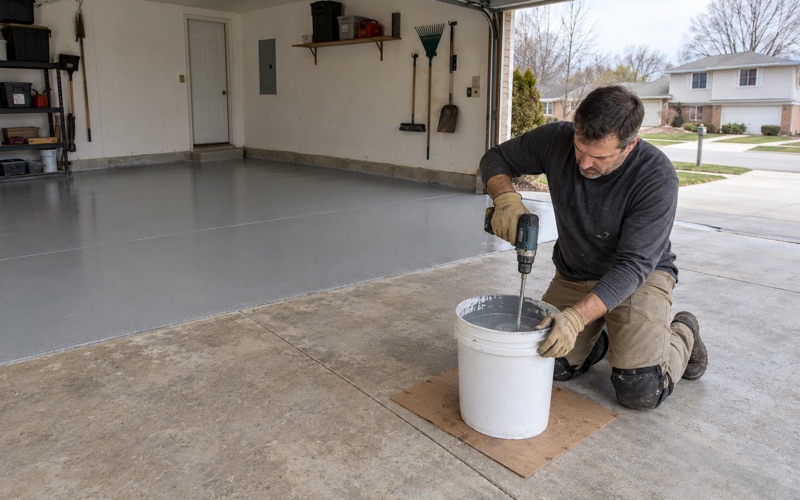
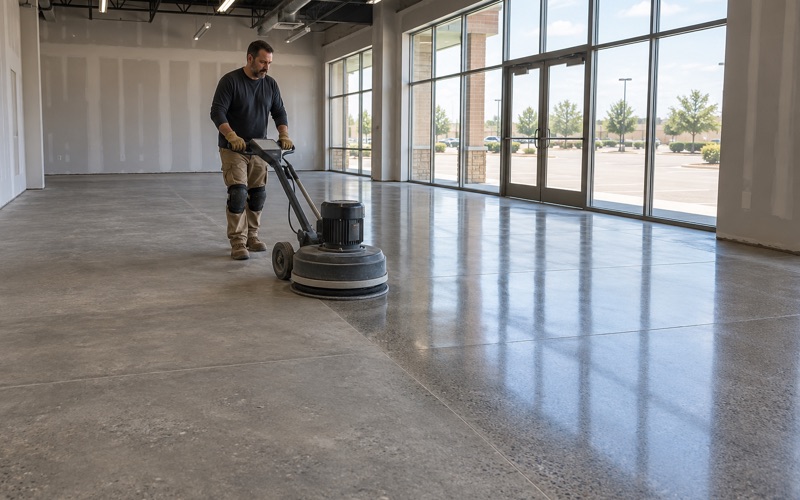
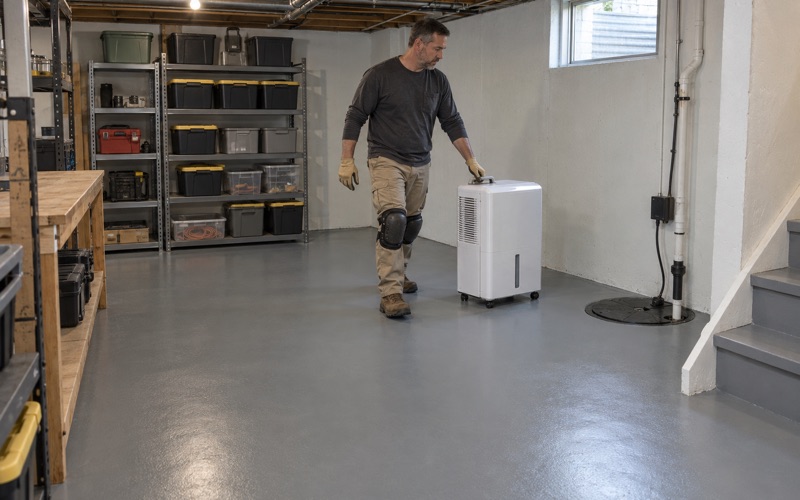
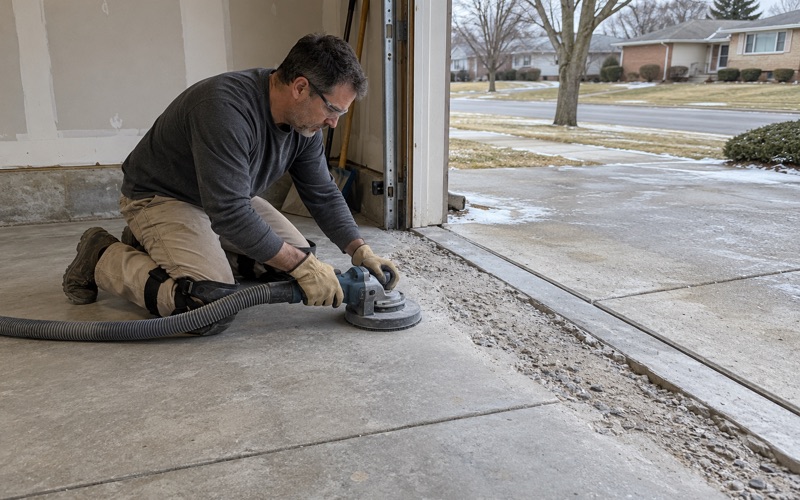
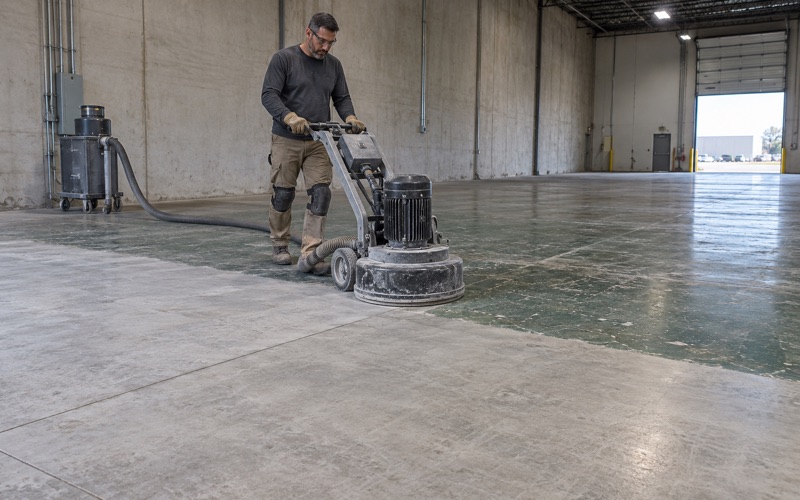
Every slab is opened with a diamond grinder or a shot blaster to a measured ICRI surface profile, never acid etched. On a basement we run an ASTM F2170 in-situ relative humidity probe or an F1869 calcium chloride test as a line item, because a coating that traps vapor under it is the first one to blister.
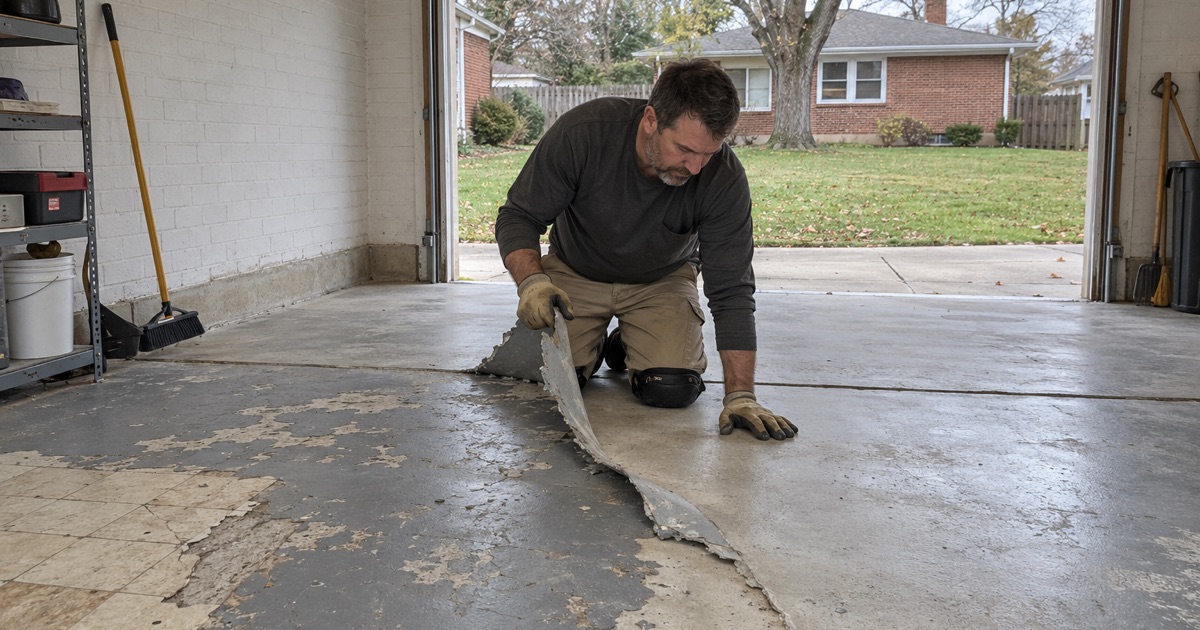
An old garage coating that is peeling at the tire paths, or a basement paint that lifts with a fingernail, comes off completely before anything new goes down. Bonding a fresh system to a failing one only moves the failure up a layer. Removal shows up as its own line on the quote, so a seller can weigh it against the listing date.
Timing against a listing date
Cure time depends on slab temperature and the dew point spread at the surface, not on the calendar. A 100% solids epoxy base with a polyaspartic topcoat can be ready for foot traffic quickly in a heated basement, and an unheated garage in January may simply have to wait. We tell a seller that before the contract is signed, not after the open house has been booked.
Buyer’s Side: 60 Days on a Correction List
The other way through the certificate is the Transfer of Compliance Responsibility. A buyer who signs it acknowledges the sale inspection report and accepts responsibility for correcting the listed violations within 60 days of the notice, unless the Building & Code Department amends that window. The form is signed before a notary, and it carries an agreement to schedule a re-inspection before the deadline.
Where a floor fits in those 60 days
Most new owners want the garage or basement floor done early, before boxes and cars move in. That instinct is right, but the floor goes after the correction list, not around it. If a listed item sits in the room we are coating, the repair and its re-inspection come first, and we schedule the grind for the following week.
We ask buyers to send us the inspection report along with the floor measurements. It lets us see which rooms are clear to start in and which ones are waiting on another trade. On a two-flat, where the list can cover more than one unit, that ordering saves a second mobilization.
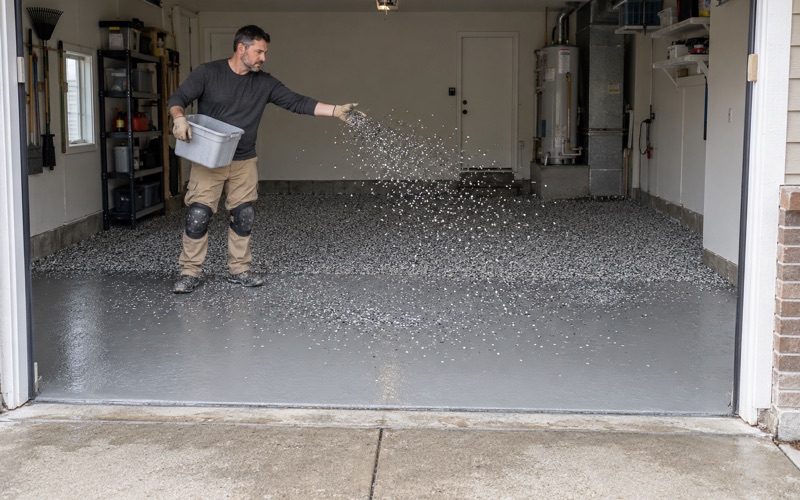
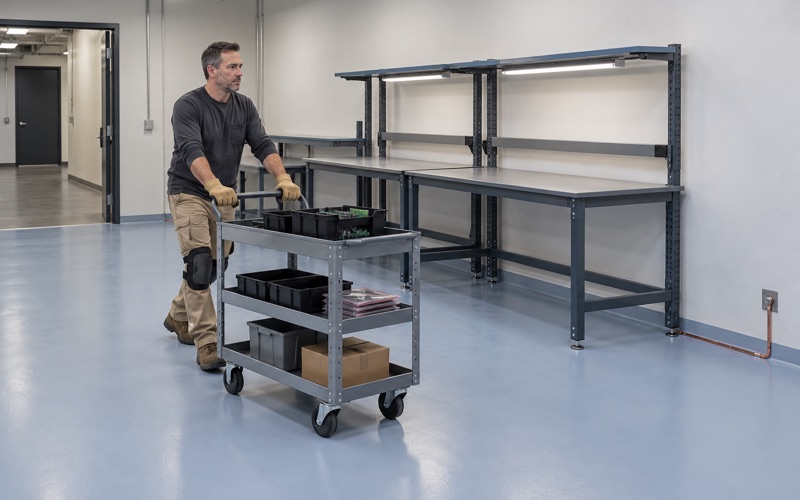
A buyer working inside the 60 days also has a moving truck, a lender and a job to manage. We keep the floor itself to a short, fixed window: grind and repair on the first day, base and broadcast on the second, topcoat once the slab and air conditions allow it. The schedule is written down before we start, so it can be planned around the re-inspection date.
What the form is not
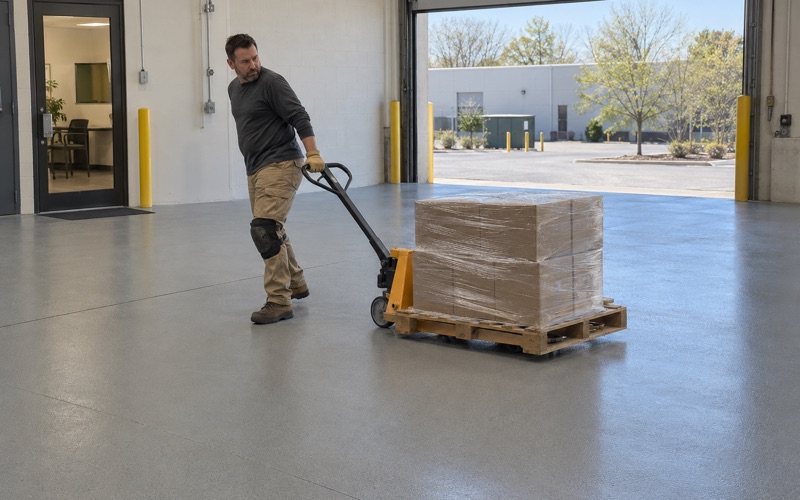
The village is careful to say the transfer form is not an occupancy permit. A new commercial occupancy needs its own occupancy inspection and business license, and a shop floor in a building changing hands follows that track. We price those floors separately, around the hours the building has to keep running.
Paperwork on our side
On a home job the buyer also gets a written contract and the Home Repair: Know Your Consumer Rights pamphlet before we start, as the Illinois Home Repair and Remodeling Act requires. The proposal names the primer, the broadcast, the topcoat and the finished thickness, so a new owner can file it with the closing papers and check later that what was quoted is what went down.
A Coating Hides Nothing
The village says it outright: undetected violations are not excused. A problem the inspector did not see on the day of the sale inspection is still a problem, and the owner is still responsible for it. That one line is why we treat every pre-sale floor as a floor first and a cosmetic job second.
What we will not do
We do not coat over an active crack, standing water or a damaged slab to get a house through a sale. If someone asks us to, we decline and explain why. A film of epoxy over a moving crack telegraphs through within a season, and a basement slab pushing moisture will lift the finish whether the house sold or not.
When a slab needs repair or replacement before it can be coated, the quote says so in writing. Warranty exclusions are read out before the job is sold, and moisture is the first one we name. A buyer who inherits our floor should be able to read exactly what we promised and what we did not.
Cracks are routed and filled, and control joints get a semi-rigid polyurea filler that can move with the slab rather than a coating bridged straight across them. On a basement that shows efflorescence or a damp moisture test, the system starts with a moisture-mitigation primer, or the quote says the floor should not be coated yet. Either answer is written down where the next owner can find it.
What a sound floor still earns
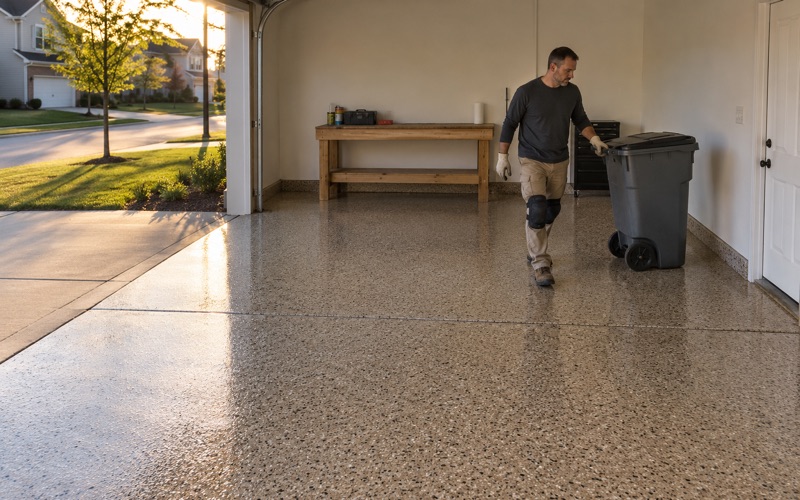
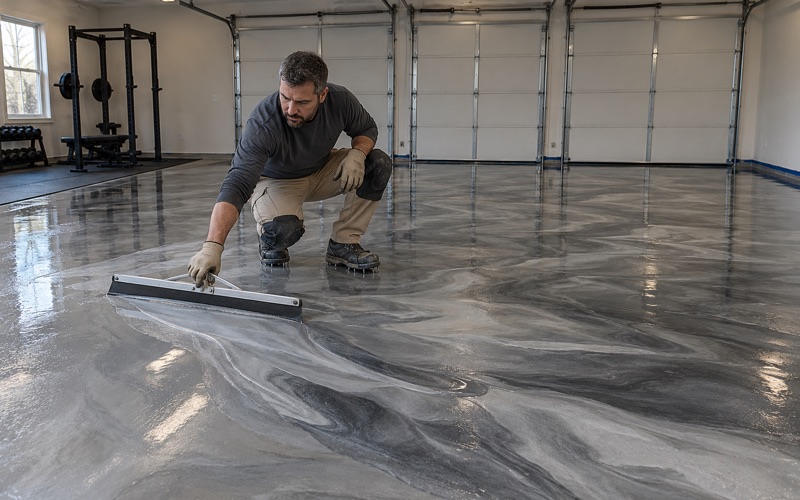
None of this means a seller should skip the floor. A clean, ground and coated garage with a vinyl flake or quartz broadcast is easier to keep, stands up to the calcium chloride and rock salt cars carry in all winter, and shows a buyer a slab that has been looked after. The point is that it is the last step, done on concrete that is ready for it.
Grinding dust is collected at the machine and never washed toward a floor drain, which matters in a house about to be shown. And we stay inside the Illinois limit on VOC content for every coating we put down, a rule that binds the installer as well as the manufacturer.
- 20+ Years Coating Concrete
- Moisture Testing in Every Scope
- Free Written Estimates