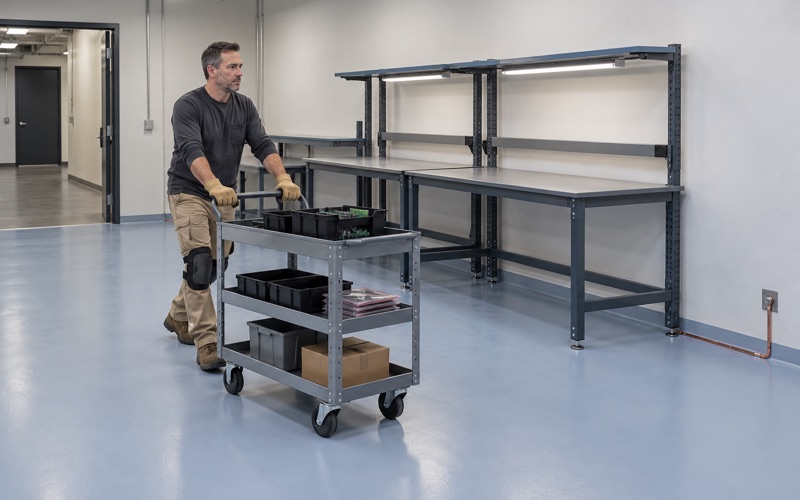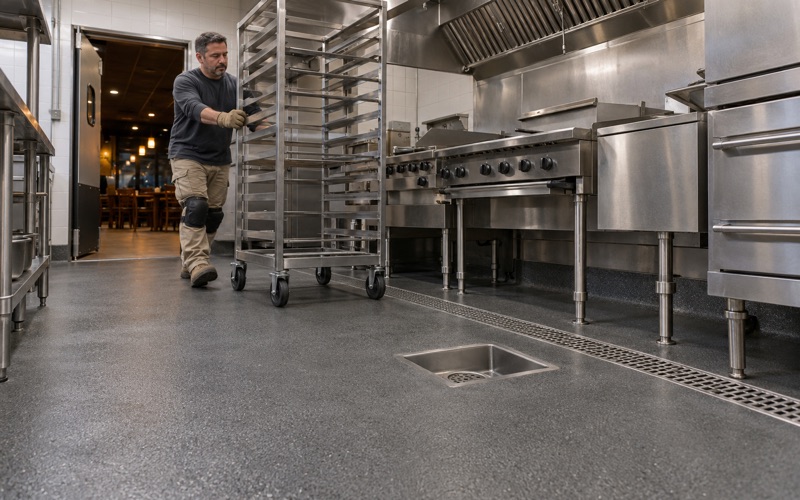
Bolingbrook Epoxy Flooring has spent more than 20 years on epoxy flooring in La Grange and across the western suburbs, and the jobs that teach the most are the ones where the floor has a measurable job to do. A garage floor has to shed salt brine and hot tires. A static-control floor has to carry charge to ground at a resistance someone will check with a meter, and it either passes or it does not.
That difference shapes how we quote. Before a number goes on paper, we walk the slab, read its cracks and joints, look at any coating already on it, and say plainly if the concrete needs repair or replacement first. The proposal then names the product, the system build and the finished thickness, so the floor that goes down can be checked against the floor that was sold.
The same discipline covers a detached-house basement, a downtown storefront and a light-industrial room where people handle circuit boards. What changes from one to the next is the specification, and on an electronics floor the specification is written in ohms.
An Electronics Plant on Hillgrove Avenue
Most people think of La Grange as a village of older houses and a busy downtown, and most of it is. It also holds a manufacturer. Grayhill keeps its corporate headquarters and manufacturing plant at 561 West Hillgrove Avenue, an address that sits inside the village limits in Lyons Township.
A major employer, not a back office
The village’s FY2022-23 financial report ranks Grayhill as its third-largest employer, with 581 people, behind only the hospital and Lyons Township High School. The company was founded in 1943 and designs and builds rotary switches, encoders, keypads, joysticks and pushbuttons. Grayhill does not say which of those lines are made at the La Grange plant, so the fair description is a plant that produces electronic components.
We have no relationship with Grayhill and have never seen the floors inside that building. We bring it up because it marks the kind of work that exists along Hillgrove Avenue and the West End light-manufacturing belt beside the BNSF tracks: rooms where small parts, assemblies and boards are handled by hand every shift.
What the rest of the belt looks like
The shops and small plants along Hillgrove and the West End are mostly older industrial slabs, poured long before anyone specified a floor by its resistance. Many carry layers of paint, sealer or worn epoxy from earlier tenants. Any of those films can sit between a new static-control system and the concrete, so the old coating comes off completely before we build anything conductive on top.
We also look hard at how the room is actually used. A packing area, a test bench row and a parts cage may share one floor but need different readings, and a single quote that treats the whole space alike usually means one of those areas ends up out of range.
Checking the address before the permit
One wrinkle is worth knowing. Grayhill also runs a plant on Vernon Avenue that carries the same 60525 ZIP code, but that building is in McCook, not La Grange. A commercial address with a La Grange mailing line still needs its municipality confirmed before anyone assumes which village issues the permit.
Inside La Grange, the Village of La Grange issues its own building permits. Illinois has no state license for flooring or coating contractors, so we confirm the village’s registration, bond and insurance requirements before a job goes on the calendar.
Looking for epoxy-flooring closer to Palos Hills? See Palos Hills Epoxy-Flooring.
The Floor as Part of the Grounding Path
In an electronics handling area, static control is a program rather than a product. The industry standard for that program is ANSI/ESD S20.20, and it treats the floor as one link in a chain that runs from a person’s body, through their footwear, into the floor and on to ground. A floor that cannot pass charge breaks the chain no matter how good the wrist straps and mats are.
Why color and gloss tell you nothing
A static-control epoxy can look exactly like a decorative one. The conductive fillers and carbon fibers that do the work are mixed through the resin or laid in a conductive primer underneath, and none of that shows at the surface. Two floors with the same gray finish can sit orders of magnitude apart in resistance.
That is why we write the floor into the scope by its resistance range, not by its appearance. A buyer who asks for an ESD floor should get a proposal that names the target range, the system that reaches it, and how it will be measured when the work is done.
Conductive or dissipative
ANSI/ESD S20.20 requires floors in electronics handling spaces to measure below 1.0 x 10^9 ohms. Within that ceiling there are two classes. A conductive floor measures at or below 1.0 x 10^6 ohms, and a dissipative floor sits above 1.0 x 10^6 and below 1.0 x 10^9 ohms.
Which class a room needs depends on what is handled there and on the facility’s own static-control plan, which is the owner’s document, not ours. We build to the range the plan specifies. When the plan has not been written yet, we say so rather than guessing at a number.
Building the system to reach the range
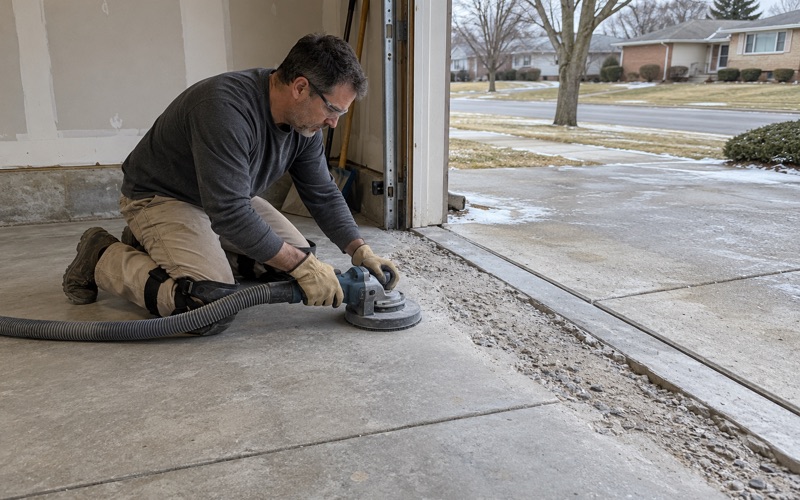
A static-dissipative system usually starts with a slab opened by diamond grinding or shot blasting to a profile the primer can grip, then a conductive primer, copper grounding strips tied to building ground, and a dissipative 100% solids epoxy body coat. We never acid etch, on this floor or any other. Every layer in that stack affects the final reading, so the system build is named in the proposal and not swapped on site.
Cracks and control joints need their own plan. A joint filled with an insulating material leaves a strip across the room that will not pass charge, so we fill joints with a semi-rigid polyurea joint filler and carry the conductive layers over them. Where a crack is moving or the slab is breaking up, we say so and recommend repair before any coating goes down.
Testing the Floor With the People on It
A floor can pass a resistance test on its own and still fail the people standing on it. That is the reason the standard does not stop at the floor.
Point-to-point and point-to-ground
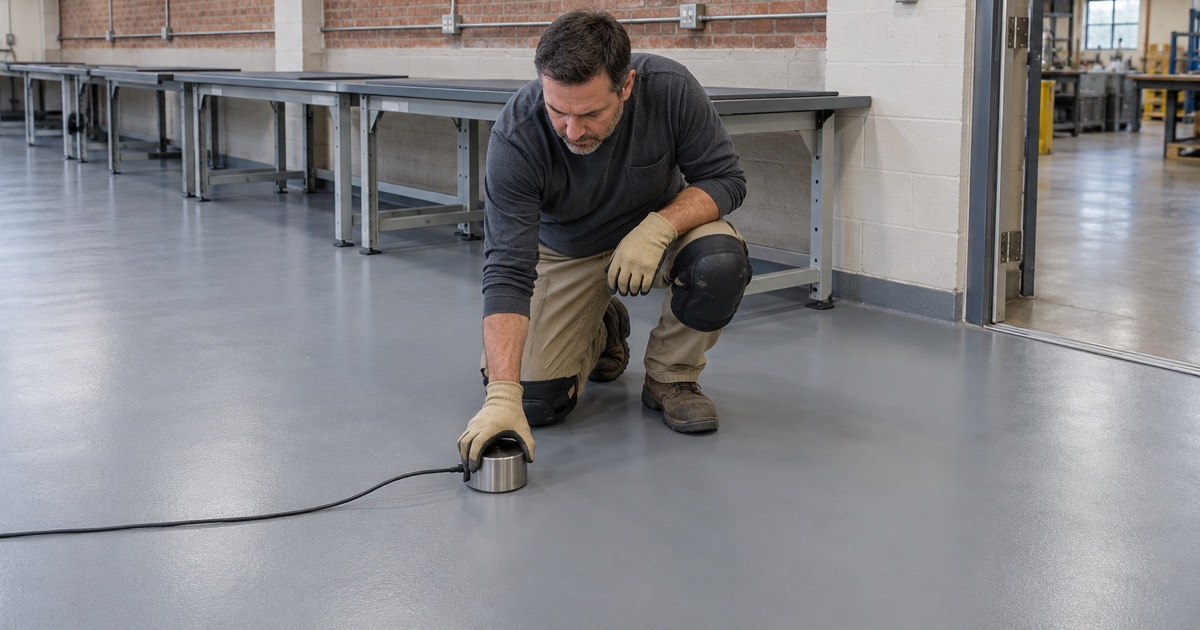
At acceptance, the bare floor is tested with a resistance meter and weighted electrodes, both from point to point across the surface and from the surface to the ground connection. We take readings at multiple spots across each room, including near seams, corners and the ends of the copper strips, because one dead zone undoes the rest.
Slab moisture and room humidity can move those readings. Before the coating goes down, moisture testing is a line item in our scope, using ASTM F2170 in-situ relative humidity probes or ASTM F1869 calcium chloride testing depending on the slab. A floor tested on a damp day and again in a dry winter should still sit inside its range.
We record each reading against a marked location on a floor plan and hand that sheet over with the job. It gives the facility a baseline, and later readings mean far more when they can be compared spot for spot with the day the floor was accepted.
The footwear-plus-floor system
ANSI/ESD STM97.1 measures the whole path: a person wearing their actual footwear, standing on the floor, with the system resistance required to stay below 1.0 x 10^9 ohms. That test is what tells a plant whether its shoes, heel grounders and new floor work together.
We describe that standard to clients and plan for the test, but we do not certify results or claim compliance on anyone’s behalf. Verification belongs to the facility’s own static-control program and whoever it appoints to run the measurements.
Scheduling around a working plant
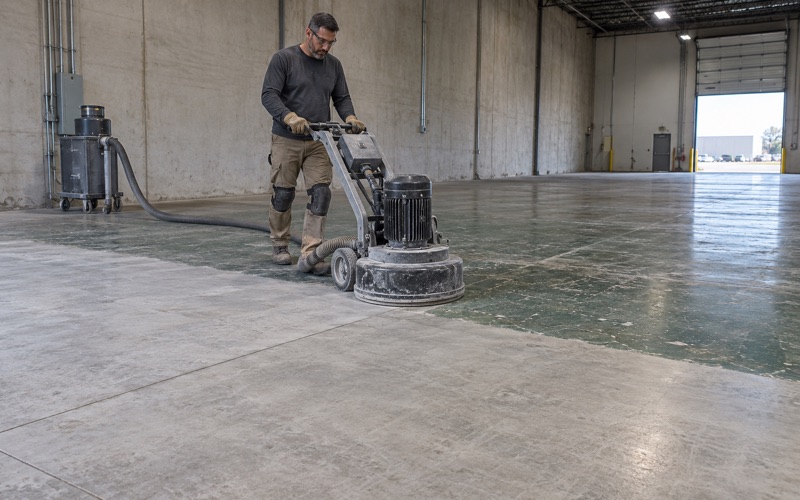
Electronics rooms rarely sit empty for long. We plan the work in phases and zones, often across overnight and weekend windows, so a production area can keep running while one section at a time is ground, coated and cured. Grinding dust is collected at the machine and never washed toward a floor drain.
Keeping the Resistance Through Cleaning and Recoats
A static-control floor that tests well on day one can drift out of range within a year. Most of that drift comes from what gets put on the surface after we leave.
Cleaners and floor finishes
Ordinary floor waxes and many general-purpose cleaners leave an insulating film. Over time that residue raises the surface resistance, and a dissipative floor creeps toward or past the 1.0 x 10^9 ohm ceiling. We hand over the coating manufacturer’s cleaning guidance with the job and recommend periodic readings so a change shows up in the data before it shows up as a damaged part.
Recoating without breaking the chain
When a static-control floor wears through, the recoat has to match the original system. Putting a standard clear topcoat over a dissipative floor can insulate it completely, even though it looks like routine maintenance.
We mechanically prepare the worn surface, confirm the existing ground connections still read, and apply a compatible dissipative coat. The floor is retested afterward, point to ground and with footwear, before the room goes back into use.
When a floor stops reading
A floor that drifts out of range is not always a coating failure. We start with the baseline sheet, retest the same spots, and check the ground connections at the copper strips before anyone talks about tearing anything up. A clean, deep scrub with the right cleaner often brings a contaminated floor back inside its range on its own.
If the readings stay high after cleaning, the cause is usually wear through the dissipative layer or a later topcoat that should not be there. Either way, the fix is scoped by area and quoted per square foot for the system actually needed, rather than as a whole-room replacement by default.
Coatings that meet Illinois rules
Every product we use is selected within the Illinois limit on VOC content for architectural coatings, which binds the installer as well as the manufacturer. Cure schedules follow slab temperature and the dew point spread at the surface, not the date on a calendar. On a floor that has to read in ohms, an amine blush from a cold, humid cure is more than a cosmetic problem, so we wait for the conditions rather than coat into them.
- 20+ Years Coating Concrete
- Moisture Testing in Every Scope
- Free Written Estimates