Bolingbrook Epoxy Flooring has handled epoxy flooring in Hinsdale and the surrounding suburbs for more than 20 years, and the lesson this village teaches is that the calendar decides a floor as often as the traffic does. Schools, offices and shared buildings here do not close whenever a contractor would like them to. The work is bid, slotted into a fixed window and finished before people walk back in.
That makes the schedule part of the specification. A coating that needs a week of mild weather before it can take a cart is the wrong answer for a building that reopens on a set date, however well it might wear afterward. Our proposals name the product, the system build and the finished thickness, so whoever signs off can hold what was quoted against what went down.
Homeowners get the same discipline on a smaller scale. A garage or basement floor is still a sequence of opening the slab, testing it, priming, building the system and letting it cure, and every step either fits the time available or pushes the rest of the job back.
A $140 Million Renovation, Bid One Trade at a Time
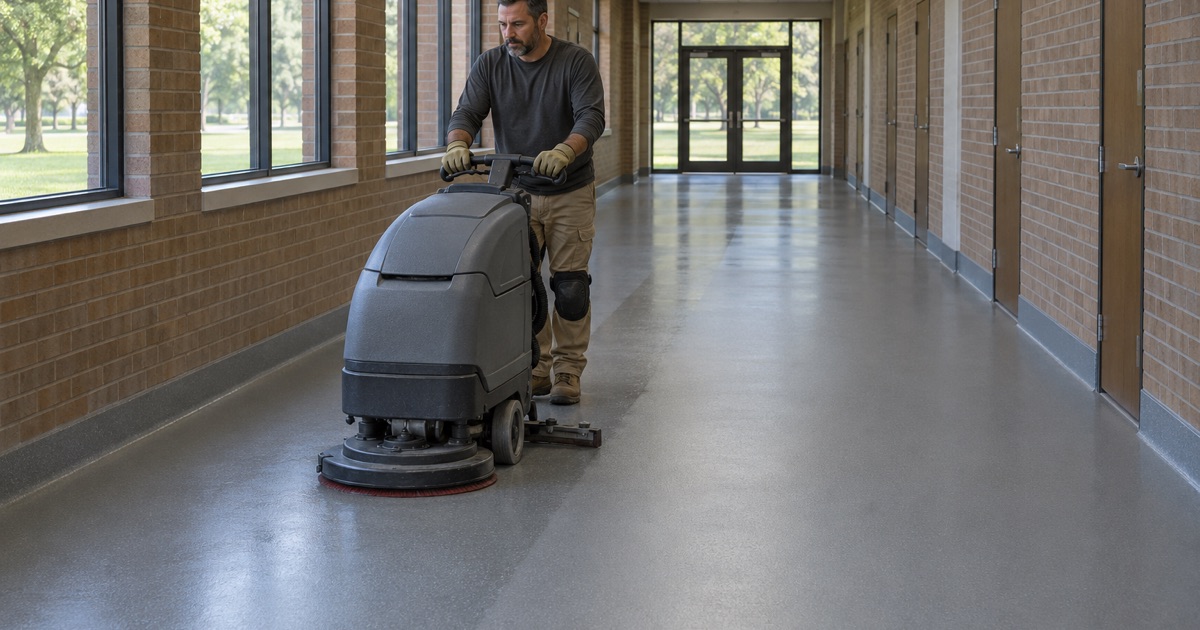
The clearest local example of how institutional floors get bought is Hinsdale Central High School at 5500 S. Grant Street. Hinsdale Township High School District 86 put two earlier upgrade measures for Central and South before voters, and both failed. The third, a $140 million referendum, passed in April 2019, and the district then let the renovation of its 1950 building in pieces rather than as one contract.
Nearly 100 bids in nine phases
By the time the board reached the last package in November 2022, it had awarded almost 100 bids across nine phases. Earlier phases took in the cafeteria, pool work and athletic facilities. The final phase covered most of the work to renovate and upgrade 89 classrooms at Hinsdale Central the following summer, split into separate trades that each had to be priced, awarded and scheduled.
Flooring as its own line item
In that final package, flooring was bid at $519,000 and painting and coating at $168,240, as two separate lines beside electrical, drywall, masonry, acoustical ceiling, demolition and general trades. The bids came to $6.3 million against a $5.9 million budget, and the fire suppression and HVAC bids were rejected so those trades could be rebid. The coverage we read does not say which flooring material was bid, and we had no part in the project. We cite it because it shows plainly how a public floor is purchased.
What a line item asks of a floor
When a floor is its own line, it is written to a specification and priced against a budget that a board is free to reject. Vague scope does not survive that. We price per square foot for the system we are actually proposing, not from a national figure for an average garage, because a number that cannot be traced back to a build is a number nobody can approve.
A specification also protects the person paying. If the line says a primer, a broadcast coat and a topcoat at a stated thickness, anyone can walk the room afterward and ask whether that is what was installed. The same proposal that wins the job becomes the checklist for closing it out, which is exactly how a facilities manager or a board member would want to read it.
Looking for epoxy-flooring closer to Shorewood? See Epoxy-Flooring Services in Shorewood.
One Summer, Cure Time and the Other Trades
A school renovation has a hard stop: the first day of classes. Everything between the last bell of spring and the first one in late summer has to happen in that order, in those rooms, and the floor is rarely the first trade or the last.
The window is fixed; the cure is not
Coatings cure on chemistry, not on the calendar. We schedule cure against the slab’s temperature and the dew point spread at its surface, because a humid stretch can leave amine blush on a 100% solids epoxy coat and spoil the bond of the coat that follows.
Where return-to-service is tight, a polyaspartic or polyurea topcoat shortens the wait between coats and before traffic. Where it is not, a thicker epoxy build may give better value. The decision is made from the schedule backward, not from a catalog forward.
Sequencing with demolition, ceilings and paint
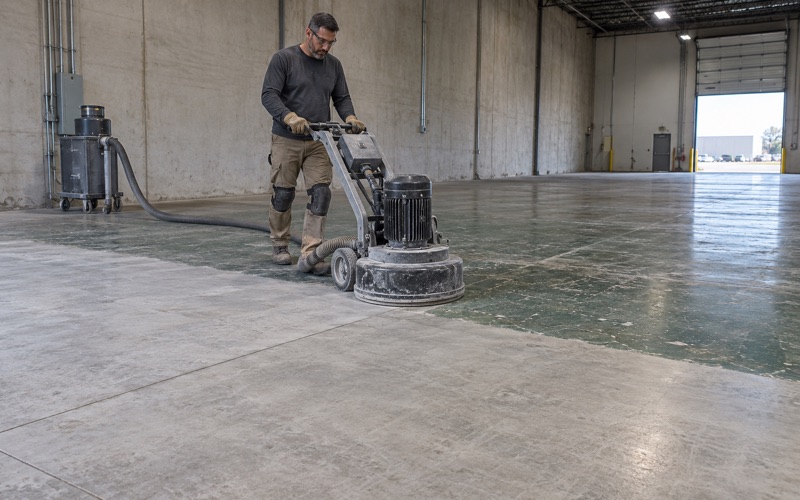
In a classroom renovation the floor shares the room with demolition, electrical, drywall, acoustical ceilings and paint. A coating applied too early gets scaffolding wheels, ceiling grid offcuts and paint drips; one applied too late runs into furniture delivery. We plan the grind and the coats to land after the dusty trades and before anything heavy rolls in. Grinding dust is captured at the grinder by vacuum and never rinsed toward a floor drain, which matters in a building where other crews are working down the hall.
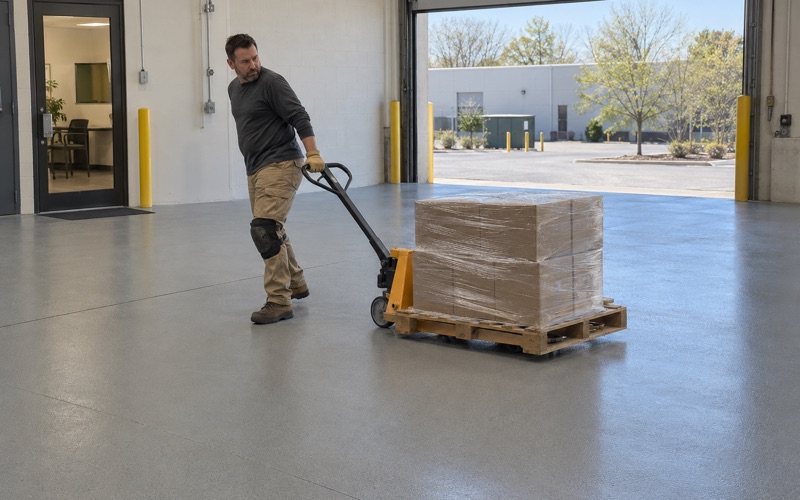
A finished floor still needs protecting while the last trades finish around it. We agree in advance when the room can be closed, how long it stays closed and what can roll across it on day one, day three and day seven. Those dates go to the general contractor in writing, so nobody has to guess whether a pallet jack is allowed in yet.
Moisture is tested before the schedule is set
A slab poured under a 1950 building may have no vapor retarder beneath it at all, and an old floor covering can hide what the concrete underneath is doing. Moisture testing is written into our scope as a line item, using ASTM F2170 in-situ relative humidity probes or ASTM F1869 calcium chloride tests, rather than sold after a coating has already blistered. Testing takes days, so it belongs at the front of a summer window, not the middle. If readings come back high, a moisture-mitigation primer goes into the build and into the price before work begins.
Opening the slab correctly
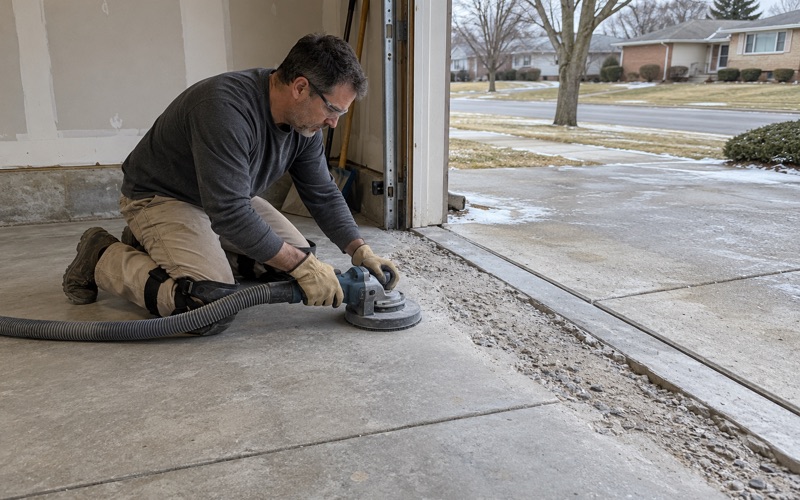
Every slab is opened mechanically with a diamond grinder or shot blaster to the ICRI CSP surface profile the manufacturer specifies for the system. We do not acid etch. On an old floor we also read the cracks, joints and any previous coating before we quote, and if a section needs repair or replacement before it can be coated, we say so in writing.
Cafeterias, Pool Areas and Athletic Floors
The earlier phases at Hinsdale Central are a reminder that a single campus holds very different floors. A cafeteria, a pool deck and a weight room each fail in their own way, and a system that suits one can be a liability in the next.
Food service floors
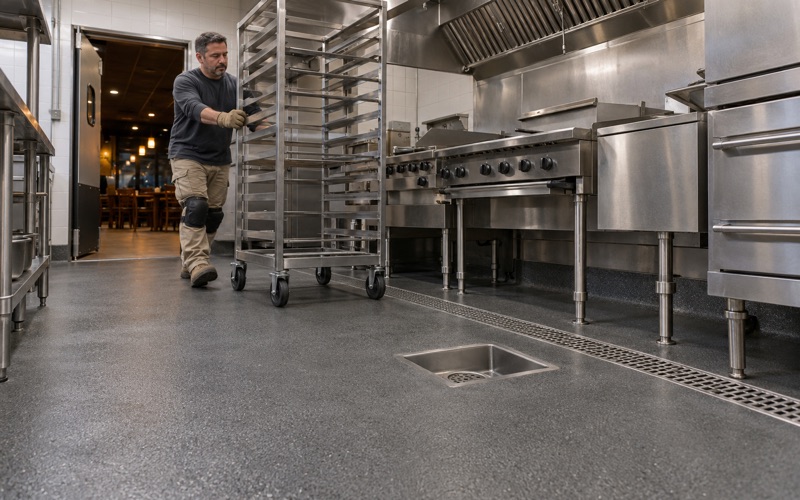
A commercial kitchen or serving line has to meet the FDA Food Code. Section 6-201.11 calls for smooth, durable, nonabsorbent, easily cleaned floors, with an exception for antislip surfaces, and 6-201.13 calls for coved floor-and-wall junctures where water-flushing is used. Urethane cement is often the right base in hot, wet kitchens because it tolerates thermal shock that would crack a thin epoxy. We build the cove into the system rather than treating it as trim, and we schedule kitchen work around the hours the operation has to keep running.
Wet decks and locker rooms
The Central pool was scaled back to six 25-yard lanes for the third referendum, which passed, and the board later favored a larger pool. Whatever the size, the floors around a pool and in its locker rooms are wet most of the day. Slip resistance comes from a quartz aggregate broadcast sized to the area, and the topcoat has to hold that texture without becoming impossible to clean. Drains, curbs and the edges where the deck meets a wall are where water sits longest, so we detail those first and broadcast the open floor last.
Weight room and storage floors
Weight rooms, equipment storage and service corridors take point loads, dropped plates and steel casters rather than water. There, the build is about thickness and impact resistance, and joints get a semi-rigid polyurea filler so a moving slab does not crack the coating along every control joint.
What That Discipline Means for a Hinsdale Floor
Most of Hinsdale is owner-occupied homes. Census figures put owner occupancy at 89.9 percent, and only 280 detached houses are rented, so most of our work here is a family’s own garage or basement rather than a public building. The habits a school project forces are the ones we bring to a house anyway.
Garages and basements
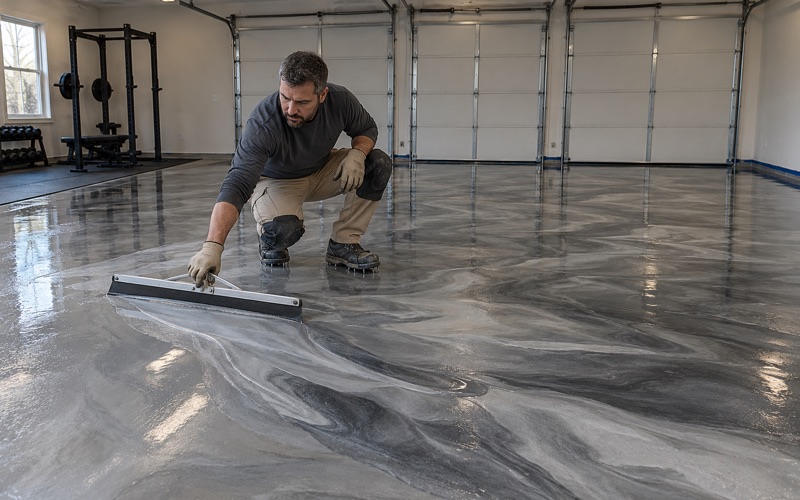
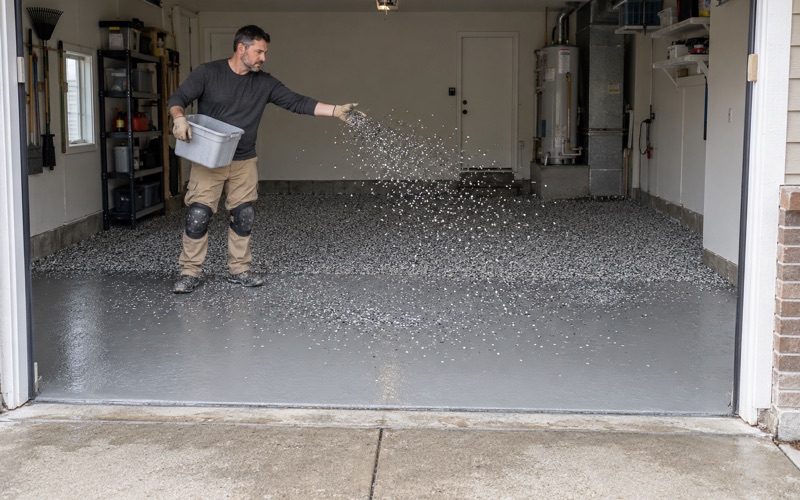
A garage floor usually gets a 100% solids epoxy base with a vinyl flake broadcast and a polyaspartic topcoat, built thick enough to resist hot tire pickup when a car parks straight off the road. A basement is a different problem: hydrostatic pressure under the slab can push moisture up through it, and white efflorescence on bare concrete is often the first visible sign. A quick ASTM D4263 plastic sheet test can flag a problem, but we rely on proper probe or calcium chloride readings before we commit to a system.
Paperwork before the first grind
Illinois issues no state license for flooring or coating work, so we check the Village of Hinsdale Community Development requirements for each job before it goes on the calendar; most residential and commercial projects there take a combination permit when a permit is needed. Every home job gets a written contract and the Home Repair: Know Your Consumer Rights pamphlet before work starts, as the Illinois Home Repair and Remodeling Act requires.
Warranty terms read out loud
Warranty exclusions are explained before anything is sold, and moisture is named first, because it is the most common reason a coating lets go. We also do not sell a floor coating as radon reduction. In Illinois that work takes a radon mitigation license from IEMA, and a coating is not a mitigation system.
Compliant products and honest scheduling
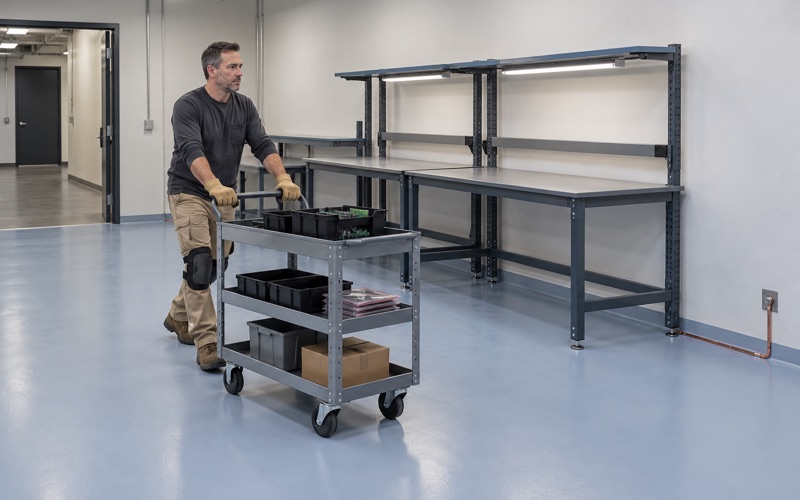
The coatings we propose sit within the Illinois VOC limits for architectural coatings, which bind the installer as well as the manufacturer. If an unheated garage is too cold for a proper cure, we say so and book it for spring rather than coating a slab that cannot cure. For offices, shops and other buildings that have to stay open, we work in overnight and weekend sections so the floor is finished without the building ever closing.
- 20+ Years Coating Concrete
- Moisture Testing in Every Scope
- Free Written Estimates