Bolingbrook Epoxy Flooring brings more than 20 years of slab work to epoxy-flooring in Hickory Hills, and the floors we are asked about most often here are working floors that get scrubbed hard. When a room is wiped down with disinfectant several times a day, the coating has to be chosen for chemistry first. Gloss and color come after that, and traffic comes after that.
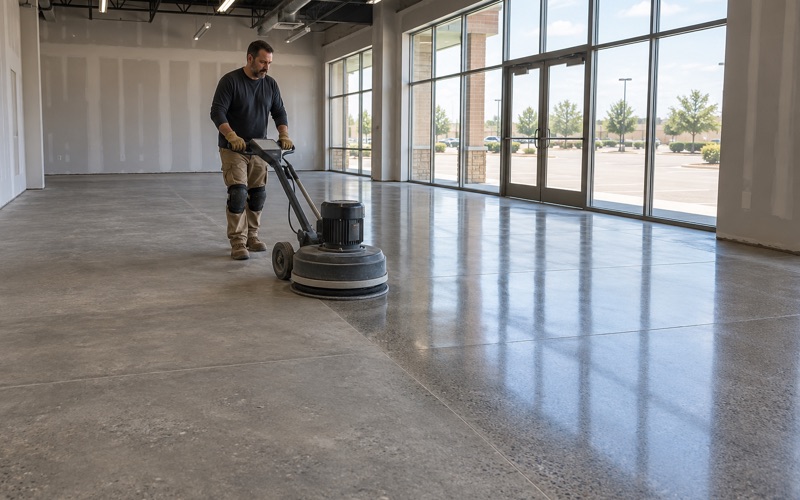
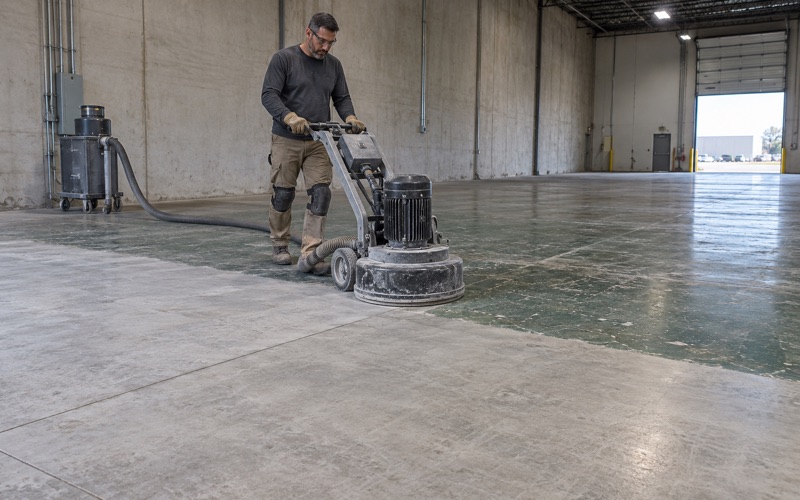
Our process does not change because the room is small. Every slab is opened with a diamond grinder or a shot blaster to a measured ICRI CSP profile, never acid etched, and the slab is moisture tested as a line item in the scope rather than as an afterthought. The proposal then names the product, the system build and the finished thickness, so an owner can hold the finished floor up against the quote.
We also read the cracks, the joints and any old coating before we price anything. If a slab needs repair or replacement before it can carry a coating, we say so in plain terms. Warranty exclusions are read out before the job is sold, and moisture is the first exclusion on the list.
A Hemodialysis Clinic on Roberts Road
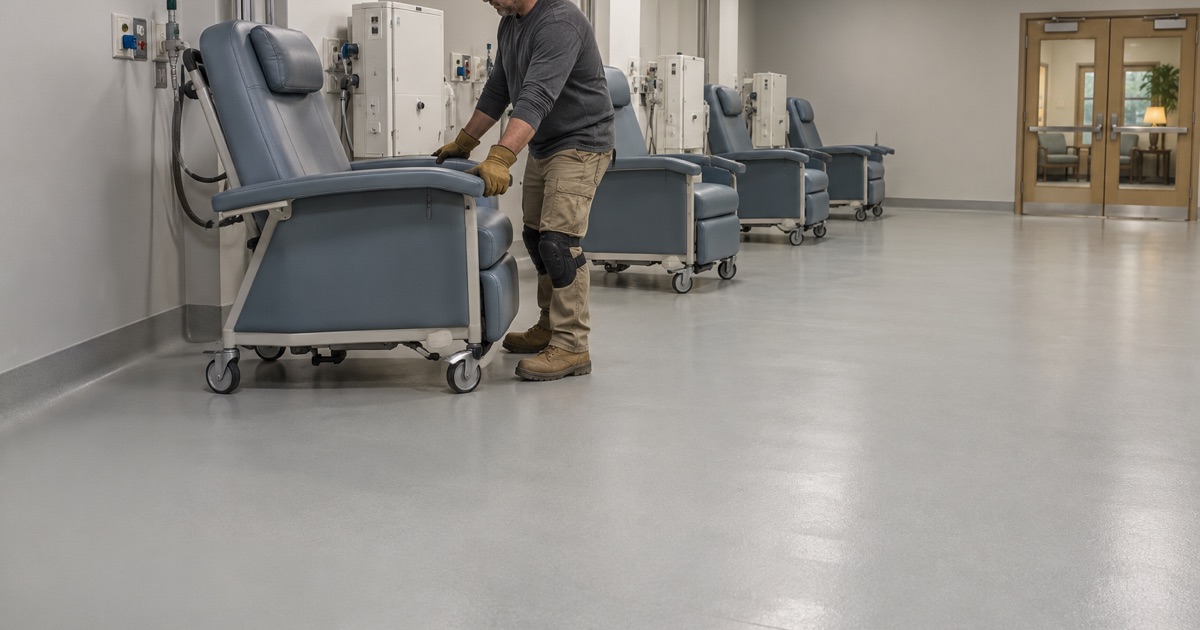
The clearest example of a disinfectant floor in town sits on Roberts Road. U.S. Renal Care lists an in-center hemodialysis clinic at 9640 S. Roberts Road, Suite B-3A, and that address geocodes inside Hickory Hills city limits, in Palos Township in Cook County. We have not seen that clinic’s floors and we are not describing them; the clinic is simply the best local picture of what this kind of room asks of a slab.
What a treatment floor is for
In-center hemodialysis means patients come in on a schedule and sit through treatment in shifts. Between those shifts the chairs, the machines and the floor around them are wiped down with hospital disinfectants, and bleach solutions are a common choice. A floor in that room is cleaned more often in a week than most garage floors are cleaned in a year.
That changes what the coating is being bought for. Foot traffic in a treatment room is light and rolling loads are modest, so abrasion is rarely what wears a floor out. What wears it out is chemistry: repeated oxidizers, standing cleaning solution, and the occasional spill that has to be lifted completely.
Why the question is resistance, not looks
A decorative flake floor that looks right on day one can dull, yellow or soften at the surface after months of bleach. So when we scope a clinical or clinical-style room, the first conversation is about which chemicals touch the floor, how strong they are mixed and how long they sit. We ask the owner or the facility manager for the cleaning products in use and build the system around those, rather than around a sample board.
Hickory Hills is a Cook County suburb of Chicago that counted 14,505 residents in 2020, and many of its clinical and office floors sit in modest suites. That scale suits this kind of room. A treatment space or exam suite is small enough to grind, cove and coat as one continuous system with no seams left in the field of the floor.
Looking for epoxy-flooring closer to North Aurora? See Epoxy-Flooring Services in North Aurora.
Bleach Every Shift, and Spills That Must Come Up
Sodium hypochlorite is an oxidizer, and an oxidizer works on a coating the same way it works on everything else it touches. A standard aromatic epoxy holds up to it better than paint does, but its top surface can chalk, stain or shift in color with long exposure. That is why the body coat and the wearing surface are often two different materials on a disinfected floor.
Choosing the wearing surface
A 100% solids epoxy body coat gives the floor build and bond to the ground concrete. Over it, a polyaspartic or polyurea topcoat, or a chemical-resistant urethane, carries the daily exposure and holds its color under light better than epoxy alone. Where a room sees heavier chemical and wet exposure, urethane cement is a stronger choice for the full system, and it tolerates water and cleaning far better than a thin film does.
We will not call any of these bleach-resistant without qualification. Resistance ratings depend on concentration and dwell time, and a product that shrugs off a quick wipe can still mark if a puddle of strong solution sits overnight. The proposal states the product data we are relying on, so the claim can be checked.
Bond is part of chemical resistance
A topcoat only resists what reaches it from above. If the base coat was laid on a slab that was never properly opened, cleaning solution finds the weak edge, creeps underneath and lifts the film in sheets. That is why we grind to profile on every clinical job, vacuum the slab clean and check the bond before the next coat goes on.
Blood and dialysate
A treatment floor also has to take blood and dialysate spills, and both have to come up completely, not mostly. Dialysis concentrates include acid and bicarbonate solutions, and spilled solution dries to a residue that can etch or cloud a soft topcoat if it is left. The defense is a tight, nonporous surface with no open texture for liquid to settle into.
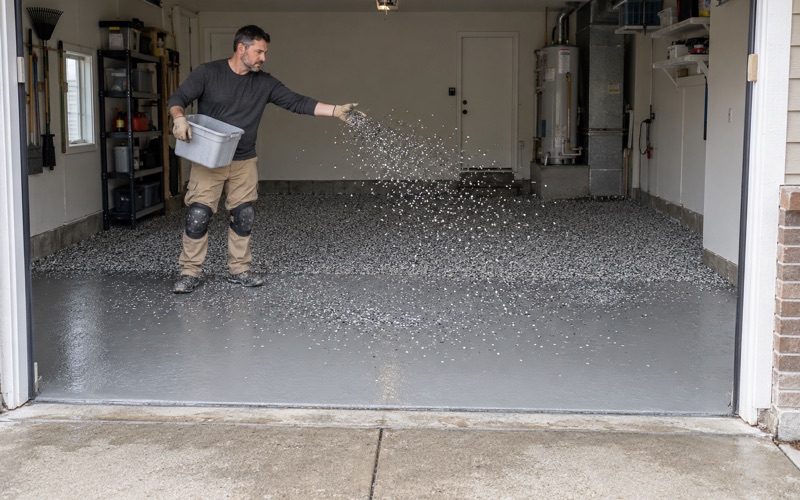
That is the reason we keep broadcast texture modest on a clinical floor. A heavy quartz aggregate broadcast grips well but holds residue in its peaks and valleys, while a fine texture under the topcoat gives some traction and still wipes clean. On most clinic floors that is the balance we recommend, and we show the owner both textures before the order is placed.
Seams, Joints and the Wall Base
Disinfectant does not stay in the middle of the room. It runs to the edges, it pools against the wall and it finds every saw cut and crack in the slab. On a cleaned-hard floor, the seams decide whether the floor stays sound.
Coving the wall base
An integral cove base carries the coating up the wall in a continuous curve, so there is no corner where the floor meets vinyl base or drywall. A mop or a wet wipe cannot push liquid under a cove, and nothing collects in the joint behind it. We form the cove with a trowel-grade epoxy or urethane mortar and topcoat it with the floor in one system.
Where a suite already has a rubber or vinyl base glued to the wall, that base is a seam, and seams wick. Removing it and coving the edge is usually part of the scope on a clinical floor.
Joints and cracks
Control joints and cracks are cleaned out and filled before the coating goes down, never simply coated over. For joints that still move, a semi-rigid polyurea joint filler stays flush with the floor and can be shaved and topped. A crack telegraphed through a thin film becomes a line where disinfectant sits and the coating starts to lift.
The water-treatment room
Behind most dialysis treatment floors is a water-treatment room holding the purification equipment for the clinic. Those rooms carry heavy tanks, wet piping, a floor drain and the regular chance of a leak or an overflow. The floor there sees standing water and the chemicals used to disinfect the water loop, so we treat it as a wet room in its own right.
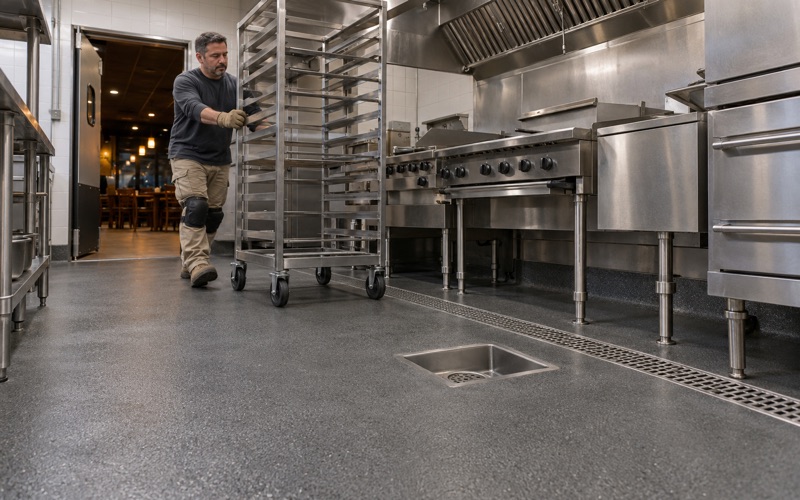
In a room like that we slope the coating to the drain where the slab allows, carry a cove up every wall and plinth, and choose a system that tolerates long immersion. Urethane cement or a heavy-build epoxy with a chemical-resistant topcoat are the usual candidates. Penetrations around pipes and anchors get sealed the same way the wall base does.
Clinic and Office Suites Along Roberts Road
Roberts Road near 95th Street also holds a Lewis University location a few doors from the clinic, and over half the housing in town dates from 1960 through 1979. A slab poured in that era usually predates under-slab vapor retarder practice, and an older suite slab may be no different. We test before we quote, every time.
Testing the slab
Moisture testing on a suite slab can include ASTM F1869 calcium chloride readings, ASTM F2170 in-situ relative humidity probes or a first-pass ASTM D4263 plastic sheet test. The results are compared against the coating maker’s limits before a system is chosen. Where the readings run high, a moisture-mitigation primer goes into the scope as its own line, priced and explained, rather than discovered later when the floor blisters.
Curing is scheduled against slab temperature and the dew point spread at the surface, not the calendar. A suite that is cold over a weekend, or a slab sweating on a humid day, can cause amine blush on fresh epoxy, which leaves a waxy film that weakens the bond of the next coat. We check the room conditions on the day and hold the next coat if they are wrong.
Old coatings get the same scrutiny. A previous tenant’s floor paint or thin epoxy may look sound, but if a scraper lifts it at the edges it comes off entirely before anything new goes down. Coating over a failing film only moves the failure up one layer.
Other floors that get the same treatment
The same chemistry applies to any room in town that gets disinfected on a routine. A veterinary clinic on 95th Street, a dental or physical therapy suite, or a lab space all face cleaners strong enough to mark a weak topcoat. We size the system to the actual cleaning schedule in each room, and we quote it per square foot for that system rather than from a national average.
Grinding dust is captured at the grinder by vacuum and bagged for disposal. None of it is rinsed toward a floor drain or out to a storm inlet, which matters in a working building where the drains still serve the tenant.
Licensing in Hickory Hills
Illinois issues no license for flooring or coating work, so the city license is the one that binds us here. The City of Hickory Hills Building Department requires a contractor license, renewed each calendar year, with a certificate of insurance naming the city as certificate holder. The city asks for no bond, and a copy of that insurance certificate goes to the building owner before we start work.
- 20+ Years Coating Concrete
- Moisture Testing in Every Scope
- Free Written Estimates