
Bolingbrook Epoxy Flooring has been doing concrete grinding for 20+ years in Bolingbrook, IL, serving surrounding cities including Lemont, Warrenville, Burr Ridge, Hinsdale and Shorewood. Grinding is the first step of every coating job we do and a service on its own: removing old coatings, adhesives and sealers, flattening ridges and lips, and opening the surface so the next material can bond.
We grind with diamond tooling and, on large open floors, shot blast. Both are mechanical methods that leave a measurable surface profile. We do not acid etch any slab, because etching leaves a weak layer and pushes water into concrete that is about to be tested for moisture.
Dust is collected at the machine by industrial vacuums and bagged, never washed toward a floor drain or a storm inlet. That matters in occupied buildings, in basements under living space and in garages that open onto a driveway.
Why Surface Preparation Decides the Floor
Coatings Bond to What They Touch
An epoxy, polyaspartic or urethane coating bonds only to the surface it is applied to. If that surface is paint, a sealer, curing compound residue or weak paste, the coating holds only as well as that layer, and it peels with it.
Grinding removes those layers and exposes sound concrete, which is why preparation, not the coating product, decides whether most floors last. Two floors coated with the same product can perform completely differently because of what happened before the first coat.
Surface Profile and the ICRI CSP Scale
The texture left by preparation is measured on the ICRI concrete surface profile scale, which runs from CSP 1, nearly smooth, to CSP 10, very rough. Thin coatings need a fine profile; thick broadcasts, mortars and urethane cement need a coarser one.
We choose the tooling to hit the profile the coating maker specifies, and compare the result against profile chips, rather than grinding until the floor looks rough. A profile that is too coarse wastes material and can show through a thin coating, while one too fine leaves the coating little to grip.
Finding Problems Under the Surface
Grinding often reveals what a walk-through cannot: hollow-sounding delaminated areas, soft concrete, oil soaked deep into the slab and old patches that never bonded. Finding them during preparation lets us repair them before coating rather than after the floor fails.
Grinding Methods and Equipment
Diamond Grinding
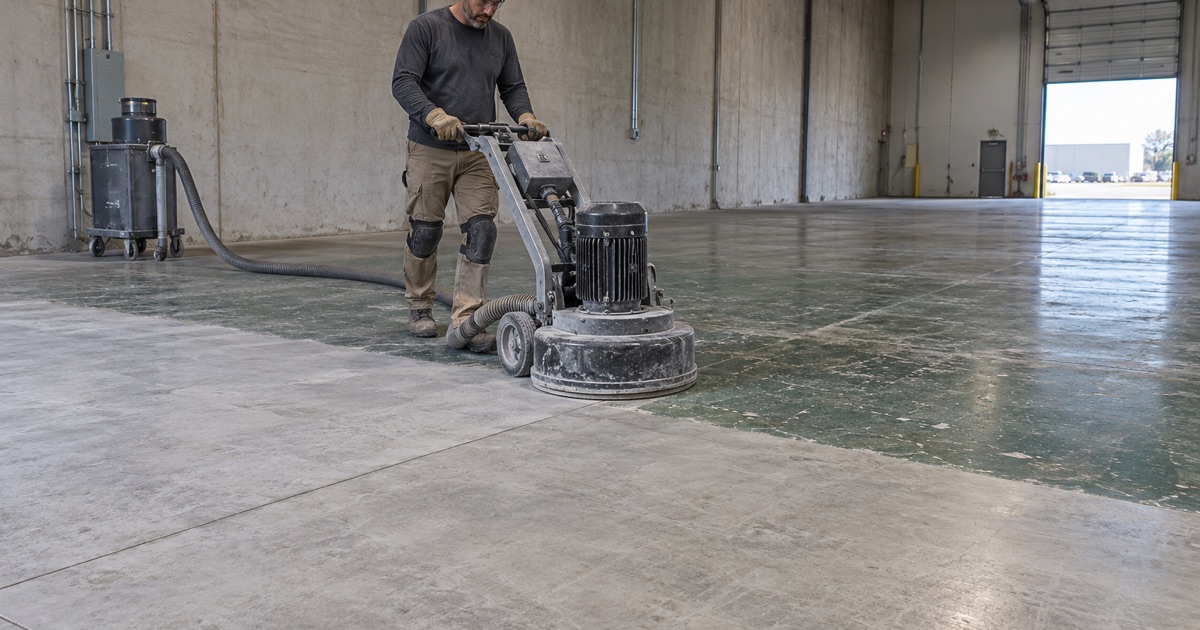
Planetary diamond grinders use rotating heads fitted with metal-bond or resin-bond diamond segments. Coarse metal-bond tooling removes coatings and opens the surface; finer grits refine it for thin coatings or polishing.
Edges, corners and small rooms are ground with smaller handheld and edge grinders, so the profile at the walls matches the middle of the floor. Edges are where coatings most often start to lift, so they get the same attention as the open field.
Shot Blasting
A shot blaster throws steel shot at the slab and recovers it in the same machine, profiling large areas quickly with very little airborne dust. It suits warehouse and commercial floors where a coarser profile is needed for thick systems.
Scarifying and Heavy Removal
Thick coatings, built-up mastics and uneven toppings sometimes need a scarifier, which cuts the surface with rotating cutters. It is aggressive and leaves a rough profile that usually needs grinding or a skim coat before a finished floor goes down.
What We Grind Off
Old Paint, Epoxy and Sealers
Garage floor paint, failing epoxy, store-bought kit coatings and penetrating sealers are the most common removals. Sealers are the hardest to spot, because they leave the floor looking bare while still repelling a new coating.
Carpet Glue, Tile Mastic and Thinset
Basements and commercial spaces often have adhesive residue from old carpet, vinyl or tile. We remove it down to clean concrete so the new floor bonds to the slab, not to the old glue.
Lips, Ridges and Trip Hazards
Raised edges at cracks, joints and patches create trip hazards and show through thin coatings. Grinding takes them down level with the surrounding slab.
Grinding for Different Projects
Before Epoxy and Polyaspartic Coatings
For coating projects, grinding is followed by crack and joint repair and a moisture test, all on the same visit. The proposal includes the preparation as its own line so you can see what goes into it.
Before Polishing
Polished concrete starts with the same grinding but continues through progressively finer diamonds with a densifier applied between steps. The early grinding passes decide how much aggregate shows in the finished floor.
Before Other Flooring
Tile, luxury vinyl and some carpet systems need a flat, clean slab. We grind for other flooring installers, removing old adhesive and high spots so their product goes down on a prepared surface.
We can also grind trip lips and coatings off floors that will stay bare, such as a garage being sold or a shop floor where an old coating is peeling. Removing a failing coating is often better than leaving it to flake, even if nothing new goes down.
After the Grinder Stops
Moisture Testing the Opened Slab
Once the surface is open, the slab is ready for a meaningful moisture test. We use ASTM F1869 calcium chloride kits, which measure vapor emission at the surface, or ASTM F2170 probes set into the slab to read relative humidity, and compare the results with the coating maker’s limits.
A plastic sheet taped to the floor can flag an obvious problem, but a dry sheet proves little, so it never replaces a real test on a floor that will be coated.
Crack and Joint Repair
Grinding opens cracks and exposes worn joint edges, which are repaired next. Cracks are chased and filled, spalls rebuilt and joints filled with a semi-rigid polyurea filler where forklifts or carts cross them.
Vacuuming and Inspection
The floor is vacuumed thoroughly and inspected before any primer goes down. Any remaining sealer, oil or weak spots show up at this stage, and they are ground again rather than coated over.
Dust, Disposal and Occupied Spaces
Dust Collection at the Machine
Every grinder and shot blaster we run is connected to a vacuum that collects dust at the cutting head. The dust is bagged and removed, and we never wash slurry or dust toward a floor drain, a sump or a storm inlet.
Working in Occupied Buildings
In offices, clinics, stores and homes, we seal doorways with plastic, run air scrubbers where needed and schedule the loudest work for hours when the space is empty. Grinding is noisy, so we agree the schedule in advance.
Pricing Grinding Work
Grinding is priced per square foot, with the main variables being what has to come off and the profile required. A bare, clean slab is fast; thick coatings, mastic and heavy leveling take more passes and more tooling, which we show in the quote.
- 20+ Years Coating Concrete
- Moisture Testing in Every Scope
- Free Written Estimates