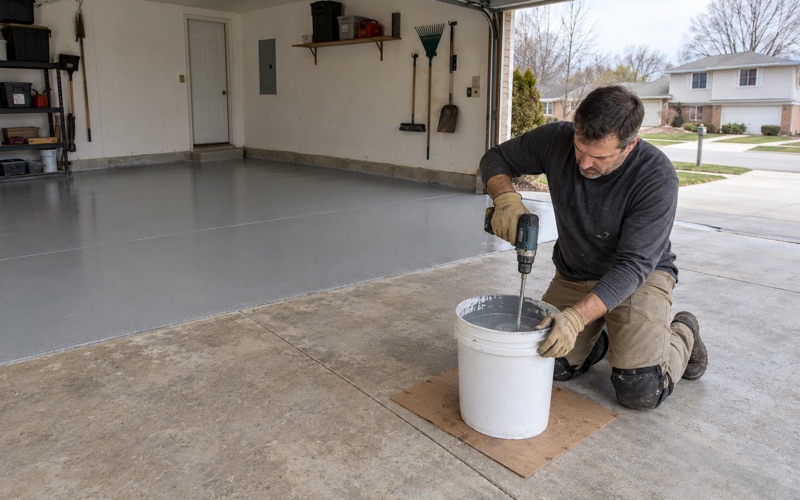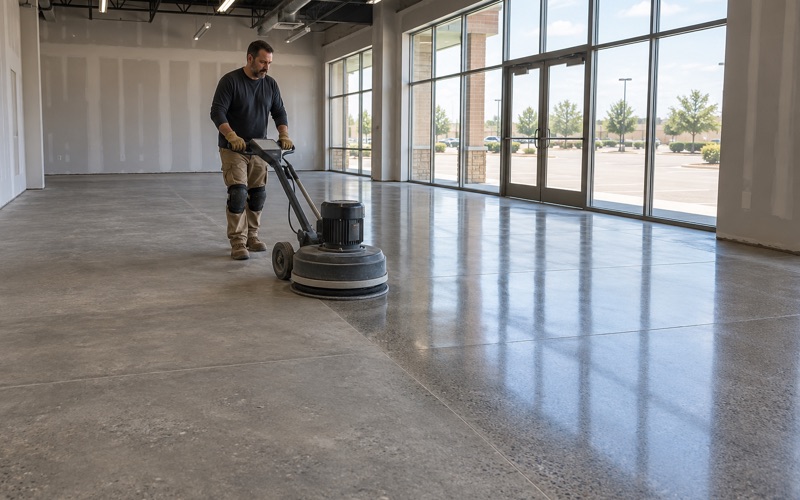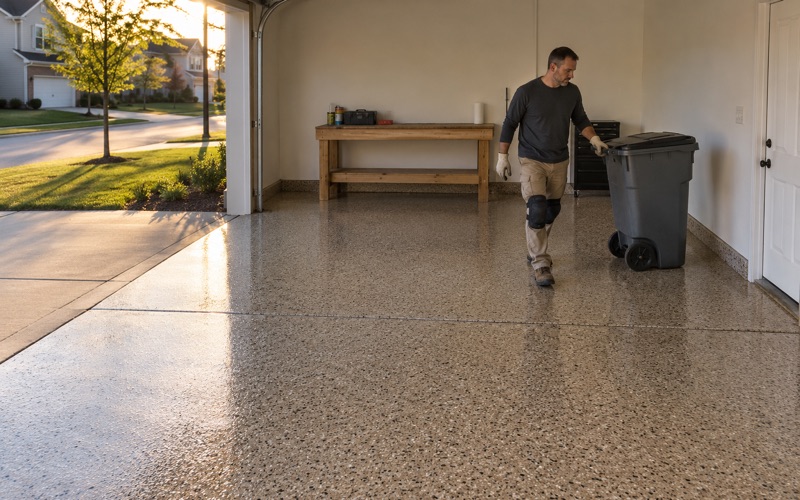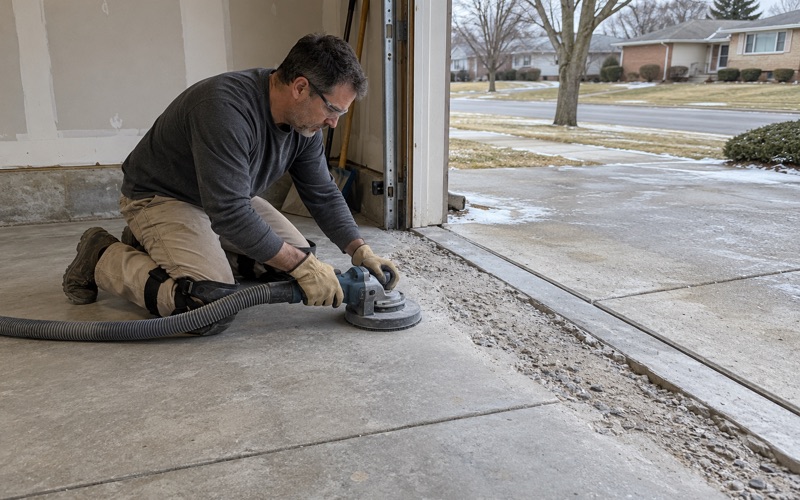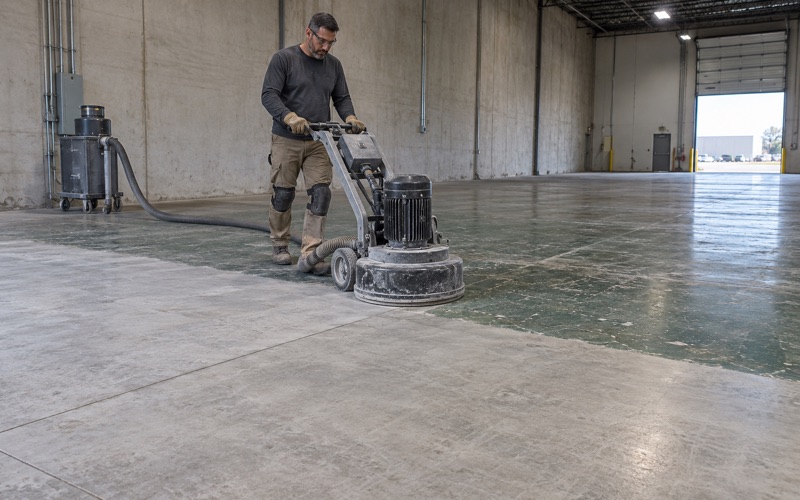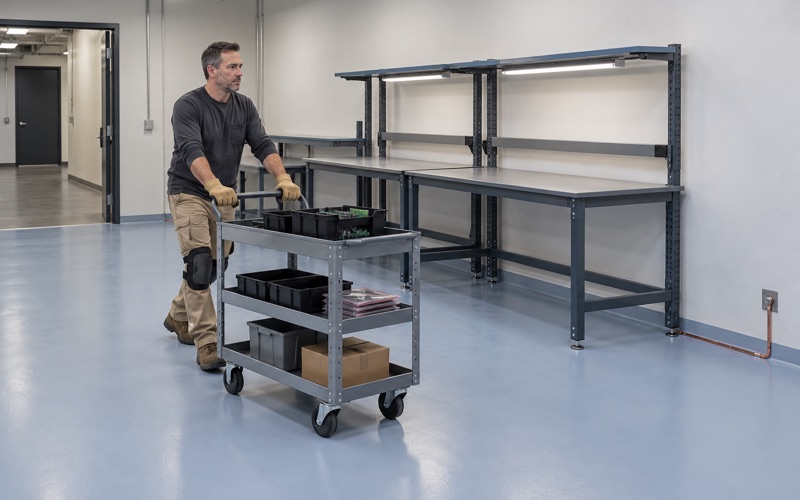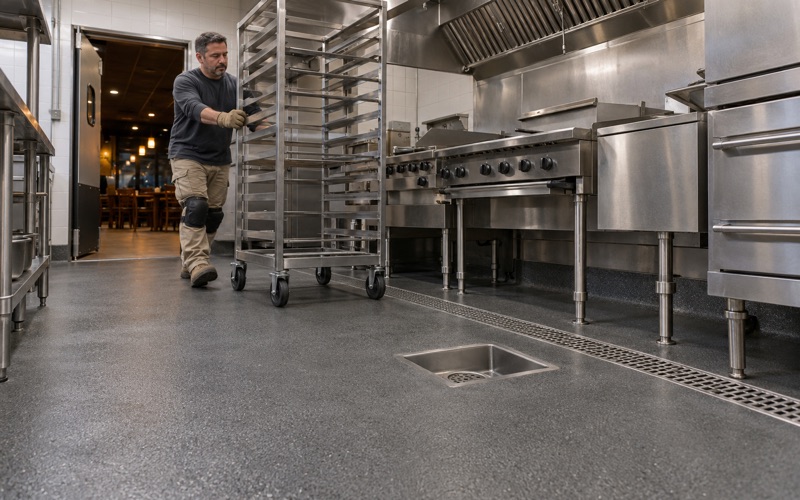
Bolingbrook Epoxy Flooring has spent more than 20 years putting epoxy flooring in Channahon garages, basements and commercial buildings, and our work here starts at the slab rather than the coating. Every floor we take on is opened with a diamond grinder or a shot blaster before any primer touches it. We do not acid etch, because etching leaves a profile nobody can measure and a residue nobody can fully rinse out.
Moisture testing sits in our scope as a priced line item, scheduled like the grinding, whether the slab is under a garage or a warehouse. That matters more in this village than in most, for reasons the rest of this page explains. Our proposal also names the product, the system build and the finished thickness, so the floor you get can be checked against the floor you were quoted.
We read the slab before we price it. Cracks, joints, an old coating lifting at the edges, a white bloom of efflorescence along a wall: each one tells us something, and when a slab needs repair before it can carry a coating, we put that in writing.
Where the Rivers Meet, and the Spring They Rose
Meeting of the waters
Channahon is a village in Grundy and Will counties, and its name comes from a Potawatomi phrase meaning meeting of the waters. The description is literal. The DuPage River joins the Des Plaines River here, and the I&M Canal crosses the DuPage at Channahon State Park, home to Lock No. 6 and the Dresden Mule Barn. The Channahon Park District holds more than 383 acres, McKinley Woods on the Des Plaines among them.
That geography is why people built along the water, and it is also why some floors in the village have spent time underneath it. When we talk with a homeowner near the river corridor, our first question is not which flake color they want. It is whether the slab has ever been wet from the outside.
April 2013: Canal Street, Story Street and Blackberry Lane
On April 18 and 19, 2013, the Des Plaines River and the I&M Canal corridor rose, and erosion was found at the dam in Channahon State Park where the DuPage River and the canal cross. The village evacuated homes on Canal Street south of the park, on Story Street and Jessup Street, and at a Blackberry Lane apartment complex, saying it was evacuating those areas as a precaution. About 41 residents were notified, and at least 21 people left the Blackberry Lane apartments.
Jersey barriers and sandbags went up, I-55 closed between I-80 and U.S. 6, and the Channahon Park District field house became a shelter. For a floor contractor, the lesson is simple. In parts of this village, river water reaching a garage or basement slab is not a hypothetical, and a coating plan has to account for it.
What the housing looks like
Many Channahon homes are newer than visitors expect. 62.8 percent of the housing was built between 1990 and 2009, and 91.7 percent of owners live in detached houses. So the residential floor we see most often is the garage or basement of a 1990s or 2000s detached house, frequently carrying an old sealer or a store-bought coating that has to come off first.
Looking for epoxy-flooring closer to Midlothian? See Epoxy-Flooring in Midlothian.
After the Water: Cleaning a Flooded Garage or Basement Slab
Recovery comes before coating
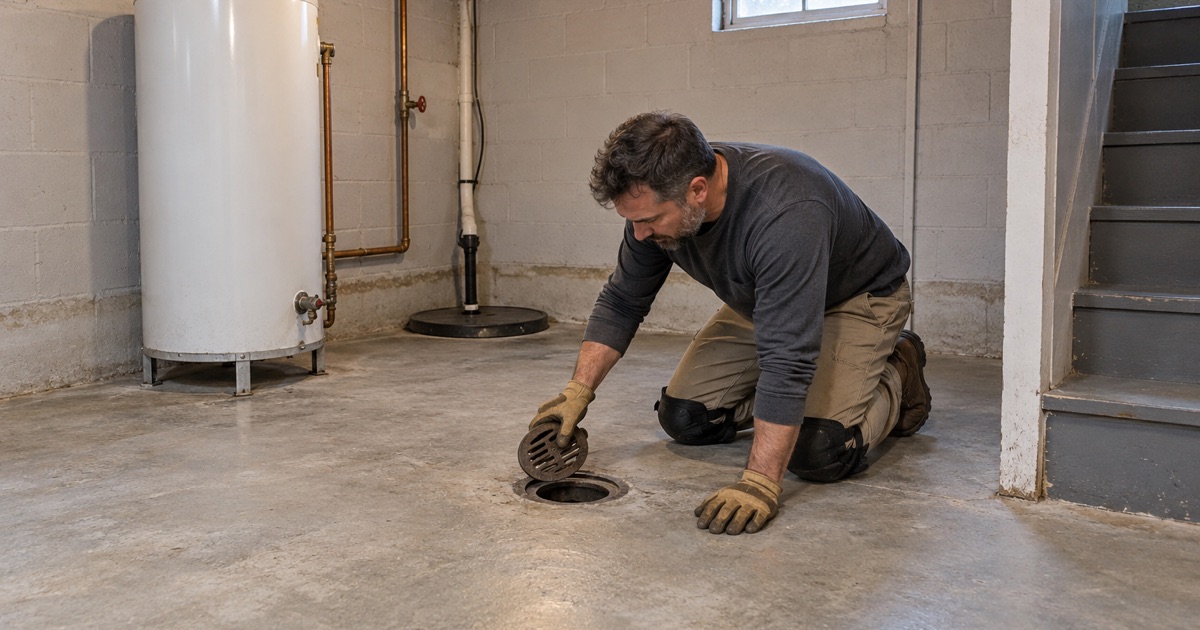
A garage or basement floor that has taken river water is a recovery job before it is a coating job. Overbank water does not arrive clean. It carries silt from the riverbank, and on its way through a garage it picks up whatever was stored at floor level: gasoline from a mower, motor oil, fertilizer and lawn chemicals, pool supplies, paint.
All of that settles into the pores of the concrete as the water drains away. An epoxy laid over it bonds to the contamination instead of the slab, and a floor that looks finished in May can be peeling along the tire paths by August. So our first visit after a flood is about what is in the concrete, not what will go on top of it.
How we take contamination off
Our cleaning starts with removing loose silt and mud, then degreasing the areas where fuel or oil sat, with the rinse water collected rather than pushed toward a floor drain or out to a storm inlet. Where stains have soaked in, the grinder decides. Diamond grinding takes off the top layer of paste, and if a dark ring keeps showing as we go deeper, that section needs more work or a repair before it can hold a coating.
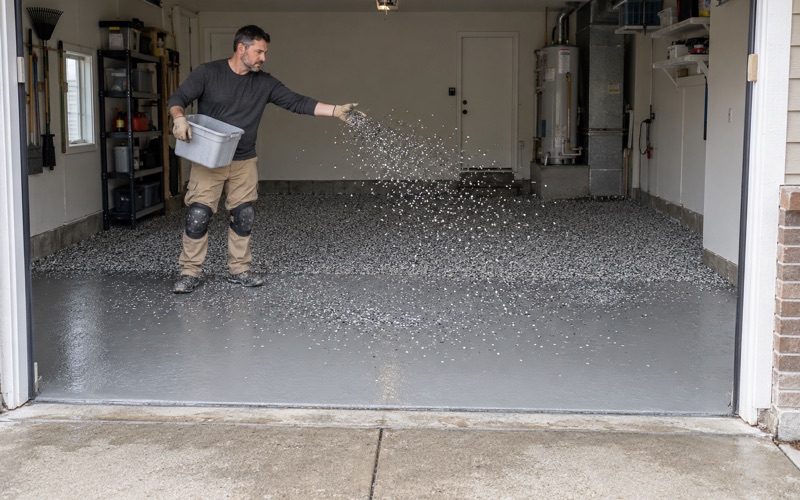
Grinding dust is collected at the grinder by a vacuum, never swept or hosed away. On a slab that may still hold traces of fuel or fertilizer, keeping that dust contained matters for the household as much as for the finish. We then profile the surface to the ICRI CSP range the proposed system calls for, typically CSP 2 to 3 for a 100% solids epoxy with a vinyl flake broadcast.
Reading the slab after a flood
Once the surface is open, we look again at the cracks and control joints. Water moving under and around a slab can carry away fine material beneath it, and a crack that has widened or a section that now rocks underfoot is telling us something a coating cannot fix. When a slab needs repair or replacement, we say so plainly and put it in the proposal, rather than coating over the problem and leaving the warranty to argue about it later.
Smaller defects are a different story. Hairline cracks and spalled joint edges can be routed and filled, and control joints can be filled with a semi-rigid polyurea joint filler so they stay visible as joints instead of reappearing as cracks through the coating.
Dry First, Test the Moisture, Then Coat
Why a slab that looks dry is not ready
Concrete holds water deep in its body long after the surface turns pale and dry to the touch. A slab soaked by river water can look fine within a week and still be giving off moisture months later. Coat it too soon and that vapor pushes against the underside of the epoxy, which is how blisters form in a floor that seemed perfect on the first day.
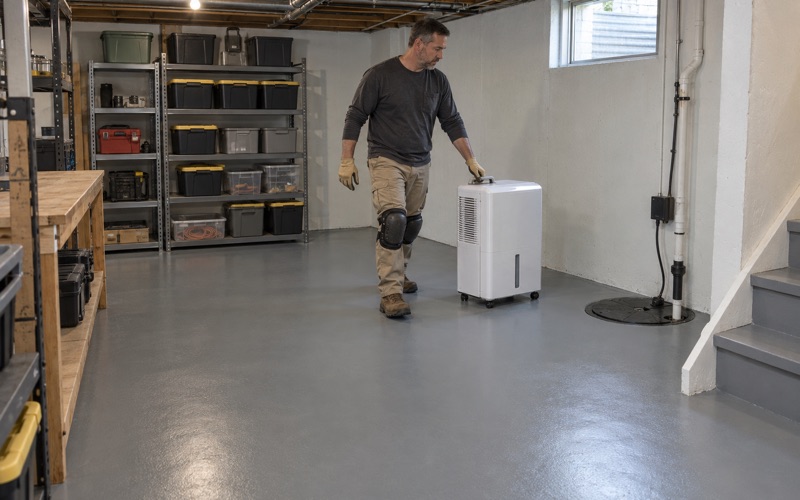
Drying takes time, moving air and some heat, and no coating chosen for its color can shortcut it. A basement slab sits against soil that may stay damp long after the river goes down, so it often dries more slowly than an attached garage. We would rather tell a homeowner to wait than come back to a blistered floor.
Moisture testing we actually do
Moisture testing is in our scope on every job, and after a flood it sets the schedule. We start with the ASTM D4263 plastic sheet test as a quick screen, then measure properly. ASTM F1869 calcium chloride testing gives a moisture vapor emission rate at the surface, and ASTM F2170 in-situ relative humidity probes read the moisture inside the slab, which is closer to what the coating will actually live with.
We compare those readings with the limits the manufacturer publishes for the product named in our proposal. If the numbers are high, we wait and test again, or we change the system rather than hoping it holds. The readings go into the job file, so the decision to coat rests on a measurement rather than a guess.
When readings stay high
Some slabs, basements in particular, keep reading high after a reasonable drying period. In that case we specify a moisture-mitigation primer under the coating, or a urethane cement system that tolerates more vapor than a standard epoxy. Both add cost, and we explain why before the job is sold.
Our warranty exclusions are read out before anything is signed, with moisture named first. A homeowner deciding whether to coat a slab that took river water deserves to know exactly what the warranty covers if vapor returns, and what it does not.
Floodplain Rules and What a Coating Can and Cannot Do
Chapter 153 Flood Hazard Prevention
Channahon’s Code of Ordinances includes Chapter 153, Flood Hazard Prevention. Under it, development in a mapped floodplain inside the village needs a floodplain development permit, and the building and zoning officer, who also serves as floodplain administrator, must see that every required federal, state and local permit has been received before that permit is issued.
We have not read the village’s own definitions in full, so we do not tell anyone whether their floor job needs a permit. An interior floor coating is not by itself development in the usual sense, but repair work after a flood in the floodplain can lead to a review of how badly a building was damaged. The floodplain administrator settles that question, not the contractor, and we check with the village before scheduling work at an address in the mapped floodplain.
Contracts and registration
Illinois licenses no general, flooring or coatings contractor, so local rules carry the weight. We confirm Channahon’s contractor registration, bond and insurance requirements before a job goes on the calendar. Every home job also gets a written contract and the Home Repair: Know Your Consumer Rights pamphlet before work starts, as the Illinois Home Repair and Remodeling Act requires.
After high water, homeowners hear from a lot of people with trucks and quick prices. A written scope that names the product, the finished thickness and the moisture readings is the easiest way to compare one offer with another.
What a coating will not do
A floor coating is not a flood barrier. It does not hold back river water coming under a garage door, and it does not keep water from pushing up through a basement slab under hydrostatic pressure. Anyone selling an epoxy floor as protection against the next rise of the Des Plaines River is selling something a coating cannot deliver.
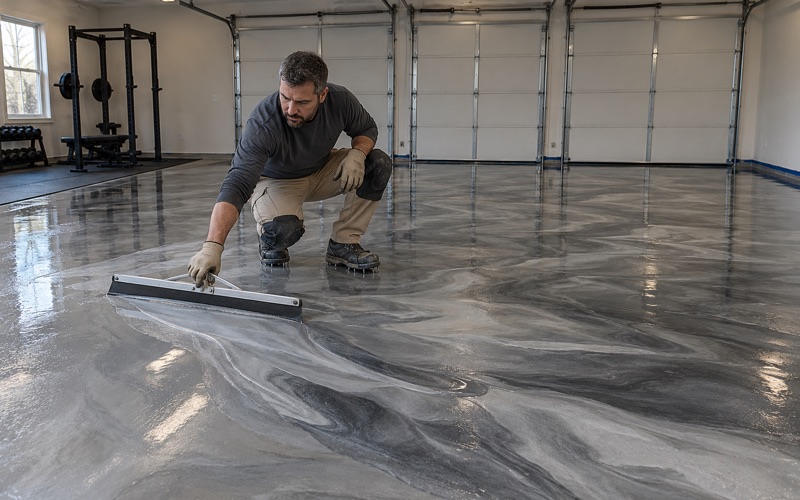
What a well-built floor does offer after a flood is a surface that cleans up. A 100% solids epoxy under a polyaspartic topcoat lets silt and mud go with a squeegee and a hose, keeps spilled fuel on the surface instead of in the concrete, and shows a new crack the week it forms. For a garage near the river corridor, that is a practical benefit, and we describe it as exactly that.
Pricing the work honestly
We quote per square foot for the system we are actually proposing, not from a national per-garage figure. On a slab that took river water, the price separates the cleaning, the repair, the moisture testing and any mitigation primer from the coating itself, so you can see what the flood added and what the floor would have cost anyway.
- 20+ Years Coating Concrete
- Moisture Testing in Every Scope
- Free Written Estimates