Bolingbrook Epoxy Flooring has spent more than 20 years on epoxy flooring, and in Burr Ridge some of the floors we are asked about are not one owner’s slab at all. A parking deck under a condominium building is driven on by many households every day, and it is paid for, approved and scheduled collectively. We plan, price and phase that kind of job differently from a two-car garage behind a house.
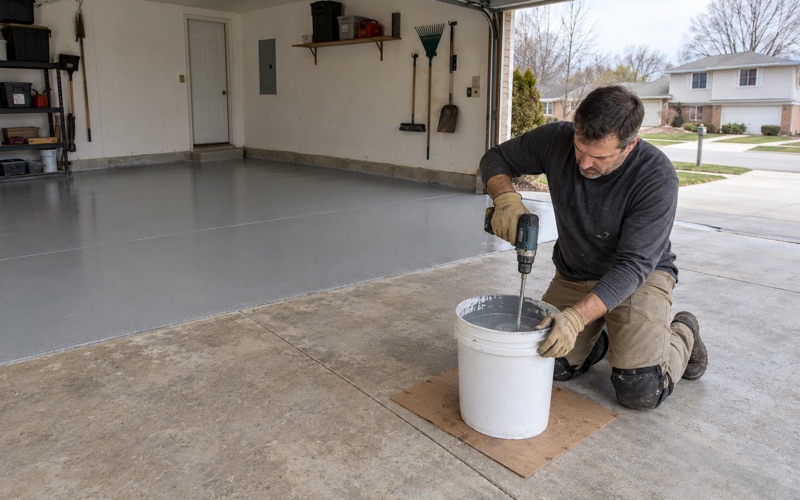
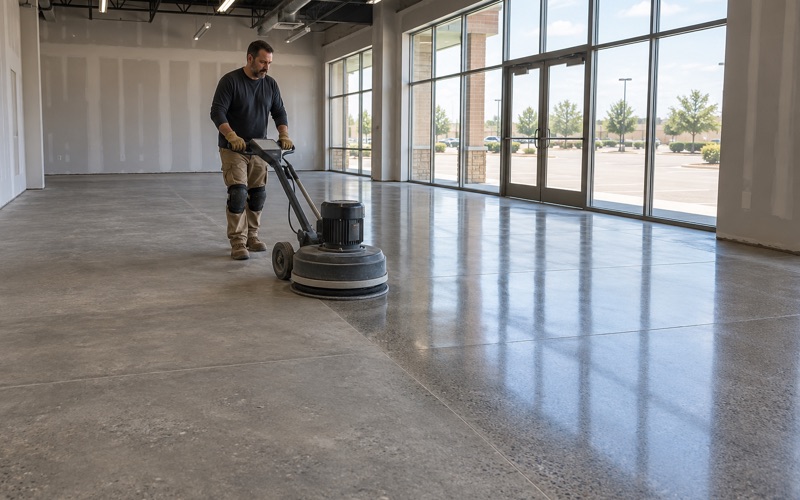
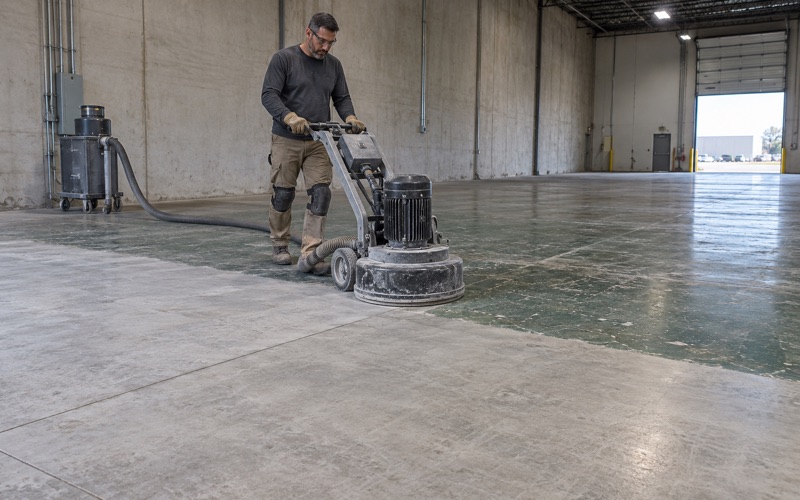
The groundwork does not change. We open the concrete mechanically with a diamond grinder or a shot blaster, and we never acid etch. Moisture testing sits in the proposal as its own priced line, not as something offered after a coating has already lifted, and the same proposal names the product, the system build and the finished thickness so a board or a manager can check what went down against what was quoted.
What does change here is the water. A heated garage floor stays wet for months on end, and that one condition drives nearly every choice below, from the primer to the order in which sections of the deck are closed.
Condominiums with heated garages beside the shops
The Village Center buildings
Burr Ridge Village Center, at Burr Ridge Parkway and County Line Road, puts more than 200,000 square feet of retail and restaurant space alongside condominiums. Trade press in 2007 described a four-story building with condominiums over first-floor retail and a second four-story building that is residential only, both with heated indoor garage parking. Listings for 450, 850 and 1000 Village Center Drive describe elevator buildings completed in 2008 and 2009, with assigned stalls in that heated garage.
These addresses sit on the Cook County side of the village. 1000 Village Center Drive geocodes to Lyons Township, Cook County, and we confirm details like that before a proposal goes out, because the paperwork follows the address.
Assessments that already pay for the heat
Listings for these buildings describe monthly assessments that cover heat, parking, insurance, exterior maintenance and snow removal. The owners are already paying to keep the garage warm. That warmth is a comfort for residents walking to their cars, and it is also a steady source of moisture on the floor, so any coating chosen for these decks has to be chosen with both effects in mind.
Snow removal in the assessment clears the drives and walks outside. It does nothing about the snow that rides in on each car after the plow has gone, and that is the snow the garage floor has to handle.
Not only a village of detached houses
Most Burr Ridge homes are detached, but the Census Bureau’s American Community Survey counts 281 owner households living in buildings of 50 or more units. Those owners do not have a private garage slab to coat. Their floor is shared, and the decision about it is shared too.
Looking for epoxy-flooring closer to Hinsdale? See Epoxy-Flooring in Hinsdale.
Why a heated garage deck stays wet all winter
Snow melts instead of freezing
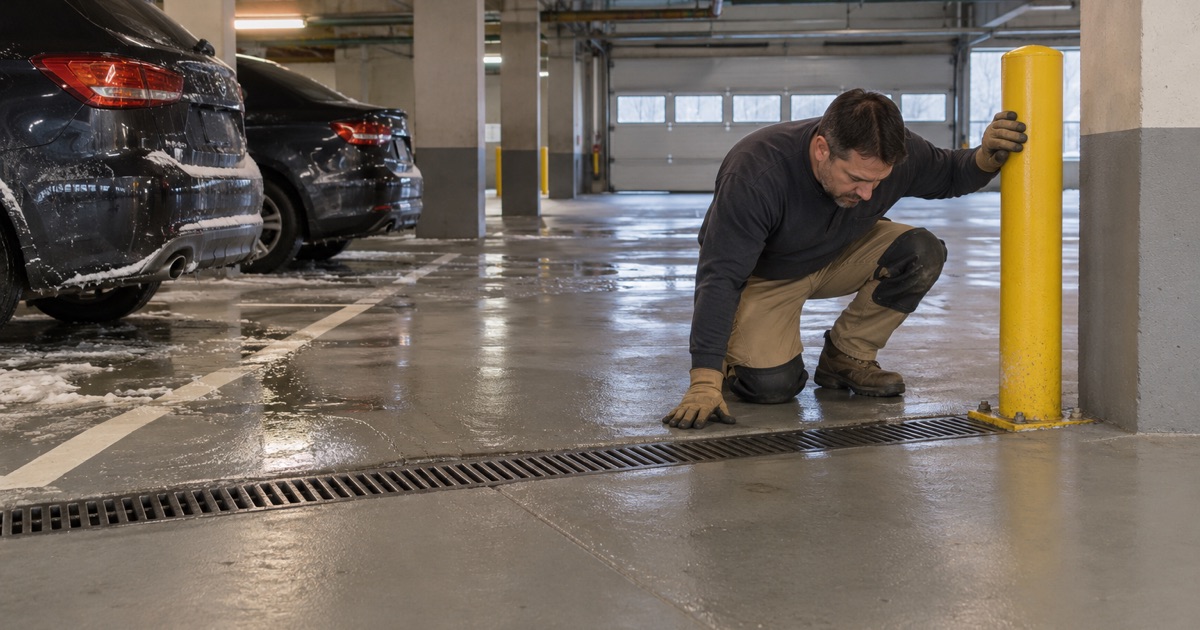
A car pulls in carrying packed snow in its wheel wells and on its bumpers. In an unheated garage that snow stays frozen until it is shoveled out or falls off as a block. In a heated garage it melts within hours, pools under the car, and runs toward the nearest drain. Repeat that every evening for a season and the deck rarely gets a chance to dry.
Standing meltwater finds every weakness in a coating: a pinhole left in the base coat, an edge that was never ground, a crack that was bridged instead of repaired. Grit carried in with the snow sits in that water and gets ground under tires, so a finish that would last years in a dry garage wears through at the wheel paths of a wet one.
Testing a slab that never dries out
Surface tests can mislead on a deck that is wet from above every day. We rely on ASTM F2170 in-situ relative humidity probes set into the slab, which read the concrete itself rather than whatever sits on top of it, and we add ASTM F1869 calcium chloride testing where the schedule allows the floor to be dried and enclosed first. When the numbers come back high, the system starts with a moisture-mitigation primer, and the proposal says so in writing.
A quick ASTM D4263 plastic sheet test is useful as a first look in a corner that stays dry, but it is never the whole answer. White, powdery efflorescence along joints or at the base of walls is another clue we note on the walk, because it shows water has been moving through the concrete and leaving minerals behind.
We also read warranty exclusions aloud before anything is signed, and moisture is the first one we name. A board deciding on a garage floor deserves to know exactly where the manufacturer’s coverage stops.
Warm air over a cool slab
A heated garage helps a coating cure, but warm, damp air over concrete that is still cool can condense on the surface and leave amine blush on fresh epoxy. We measure slab temperature and the dew point spread at the surface before each coat, and we schedule curing against those readings rather than the calendar.
Stalls, drive aisles and drains
The stalls, where water stands
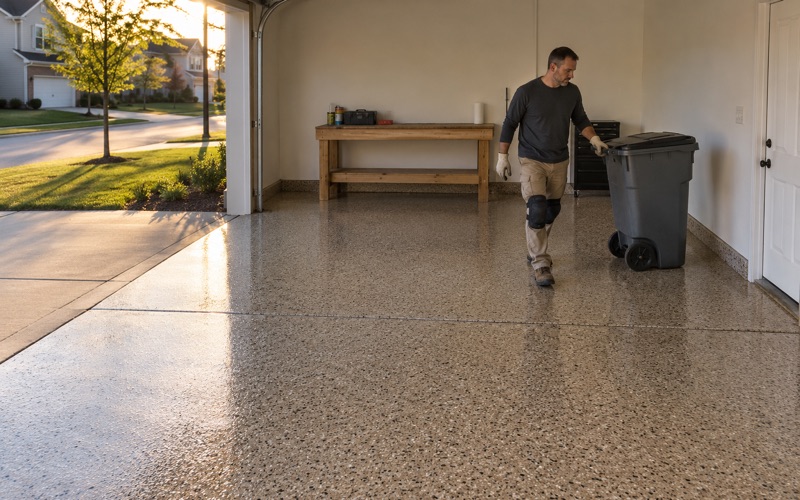
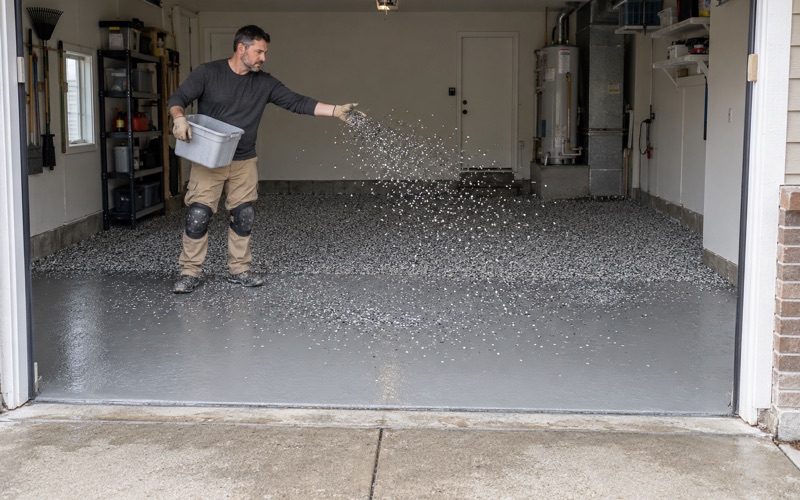
The heaviest moisture load is at each stall, right where snow drops off a parked car. We build these areas with a 100% solids epoxy base, a quartz aggregate broadcast for traction on a floor that is wet more often than not, and a polyaspartic or polyurea topcoat that holds up to puddles and tire contact. The broadcast texture is chosen so a resident stepping out of a car onto a wet surface has something to grip, while still letting the floor be squeegeed clean.
Drive aisles, where the wear goes
Drive aisles see every car in the building turning, braking and climbing toward the exit. That is a different load from a parked stall, and the build can differ to match. Where a heavier wear surface is warranted, we say so in the proposal and price it per square foot for the system actually proposed, not from a per-garage figure that ignores how the deck is used.
Getting down to sound concrete
A garage built in 2008 or 2009 may carry a sealer or an earlier coating, or it may be bare concrete. Either way we grind or shot blast to an ICRI surface profile suited to the system, usually in the CSP 2 to 3 range for a thin build and coarser for a heavier one. Anything loose, peeling or soft comes off, because a new coat bonded to a failing old one fails with it. On a deck that sees warm tires every evening, a poorly bonded finish is also the one most likely to show hot tire pickup.
Drains, slopes, joints and cracks
Meltwater has to reach the drains, so before quoting we walk the deck to see where water collects and whether the slope still carries it. We read every crack and control joint and the condition of any old coating. Joints get a semi-rigid polyurea filler that moves with the slab, and a crack that is structural rather than cosmetic is named plainly; if a section needs repair or replacement before it can be coated, the proposal says that instead of hiding it under a topcoat.
Grinding dust is collected at the grinder with vacuum extraction. It is never rinsed toward a floor drain, which matters more than usual when the drains in question carry a building’s garage water away all winter.
A shared floor: the association decides, residents keep driving
Who signs off on the work
In a condominium the garage deck is a common element. The condominium association, not the owner of any one stall, decides when the floor is coated, what system goes down and how the work is scheduled. When a single owner asks us about coating only their stall, we explain that the decision sits with the board and the managing agent, and we are glad to talk with them.
We have not reviewed any Village Center association’s rules or reserve studies, so we start each conversation by asking what the board has already decided and what it still needs to see. Our proposal is written so a board can compare it line by line with any other bid.
That proposal lists the moisture test results, the repairs to joints and cracks, the system for stalls and for aisles with their thicknesses, the phasing plan, and the warranty with its exclusions. A board can take it to the next meeting and vote on a defined scope rather than a single price.
Phasing around residents’ cars
Residents still need to get in and out while the floor is being done. We work the deck in sections, closing a block of stalls or one stretch of aisle at a time, and we plan the sequence with the manager so residents know days ahead which stalls close and where to park instead. Overnight and weekend windows are available where they keep the building running.
Each section reopens only when its topcoat has cured enough to take tire traffic, and we tell the manager that time in advance rather than guessing on the day. A heated garage has one advantage here: unlike an unheated garage, which sometimes has to wait for spring, it can often be coated in winter, as long as the deck has been dried and the readings support it.
Because the garage sits under homes, ventilation and odor matter. We select coatings within the Illinois VOC limits for architectural coatings under 35 Ill. Adm. Code Part 223, which bind the installer as well as the manufacturer, and we plan air movement around each phase.
Village paperwork before the first grinder starts
Illinois issues no state license for flooring or coatings work, so the binding rules here are the Village of Burr Ridge’s own. The village licenses contractors on permitted work and asks for a $10,000 surety bond naming the village plus at least $1,000,000 in aggregate liability insurance with the village as additional insured. We confirm those requirements and any permit questions with the village’s Community Development department before a start date is set, so the board is not handed a delay after the cars have already been moved.
- 20+ Years Coating Concrete
- Moisture Testing in Every Scope
- Free Written Estimates