Bolingbrook Epoxy Flooring has spent more than 20 years on epoxy flooring in Brookfield and the rest of the western suburbs, and the floors that teach us the most are the ones that look sound and still refuse a coating. A slab can be flat, uncracked and swept clean while holding years of oil below its surface. Coat it without dealing with that oil and the new floor lets go in sheets, sometimes within weeks.
That is why our work on an industrial floor starts with the concrete rather than the catalog. We open every slab mechanically with a diamond grinder or a shot blaster, we never acid etch, and we test before we promise anything. The product decision comes last, once we know what the slab will actually hold.
The same discipline runs through garage, basement and shop jobs. What changes from floor to floor is what is buried in the concrete, and on a press shop floor the answer is usually lubricant.
A Stamping Plant on 47th Street and Where Its Oil Goes
Brookfield is a village in Cook County about 13 miles west of downtown Chicago, with a 2020 population of 19,476. It also has a small industrial edge on 47th Street, on the Lyons Township side of the village.
Stocker Hinge Manufacturing, a division of E.R. Wagner, operates there at 8822 W. 47th Street. The village’s 2023 financial report lists it sixth among Brookfield’s principal employers, with 80 employees.
We have not worked inside that building and are not describing its floor. We name it because it is a working example of the kind of floor this page is about. Its parent company lists stamping, forming and assembly in carbon steel, stainless, aluminum and brass among its capabilities, and its product line includes continuous hinges. Metal stamping of that kind runs on lubricants, and lubricants end up on the floor.
Stamping and die lubricants on a press shop floor
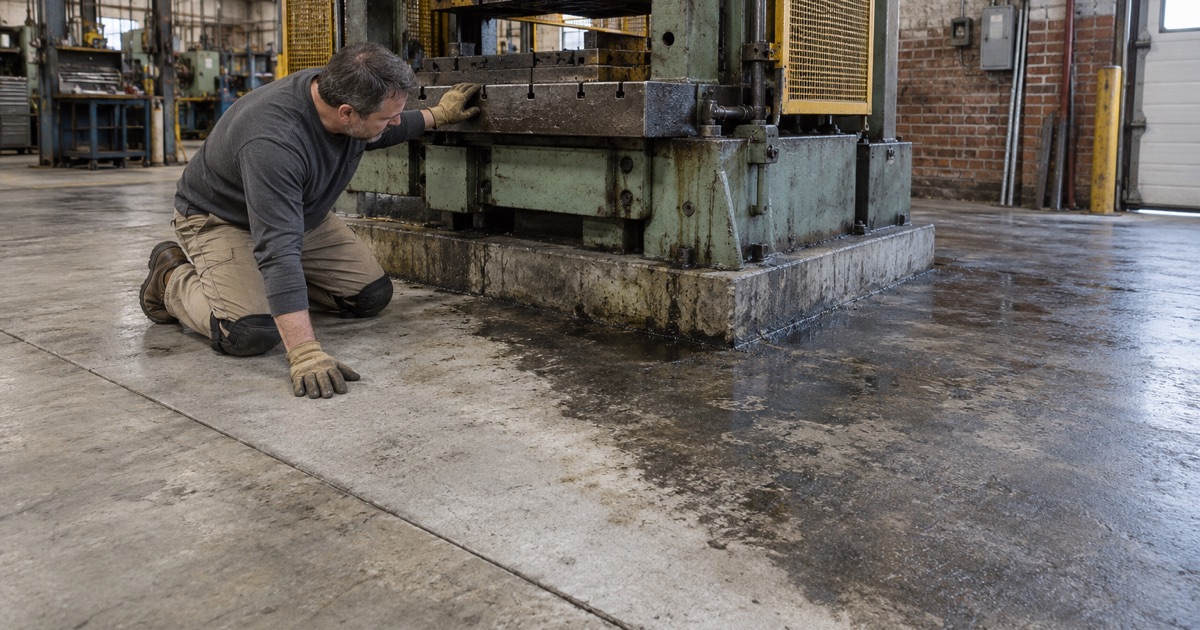
Presses and dies are oiled to keep metal moving cleanly through a forming step. Some of that lubricant drips from the tooling, some rides out on finished parts and scrap, and some is tracked across the floor on boots and pallet jacks. Around a press line it collects as a film, and the film does not stay on top.
How oil migrates into concrete
Concrete is porous. Over months and years, oil that sits on a slab wicks down into the capillaries of the cement paste, often well past the depth a mop or a pressure washer can reach. The surface can look almost clean while the top portion of the slab is saturated, and the stain you can see is often smaller than the area that is actually contaminated.
Age makes it worse. A press that has stood in one spot for many years can leave a deep footprint of absorbed lubricant beneath its base, and moving or replacing that equipment exposes concrete that has never been cleaned. Different metals and forming steps call for different lubricants, so a single floor can carry more than one kind of contamination side by side.
Mapping the floor before we quote
Our walk-through on a shop slab is a contamination survey as much as a measurement. We mark old press and die positions, drip lines, parts storage, scrap bins and forklift lanes, because each one loads the slab differently. We also read the cracks, joints and any old coating, since a peeling patch of earlier paint is often the clearest record of where oil already won.
Looking for epoxy-flooring closer to Summit? See Epoxy-Flooring Services in Summit.
Why Coatings Peel Off Oil-Soaked Slabs
An epoxy or polyurethane coating does not glue itself to concrete the way tape sticks to a box. It bonds by soaking into an open surface profile and locking into the cement paste. Oil in those pores blocks that bond, and the trade guidance is blunt about it: coating over a slab contaminated with grease, oil, paint or wax guarantees a failure.
The failure happens below the film
When a coating peels off an oily slab, the underside of the peeled piece usually shows a thin skin of oily concrete dust or almost nothing at all. The coating itself did not break down. It never reached sound concrete in the first place, so the first forklift turn, hot tire or temperature swing lifts it.
Oil causes trouble in quieter ways too. It can leave the coating soft or slow to cure over contaminated spots, and it can show up as fisheyes, small craters where the wet coating pulls away from an oily point. Those defects look cosmetic at first, but each one is a place where the bond is already weak.
Why one degrease is not enough
Wiping a degreaser across the floor removes the oil you can see. It does little about the oil that has already traveled down into the slab, and that oil can wick back toward the surface after a coating goes on. A degrease that only cleans the top is one reason a shop floor peels in patches that trace the old drip pattern.
What a short-lived coating really costs
On a working production floor, a failed coating is more than a material loss. The floor has to be shut down twice, once for the original job and again to grind off the failure and start over. That is why we treat oil contamination as the central question on a press shop slab rather than a cleanup step tacked onto the end.
Degrease, Extract, Profile, Then Test
Our preparation on an oil-saturated floor follows a fixed order, and each step has to show results before the next one starts. The goal is to bring the slab back to concrete that will accept a bond, and to prove it before any coating is mixed.
Degreasing and extraction
We begin with an alkaline degreaser worked into the slab and recovered, not left to dry in place. On heavy contamination we repeat the cycle and use extraction methods meant to pull oil back up out of the concrete, then recover the residue. Rinse water and residue are collected rather than washed toward a floor drain, and grinding dust is captured at the machine the same way.
Mechanical profiling
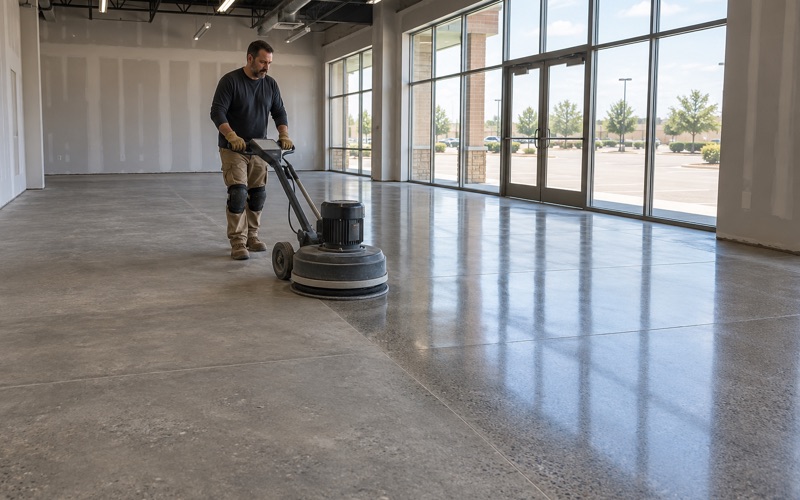
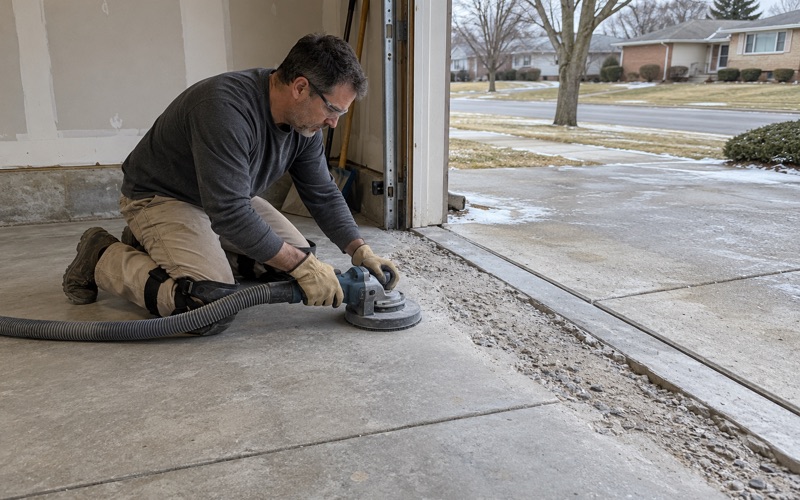
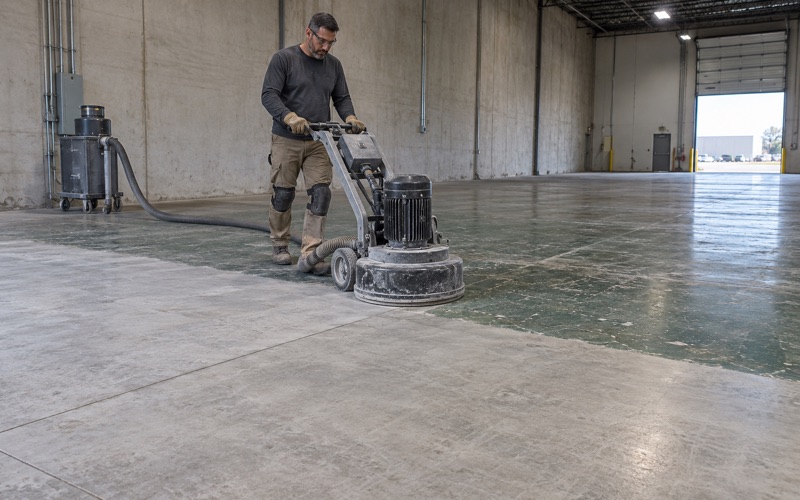
Once the oil load is down, we open the slab with diamond grinding or shot blasting to an ICRI CSP profile that suits the system we intend to install. Grinding also tells us how deep the contamination goes. If the fresh concrete under the grinder still darkens or smears, the slab is not ready, and we go back to extraction rather than forward to primer.
Adhesion testing before we commit
Adhesion testing is the step that separates a floor that should last from a floor that might. We apply small test areas of the intended primer on the worst sections, usually under the old press positions and along drip lines, let them cure, and check how firmly they hold to the concrete. Moisture testing goes into the same scope, using ASTM F1869 calcium chloride kits or ASTM F2170 relative humidity probes, because oil and moisture can both undercut a bond.
We record where each test sat and how it performed, and those results go to the owner with the proposal. If a test spot fails, we treat that zone again and retest it. The point is that nobody has to take the readiness of the floor on faith, including us.
When a slab cannot be saved
Some floors are too far gone. When extraction and grinding cannot bring a section back to sound concrete, we say so and recommend removing and replacing that area before it is coated. We would rather tell an owner that up front than sell a system the slab cannot hold.
Choosing a System for a Press Shop Floor
Only after the slab passes testing do we pick the build. Our proposals name the product, the system layers and the finished thickness, so the floor that goes down can be checked against the floor that was quoted.
Primers and body coats
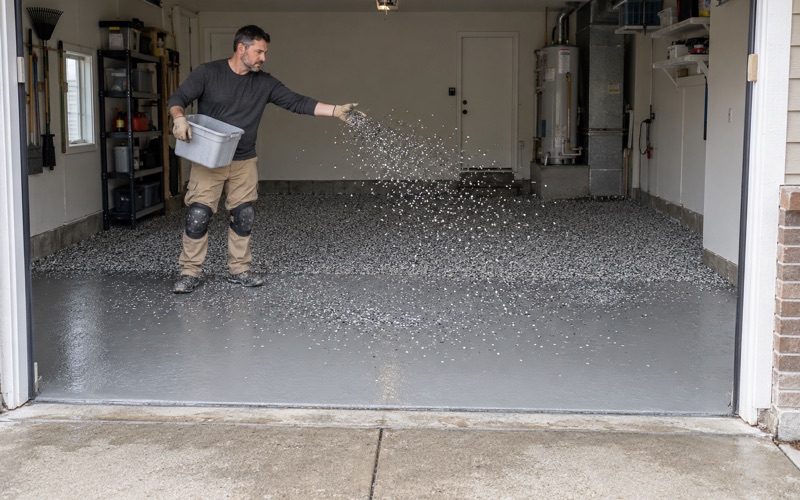
On a slab that has been cleaned and passed adhesion testing, a penetrating 100% solids epoxy primer is our usual starting point, because it wets deeply into the profile we opened. Where moisture readings run high, a moisture-mitigation primer takes its place. For heavier industrial traffic, a quartz aggregate broadcast builds thickness and texture, which helps on a floor that will still see some lubricant in service.
Topcoats for a working shop
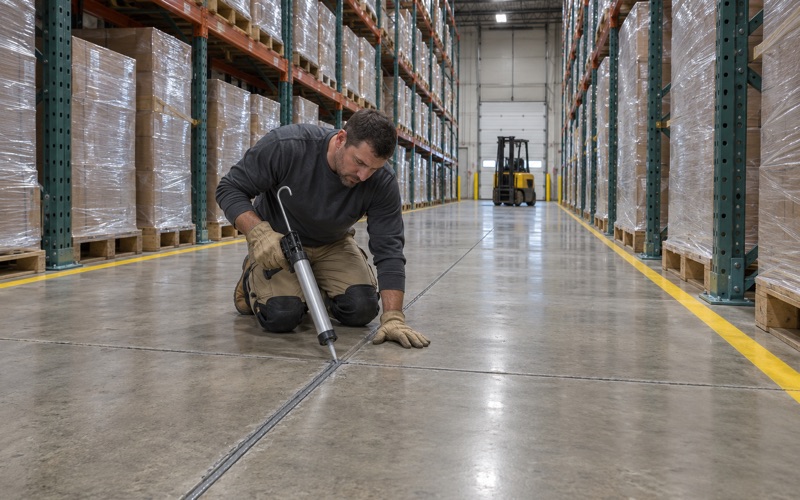
A shop floor that will keep seeing oil needs a topcoat that resists it and cleans up easily. Polyaspartic and polyurea topcoats offer good chemical resistance and fast return to service, while urethane cement suits areas with heavy impact or temperature swings. Control joints get a semi-rigid polyurea joint filler so forklift wheels do not chip the edges.
Different zones, different builds
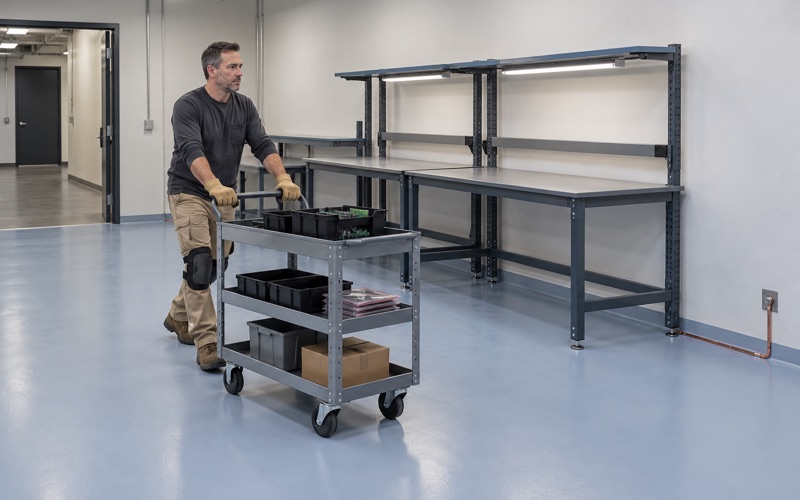
A press shop floor is rarely one floor. The ground around presses and die storage takes the most lubricant and impact, aisles take wheel traffic, and an office or inspection area may need little more than a clean, sealed finish. We often quote a heavier build at the presses and a lighter one elsewhere, and in some lightly used areas a lithium silicate densifier is a sensible alternative to a full coating.
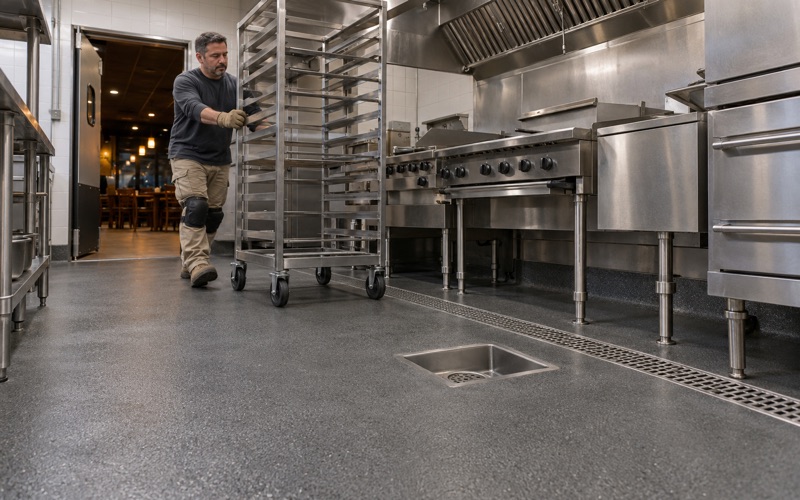
Texture matters on an oily floor too. A broadcast finish gives workers better footing where a little lubricant will always reach the surface, while a smoother finish is easier to keep clean in low-traffic areas. We talk through that tradeoff with the people who work on the floor, not only the people who sign the order.
Scheduling, licensing and codes
Production floors rarely get to stop for a week, so we plan sections around press schedules, with overnight and weekend windows where a building has to keep running. Brookfield requires every contractor working in the village to hold a Village of Brookfield Contractor License backed by a $10,000 License and Permit Bond, and we confirm those requirements before scheduling. Every coating we specify also stays within the Illinois limits on VOC content.
Warranty terms, read out first
Before a job is sold, we read the warranty exclusions aloud, starting with moisture and including contamination the testing could not reach. A floor that went down on documented, tested concrete is a floor we can stand behind. A floor that skipped those steps is one no honest contractor should warrant.
- 20+ Years Coating Concrete
- Moisture Testing in Every Scope
- Free Written Estimates