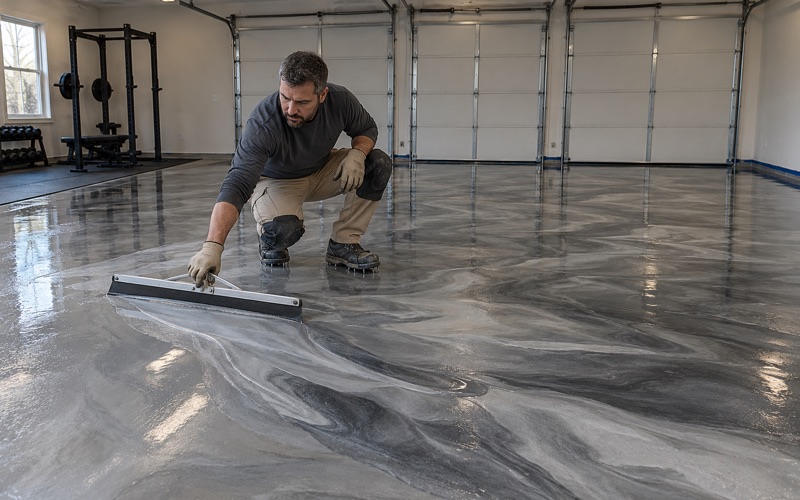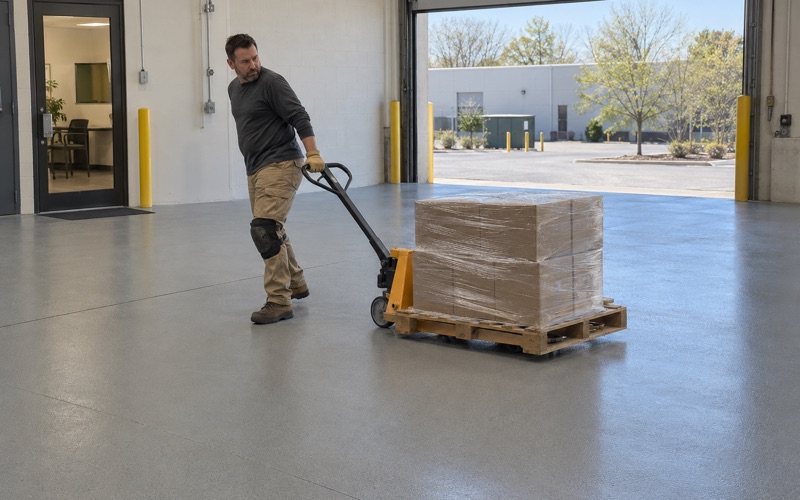
Bolingbrook Epoxy Flooring approaches epoxy flooring in Bridgeview with more than 20 years in the trade and one question asked before any other: what is going to land on this floor? A coating that looks fine on a showroom sample can fail in a month when the answer is a load measured in tons. We would rather know that before a price is written than explain it after a floor has chipped.
That question shapes the whole scope. It decides the film thickness, whether the system is a coating at all or a mortar troweled a quarter inch deep, and which parts of a building are better left as hardened bare concrete. One floor can carry three different answers, and the proposal should say where each one ends.
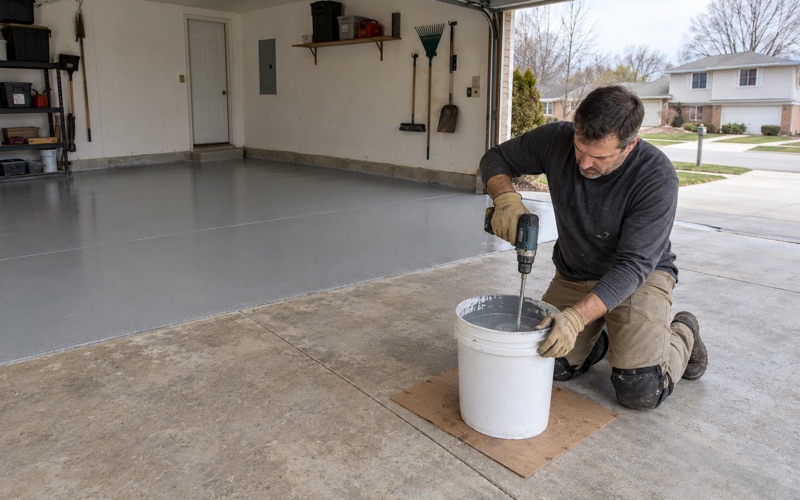
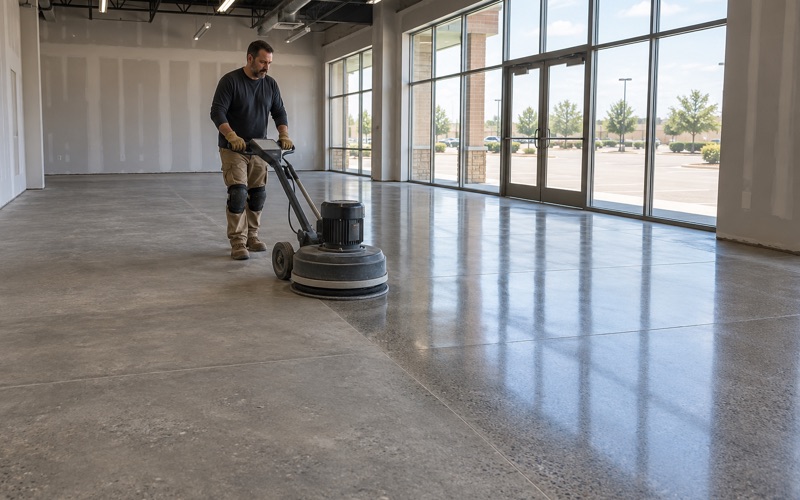
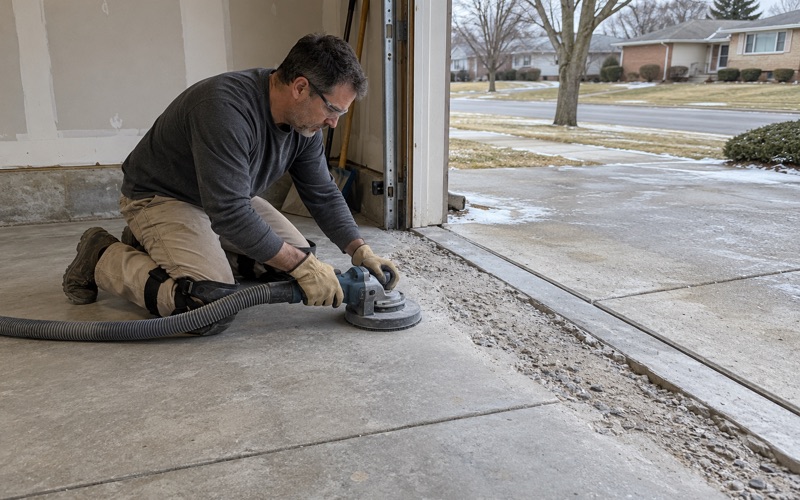
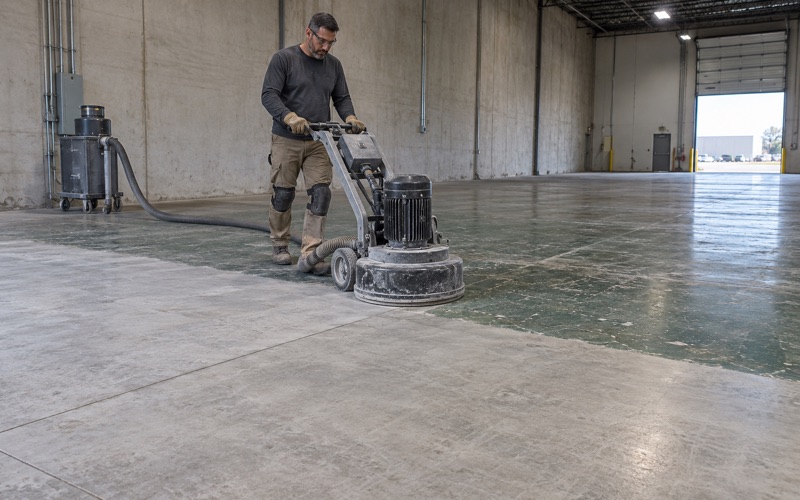
Every proposal we hand over names the product, the system build and the finished thickness for each zone, so the floor that goes down can be checked against the one that was quoted. Pricing is per square foot for that system, not a national average. Prep is mechanical, with diamond grinding or shot blasting, and we do not acid etch.
Steel coils on Ferdinand Avenue and what they do to a slab
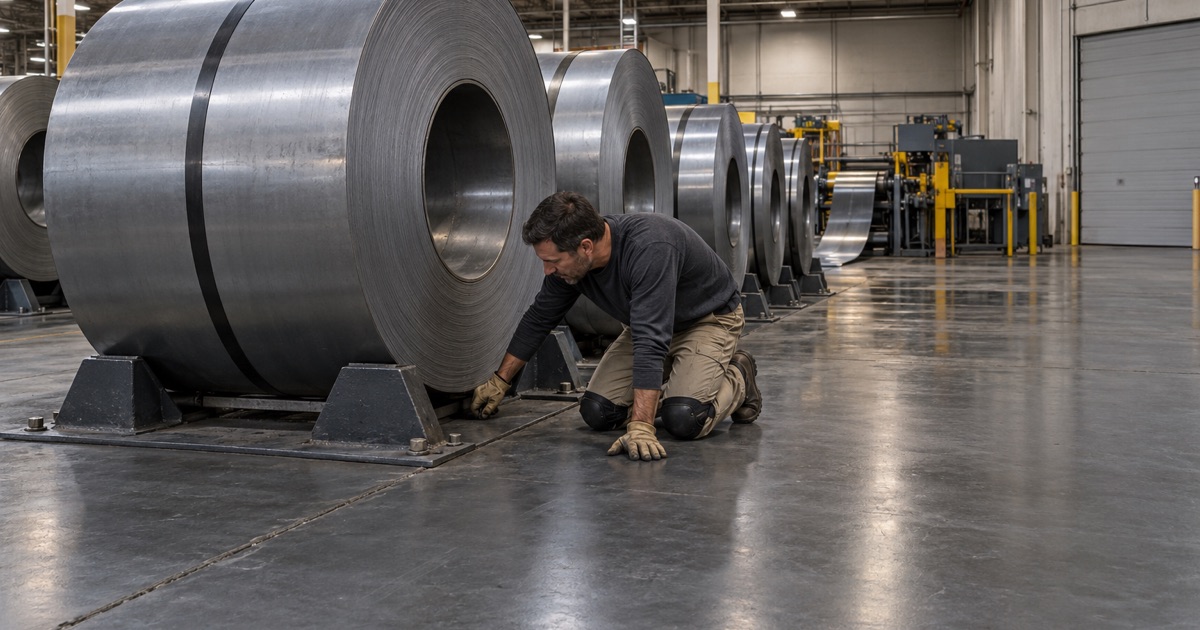
Bridgeview’s industry is not only warehousing. Some of it is steel processing, and that work asks more of a concrete floor than racking and pallet traffic do.
A service center, not a distribution box
Zeeco Metals, at 7401 S. Ferdinand Avenue in the Lyons Township part of the village, describes itself as a steel service center specializing in flat-rolled coil. Its published equipment list names two 25-inch slitters, a maximum coil weight of 20,000 pounds and a maximum outside diameter of 72 inches. It handles cold rolled, hot rolled, galvanized, aluminized and electro-galvanized sheet and coil, and does slitting and toll processing in a 25,000-square-foot building.
Zeeco is not the only metals name in the village’s books. Signode Midwest Metals appears among Bridgeview’s ten largest taxpayers for the 2023 levy, at roughly $8.1 million of equalized assessed value. We have not seen the floors at either plant, and nothing here describes them. The point is narrower: steel coils of this size are part of what Bridgeview’s industrial slabs are asked to hold.
Point load under cradles and saddles
A 20,000-pound coil does not spread its weight the way a pallet does. Stored on its edge, or resting in a cradle or saddle, it puts that weight onto a narrow line of contact or a few small steel feet. The concrete under those points sees a concentrated load, and a coating over it sees the same load squeezed through a much thinner layer.
A thin epoxy film is hard but not deep. Under a steel saddle foot it can crush at the edges, crack in a ring around the contact point, or simply wear through where the saddle shifts a fraction of an inch each time a coil is loaded.
Where coils sit decides where the heavy slab work goes. We map the cradle and saddle positions with the plant before quoting, because a storage row that moves three feet after the floor is built puts the heaviest load onto the lightest system.
The set-down
The harder moment is the landing. A coil lowered by a crane or a coil ram on a lift truck rarely touches down perfectly level, and the first edge to meet the floor takes a sharp blow. A thin-film coating chips under repeated impact of that kind, and once a chip opens, steel edges and forklift wheels peel the film back from it.
That is why a coil-handling floor is specified for impact and point load first. Forklift wear and appearance still matter, but they come after the question of what happens where the coil lands.
Looking for epoxy-flooring closer to Mokena? See Epoxy-Flooring in Mokena.
Slitting lubricant, metal fines and the coating’s grip
A slitting line does not run dry. Coil coatings, drawing compounds and line lubricants travel with the strip, and slitting leaves fine metal particles that settle around the machine and track outward on wheels and boots.
What the line leaves behind
Around a running slitter, the slab collects a film of oil with metal fines suspended in it. That film is slippery on its own, and on a smooth glossy coating it becomes worse. It also attacks the bond of any new coating laid over it, because resin will not grip concrete that has oil in its pores.
For floors near a line, we look at slip resistance as part of the system rather than an afterthought. A broadcast of quartz aggregate locked into the body coat and topcoat gives a textured surface that keeps footing when a light oil film is present, and it is far easier to clean than bare concrete.
Reading and testing the slab first
Before a quote, we walk the floor and read the cracks, joints and any old coating, and we say plainly when a section needs repair or replacement before it can carry a new system. Oil-darkened zones get marked so the prep plan accounts for them. Grinding exposes how deep the contamination runs, and a section that keeps weeping oil after grinding is not a section to coat that week.
Moisture testing is a line item in our scope, not an extra sold after a failure. We use ASTM F1869 calcium chloride tests or ASTM F2170 in-situ relative humidity probes, depending on the slab, and when readings run high, a moisture-mitigation primer goes into the build. Warranty exclusions are read out before the job is sold, and moisture is the first one we name.
Film, broadcast or mortar: matching the system to each zone
A steel-processing floor is rarely one floor. The set-down area, the slitter, the aisles and the office corridor each take a different kind of punishment, and a single system across all of them either overspends in the corridor or underbuilds at the coil.
Set-down and cradle zones
Where coils land and sit, a thin film is the wrong answer. The heavier options are a troweled epoxy mortar or urethane cement, built to roughly a quarter inch, which absorbs impact and spreads point load through its depth. Urethane cement also tolerates oil and heat better than standard epoxy, which suits floors near a line.
In the very heaviest set-down zones, the honest recommendation can be no coating at all. Bare concrete hardened with a lithium silicate densifier will dent and scuff, but it has no film to chip or peel. We would rather say that than sell a coating we expect to fail at the exact spot it matters most.
Mortar systems need a deeper surface profile to bond than a thin film does. We grind or shot blast to a coarser ICRI CSP profile for a quarter-inch mortar, and the edges of each zone are saw-cut and keyed into the slab so the mortar ends in a termination that will not lift when a wheel catches it.
Aisles, slitter surrounds and joints
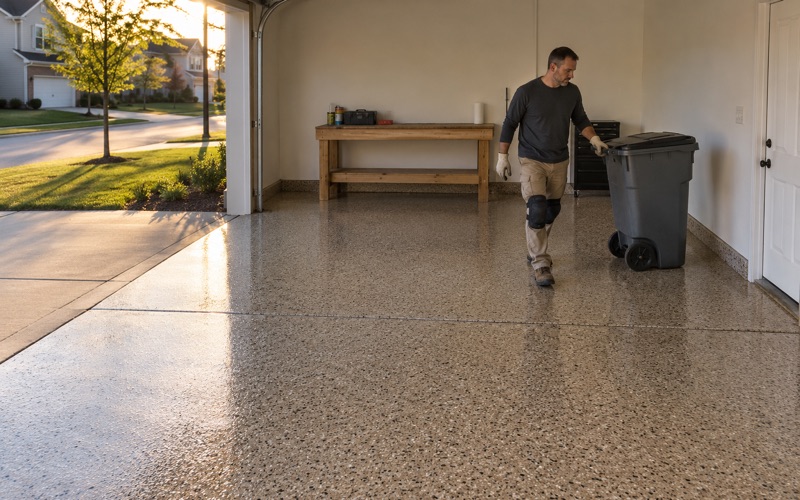
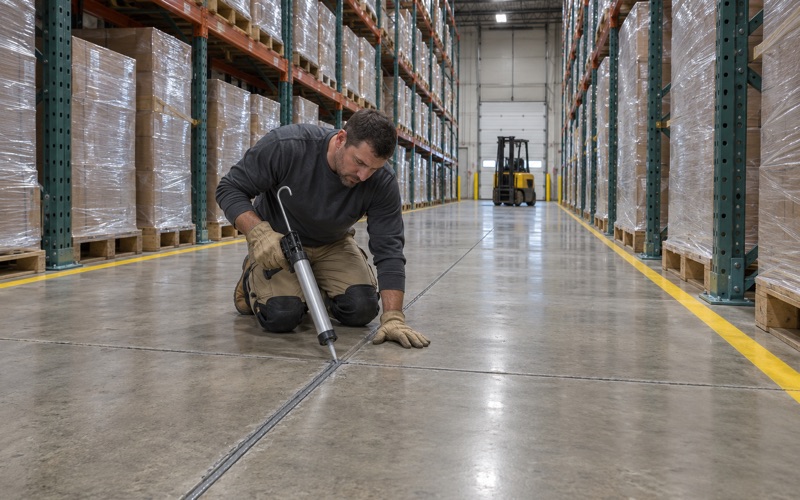
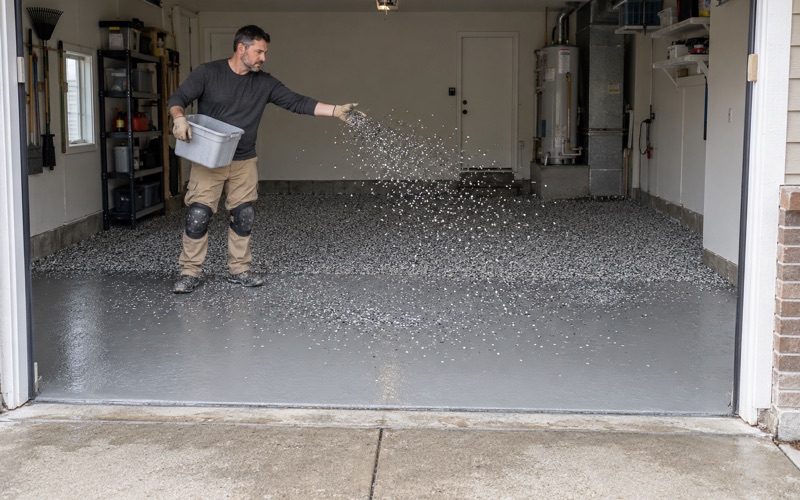
Traffic aisles and the floor around a slitter usually suit a broadcast system: 100% solids epoxy with quartz aggregate built to about an eighth of an inch, sealed with a chemical-resistant topcoat. It takes forklift wheels and oil, and its texture holds footing. Control joints in these aisles get a semi-rigid polyurea joint filler, which supports hard wheels crossing the joint instead of letting the edges spall.
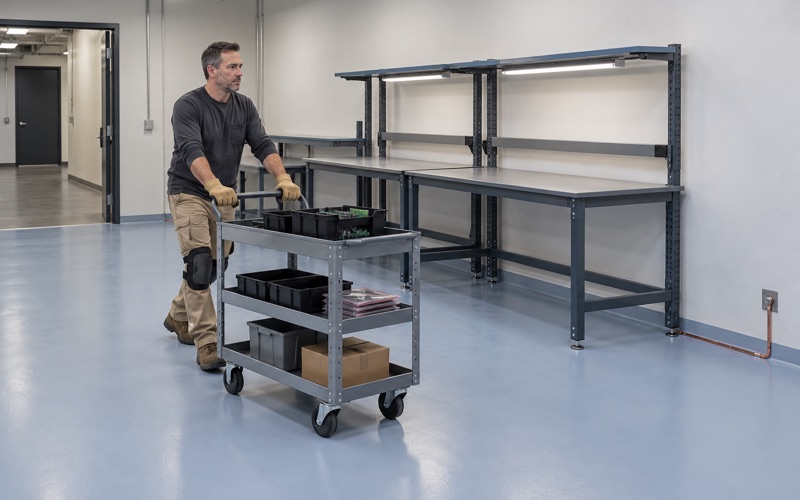
Offices, break rooms and corridors can take a lighter film. Spending the money where the coils are, and less where people walk, is usually how a steel floor gets built within budget.
Working around a running slitting line
A slitting operation that stops for a week loses orders, so we phase the work. Sections go down overnight and on weekends, with the slitter area scheduled into planned downtime and the set-down zone split in halves so coils always have somewhere to land. Curing is planned against slab temperature and the dew point spread at the surface rather than the calendar, because a cold, damp plant floor cures slower than a product data sheet assumes.
A new floor also needs protecting from the plant itself. A fresh topcoat can take foot traffic well before it can take a loaded lift truck, so we give the plant a written return-to-service time for each zone rather than one date for the whole floor.
Grinding dust is collected at the grinder by vacuum, not swept or washed toward a floor drain. That matters more in a metals plant, where the dust can carry the same oil and fines the prep was meant to remove.
Industrial Bridgeview past the coil shop
Steel coil processing is one strand of a broader industrial base. The village’s motto is “A Well Balanced Community,” and its zoning is divided equally among residential, commercial and industrial use. It is a village of 17,027 people, about 15 miles southwest of the Chicago Loop.
Other plants and taxpayers
Industrial owners fill much of Bridgeview’s top-ten taxpayer list. Moore Properties, listed as industrial, sits at the top, and Value Industrial Partners appears alongside Signode Midwest Metals further down. The local chamber’s members include Bridgeview Manufacturing Co., Fabrication Specialties, Tibor Machine Products and Van Norman Molding as well as Zeeco.
Machining, fabrication and molding floors share some of a coil shop’s problems, especially cutting fluids and dropped parts. Each still gets its own reading, since a molding floor and a coil floor do not fail the same way.
Permits and the village’s rules
Bridgeview incorporated in 1947 and runs its own Building Department at the village hall on Oketo Avenue, under the 2021 International Building Code. The village issues no permit without drawings, so a floor job tied to a larger renovation needs a drawing set before scheduling. Illinois issues no state license for coating work, and we confirm the village’s contractor registration, insurance and bond requirements before a date goes on the calendar.
The village straddles four townships that meet at 87th Street and Harlem Avenue, and 7401 S. Ferdinand Avenue geocodes to Lyons Township. None of that changes how a coil floor is built, and the building permit still comes from the village itself, whichever township the plant sits in.
What a first visit covers
On a first walk-through, we look at what lands on the floor, where the lubricant goes, how the joints are holding and where the old coating has already failed. From there, we write a zone-by-zone scope with products, thicknesses and the moisture testing written in. Coatings are chosen within the Illinois limits on VOC content, which bind the installer as well as the manufacturer.
- 20+ Years Coating Concrete
- Moisture Testing in Every Scope
- Free Written Estimates